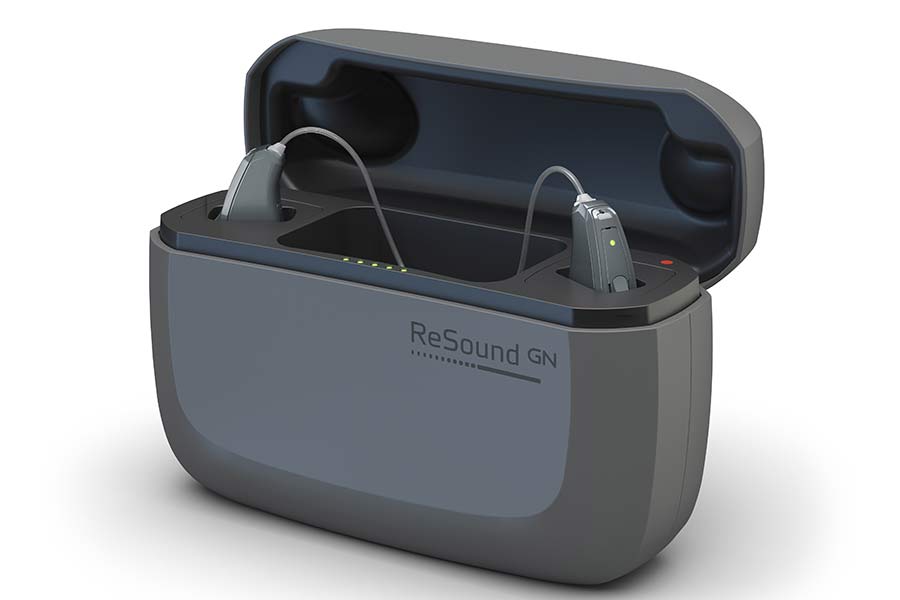
The excitement around Made For Android hearing aids has heated up with the recent announcement that Resound and Google have agreed to a partnership to deliver the protocol to allow direct connection between hearing aids and Android phones. I was in Resound headquarters in Denmark last week and discussed the deal and the expected availability of the feature with a chap from the R&D department. The protocol should be ready for release in mid-2019, but there are other things you need to know, let’s talk Made For Android Hearing Aids.
Quattro Made For iPhone, Made For Android Hearing Aid
As I said, the Linx Quattro will be the first-ever Made For Android hearing aid on the market. When the protocol is released on Android, the Linx Quattro will be enabled with a direct connection to Android phones. That means direct streaming, without any intermediary accessory, a first for Android phones.
Definitely On Pixel Phones First
The protocol will only be available on Pixel phones initially and probably only on the Pixel 3. It appears that there is a specific hardware need and older devices don’t stack up. While the protocol will be available as an Android update to other phone manufacturers such as Samsung etc, it is unclear how long it will take them to offer it, or whether their hardware is capable.
Probably Need a New Phone
I would imagine that to take advantage of the feature you will probably have to purchase an up to date phone. However, as we get nearer to the release and phone manufacturers start to update their own phones we will keep you up to date on compatibility. In fairness, it is a good excuse to buy a new model.
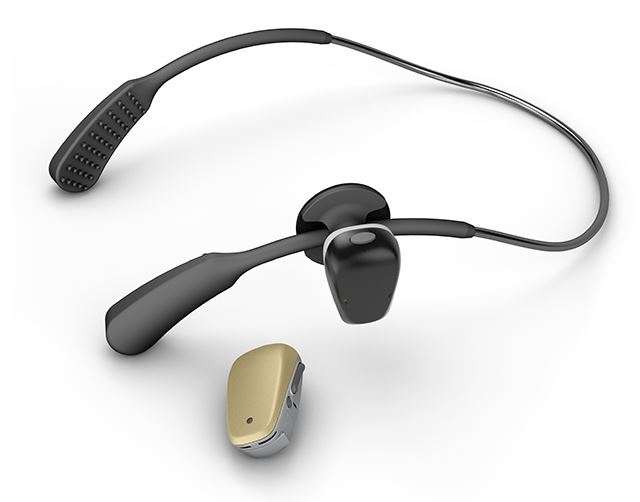
To my eternal shame I missed this a couple of months ago, Cochlear announced on January 22nd this year the introduction of a brand new instant fit BAHA device. The new device is called the SoundArc and it is designed to allow children with conductive or mixed hearing loss, or single-sided deafness (SSD), who are not yet eligible or ready for an implant to try out the benefits of Bone Anchored Hearing Aids.
Worried about surgery
Any surgical intervention is a worry, in particular when it is your child who faces it. The new solution offers the opportunity to assess the benefits of BAHA without having to undergo surgery. It is also ideal for children who are not eligible for surgery just yet.
Supporting normal development
The device will allow the normal development of language skills. Language skills are an important cornerstone of all childhood development including learning and socialisation. The device works like other BAHA devices by bypassing the damaged outer or middle ear and delivering sound to the undamaged inner ear. Cochlear says:
The new Baha SoundArc is a non-surgical, behind-the-head band that is an alternative to the Baha® Softband (released in 2002). The non-surgical wearing options are part of Cochlear’s bone conduction implant system, the CochlearTM Baha® System. The Baha System utilizes the body’s natural ability to conduct sound to skip over the damaged parts of the outer and middle ear, sending clear, crisp sound directly to a working inner ear (the cochlea).2 The Baha SoundArc and the Baha Softband are designed to provide the same benefits and hearing performance and will work with one (unilateral) or two (bilateral) Baha® 5 Sound Processors. The new SoundArc provides a modern look, is lightweight, practical and easy to put on and take off. It fits securely and comfortably in place. The SoundArc comes in several sizes, is adaptable to fit different shaped heads and sizes, and it has a variety of soft colored tips to match hair, clothes or mood.
Made For iPhone with an app
The Baha 5 Sound Processor in the SoundArc will allow users to hear better across noisy environments and connect wirelessly to a variety of electronic devices. The sound processor facilitates direct-to-device wireless streaming and control with Made for iPhone technology, and a personalized hearing experience with the Baha 5 Smart App.
A trial BAHA for adults
For adults struggling with conductive hearing loss, mixed hearing loss, SSD and any of the associated conditions, the new device can be used as a trial device to demo how a Baha will sound before they make decisions to move forward with the Baha Implant System.
In an announcement today Widex has introduced a brand new hearing aid platform that they are calling the Evoke. The details are scarce, however, the really interesting announcement is that the platform will use cloud-based artificial intelligence to continually improve the sound for users. I truly believe that this is one of the 2018 innovations that will change the future of hearing aids.
We have spoken before about continued innovation in hearing aids and what we would expect future hearing aids to offer. Oticon, Signia and now Widex have all begun to innovate beyond the hearing aid to ensure better hearing. By that, I mean that they have all looked strongly at how they can leverage wireless connection to Smartphones to deliver a far better hearing experience. Each one of the brands has done different things, however, the common theme is to expand the functionality by piggybacking on the Smartphone functionality.
Machine Learning and Hearing Aids
I have spoken about this subject several times in the past elsewhere. Artificial intelligence and machine learning have been revolutionising many industries and medical fields. The tipping point of converging technology within the hearing aid industry that we are now at is ideal to introduce this type of process to hearing aids. Widex have completely broken with the rest of the industry to seize the moment and introduce what could be a stunning step forward in hearing aid technology. It remains to be seen exactly what they have done and how in-depth the feature is, however, it has to be seen as a massive step forward nonetheless.
Machine Learning Concept
As I said, I spoke elsewhere about machine learning as a concept, in essence, my vision was that the hearing aid user would move through their days using an app to change settings and customise them as they move through different sound situations. Each customisation would be stored in the cloud alongside thousands of other user’s customisations and preferences. Over a period of time, these data points would be used to push changes to the automatic features in the hearing aids and the user’s experience would become seamlessly better. Judging by the Widex announcement, that is what they visualise. Here is the announcement:
Today, leading Danish hearing aid manufacturer Widex, announces the launch of the ground-breaking WIDEX EVOKE™ – the first hearing aid to ever feature advanced machine learning technology in real time. Together with major advances in sound technology, WIDEX EVOKE™ provides a clearer and more personal hearing experience than ever before. Hearing happens in real life, not just in a lab or in a clinic examination room. The challenge of real-life hearing is that it is personal and happens right here, right now. That requires the hearing aid to be able to adapt and adjust seamlessly and instantaneously. For the first time ever, it is now possible for a hearing aid to learn from the user’s input and preferences – and even share this learning with other users around the globe. WIDEX EVOKE is the first hearing aid to give users the ability to employ real-time machine learning, featuring intuitive new controls that quickly and surely guide users to their desired hearing experience. With WIDEX EVOKE users don’t have to remember issues with specific listening situations to explain to their audiologist when getting their hearing aid adjusted later. New SoundSense Technology means users just tell WIDEX EVOKE what sounds they prefer by choosing between sound suggestions provided by their smartphone EVOKE app. The powerful WIDEX EVOKE processor then uses this data to deliver even better real-life sound, based on the user’s personal preferences when they need it, in real time. What’s more, the combination of user input and machine learning enables WIDEX EVOKE to evolve and become even smarter as time passes. And over time, all EVOKE hearing aids will be able to learn from anonymous global user input to improve the real life sound experience even further. “WIDEX EVOKE will forever change what people expect from hearing aids. I firmly believe that WIDEX EVOKE marks the beginning of new era in hearing aid technology – a new way of thinking. It is the first hearing aid that is truly intelligent and grows smarter as you use it. EVOKE not only learns on the level of the individual device but also across the devices in the EVOKE eco-system. The perspectives and the potential are breath-taking: Just imagine an EVOKE user in Paris benefitting from the input of an EVOKE user in Sydney. You can say that WIDEX EVOKE is the world’s first hearing aid that is intelligent today – and even smarter tomorrow”, says Widex President and CEO Jørgen Jensen. WIDEX EVOKE will be offered in a full range of form factors and will become available in all major hearing aid markets beginning late April and continuing through May and June 2018. Widex Announcement 17/04/2018
I am looking forward to hearing much more about this system and to see it in action. As always, as I learn more, I will keep you informed.
If you like what you see, share it so others can benefit
During our recent look at Nano Hearing Aids we noted a new fave hearing aid review website which was being used to support the Nano website. The site is called Hearing Aid Reviews and is on the url (web address) besthearingaidreviews.com. The strategy is simple and has been around for a long time. When you are out to con someone, it is best received when the con is validated by a seemingly independent partner. The site is rubbish, let’s talk about why.
The site has been sitting around doing very little for a while, then this year a host of articles were added to the site with backlinks to Nano Hearing Aids. The idea is to help support the SEO of Nano Hearing aids. It is also to help support the trustworthiness and authority of Nano Hearing Aids. If you look through the articles, the publishing date is the 14th of January and the updated date is the 15th. Every single article.
Use Trusted Sites
Use trusted sites for your hearing aid reviews, sites like us and Hearing Tracker. You can be pretty sure that the information you receive is fair and unbiased. If you are looking at any website, look at the articles, see how far they go back. Look at the general level of content available and the subjects covered. Generally, the more you see, the better the site is.
As I said in my last article, we will support online hearing aid retailers when and where it makes sense for the consumer. We are on record that we support Blamey and Saunders in Australia and we have mentioned some other sites that we would support here. I have laid out in the past why that is so. If you are determined to buy online, and if you are a fit for that model, go to one of them, don’t get ripped off by nanohearingaids.com.
Dan Butterworth of DJB Hearing is the latest ear wax removal specialist to join the No Wax Ear Wax Removal network. Dan provides private ear wax removal in Manchester, at his hearing aid centre on Marsland Road, Sale. He also offers home visits if a customer needs them. Dan has over 25 years experience as both an NHS and Private Audiologist in Manchester.
Microsuction Ear Wax Removal Manchester
Dan provides micro-suction ear wax removal for one or both ears for £60 and he has built up an excellent reputation with many happy customers. Dan says that it has become much harder to get ear wax removal from GPs in the Manchester area and wait times are often weeks.
Dan tries to ensure that as many of his customers are seen on the same day if possible, but certainly within two days. If you are looking for ear wax removal in Manchester, give Dan a call on 0161 962 1700 to book your appointment now.
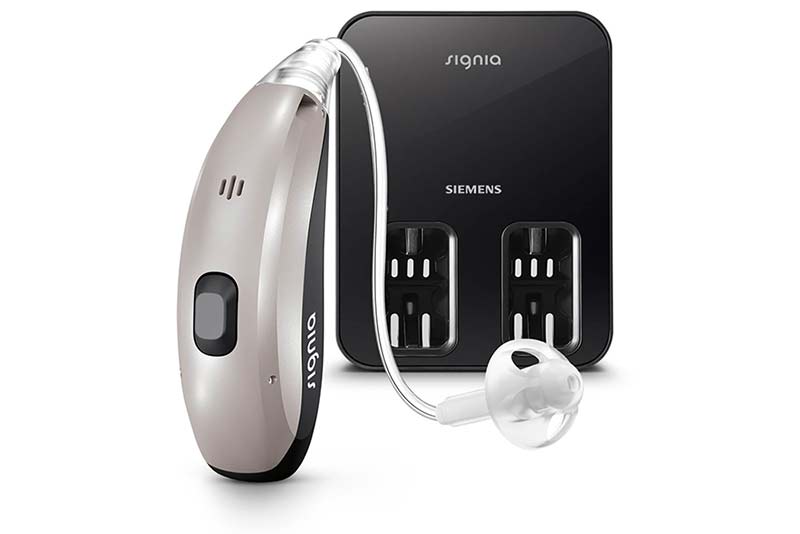
With everything that was going on with EUHA we actually missed this, Signia has added to their rechargeable hearing aid range with a new Behind The Ear Hearing Aid. They have announced the launch of their new Motion Charge&Go Nx hearing aids. That means that traditional BTE hearing aid users now have a rechargeable option on the Nx platform.
The Motion hearing aid is a very versatile device that offers coverage for mild, moderate and severe hearing losses. It can be fitted with a thin tube and instant tip, which you can see above, or a traditional ear hook, tube and ear mould. It means that people who like BTEs now have a rechargeable option.
Three Levels of Tech
There was no indication of this but I would imagine that the new model will be available across the three usual levels of Signia tech, the 7, the 5 and the 3. If we hear anything else, we will update the article.
The Relevant Power Facts
Signia say that Motion Charge&Go’s high-capacity power cell will allow for enhanced Bluetooth connectivity. This will enable users to enjoy high-quality, long-lasting stereo streaming of TV audio, music, and phone calls directly to both hearing aids.
They say that you will be able to stream up to five hours per day and still benefit from 17 hours of battery life before needing to recharge. That’s pretty good streaming time and battery life. So for a quick overview:
Up to 17 hours of battery life with 5 hours of streaming
Just 3 hours to fully charged
30 mins of charging gives 6 hours of use
Easy wireless charging, drop them in the charger and voila
Made For iPhone, Direct connection to iPhone
High-quality audio streaming
Ultra HD e2e and Bluetooth connectivity
3D Classifier
The 3D Classifier was introduced across the Nx range, it analyses many factors of the user’s environment and communication behaviour. It uses information on the user’s voice activity, their motion and sound data to tailor the hearing aids response to better suit the user’s needs.
Two Radios
The Signia Nx platform has two wireless radios, the Bluetooth radio and the proprietary Signia wireless system called Ultra HD e2e. This approach brings real benefits, it ensures that the outstanding ear to ear features can still run even if you are streaming audio or taking a phone call. All of this in a very discreet package.
Telecare 3.0
The new service means that you can set-up a video call with your hearing professional and explain the issue you are having in the situation you are having it in. While you are connected, your hearing professional can tweak your hearing aid’s settings live and you can quickly assess if they are better.
The Signia Nx platform has really been very popular since its introduction, I think the move to add a rechargeable device to the line up can only seal that popularity.
Have you ever had a song stuck in your head? – An unwanted earworm that keeps playing over and over? A catchy piece of music that continually repeats through your mind, long after it has finished playing? This is similar to how I would describe my tinnitus. But instead of the notion of the song, there is actual ‘noise’, and the music never stops playing. There is no end to the record.
Tinnitus is defined as the perception of noise or ringing in the ears or head. The noise is not from an external source, and can manifest itself in many forms. The varying sounds have been described as whistling, whirring, clicking, screeching, hissing, ringing, buzzing, pulsing, whooshing, or even musical. Tinnitus is a symptom of an underlying condition such as hearing loss, ear injury or circulation problems. From the moment I lost the hearing in my left ear, I simultaneously gained these unwanted sounds. My life became noisier.
My tinnitus feeds off salt and sugar, caffeine and alcohol, and feasts on a lack of sleep. Exposure to loud noise makes my tinnitus worse; giving it energy, enabling it to accelerate or become louder, and more prominent. Sometimes it is so loud that it is difficult to hear or concentrate on ‘real’ sounds. Sometimes it steals my attention from conversation. My tinnitus seems to be related to the pressure I feel in my ears and head. Louder or faster tinnitus means more pressure, sometimes culminating in a pain that feels like the inside of my ear is being stretched to full capacity; to the point of something bursting.
For some people their tinnitus comes and goes, and for others it is constant, chronic and persistent. Mine is ever-present. It will often fade into the background of my days; everyday noises will usually mask it, forcing it away from my attention. Yet, there is the cruelty of finding a peaceful moment, or going for a walk in the countryside, and realizing the tinnitus has no ‘real’ background noise to overcome. It bounds into the foreground, onto the stage for full attention.
At night-time there are no ‘real’ sounds to mask it. At night-time it loves the limelight; gobbling it up with glee. The more I focus on it, the more layers of noise I discover. The foundation layer is the sensation of being underwater. I am under the sea, swimming deeper and deeper; water whooshing past my ears. With more focus, electronic-sounding agonized moans begin to emerge. A violin enters the stage; playing a continuous high-pitched and out of tune note that wavers painfully up and down in tone. The sound of an old metal kettle materializes, boiling with the shrill continuous whistle; demanding to be taken off the heat. Occasionally there is a piercing spark of noise; like the sound you’d expect your finger to make if you were turning something magically to ice. Sometimes the moans sound like melancholy singing. A penetrating fog horn begins to sound. A burst of crackling radio static joins the chorus, as the knob of an analogue radio is turned; seeking out a resonating frequency and occasionally skipping past the notion of a word or a piece of music. I make pictures with my mind. I form images around the sounds. The more I focus, the more elaborate the scenes become. Wailing prisoners bound and shackled, all in a row, somewhere in the distance. Someone is trying to scream, but is not able to make the desired sound, just a sharp continuous squeal. There is someone drying their hair in another room…
… When I stop feeding it my attention, it’s back to swimming underwater.
My tinnitus is like being in an argument I don’t want to be part of. I am engaged in a duel I didn’t sign up for. At times it can be a torture. I am always fighting. I stay busy. I take my mind off it. I surround myself with everyday sounds.
I find myself observing people on the street, on the Metro, in bars, restaurants and parks. I wonder whether they too have these unwanted noises. Are they too trying to ignore the record that won’t stop playing?
I choose to ignore my tinnitus with as little effort as possible. Since the more effort used, the more attention it receives, and then it starts to win the battle. It’s a paradox I must fight. I wish for the noises to stop. I dream of relishing a quiet moment, but I can’t remember silence.
I have discussed future hearing aid technology before here on Know and it fascinates me greatly. Primarily because the opportunities and possibilities are endless. I was asked to speak at the inaugural conference of BIHIMA (British & Irish Hearing Instrument Manufacturers Association) recently on the subject of the future customer for hearing health. The conference was a fascinating one, focused completely on the future of hearing aids and hearing care.
The conference was really excellent with a variety of speakers focused on different topics that all focused on the future of hearing aids and hearing care. While my brief was the future client, (that’s you), I thought it was important that I also focused on how technology would shape your wants and needs and how hearing care professionals could meet those requirements. Take a look at the video and feedback and comments are welcome. We would like to hear the opinion of other hearing aid users on the topics that were discussed.
Alan Hopkirk, a Tinnitus Expert who has a Practice in Glasgow, Scotland, recently undertook a video report summing up the latest findings at the Regensburg Tinnitus Research Initiative Conference 2018. We thought it was important to share the video to a wide audience.
If you like what you see, share it so others can benefit
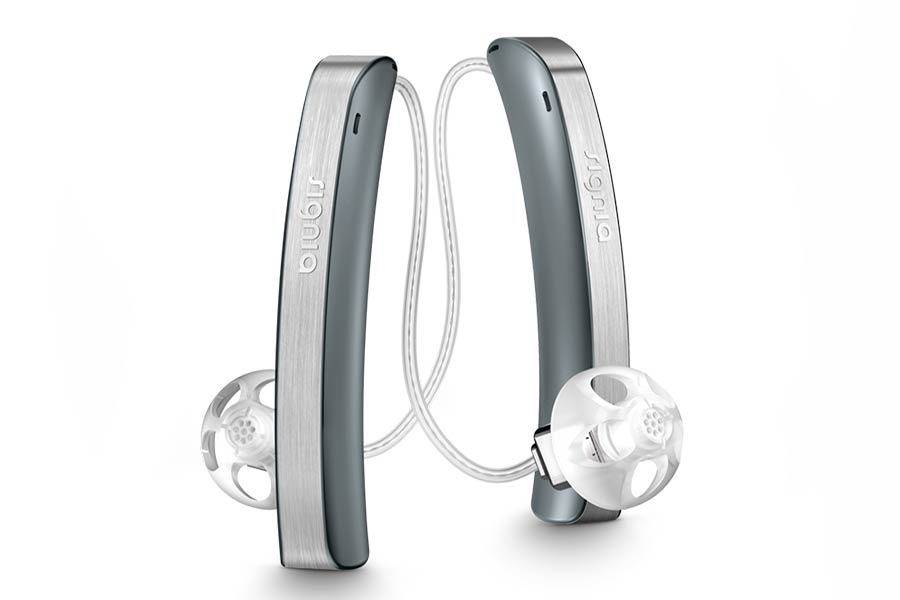
Signia is today introducing a new Lithium-ion rechargeable hearing aid they are calling the Styletto (pronounced Style-Etto). The devices are a completely new form factor which follows new conceptual design parameters. In essence, Signia decided to design something that would break the mould for hearing aid design and appeal to a new generation of hearing aid users. They are very different from anything that has come before, let’s talk about the Styletto.
A New Form Factor
Firstly, the new devices will be available on the Nx platform and they will be available in the three levels of technology. They will also have the Own Voice feature that has been pretty successful for Signia. The devices will be suitable for mild to moderate hearing losses mainly. They will not be Made For iPhone enabled, however, they will have the Signia wireless protocol. As you can see the devices are unlike anything that is currently available.
They are a Receiver In Canal hearing aid but the body of the devices are very long and very thin. Signia understands that Lithium-ion power packs can really come in any shape or size. Up to now, most power packs have been based on the traditional battery cell shape. They decided to break from that design in order that they can offer something new. That decision led to the ability to really push the form factor design concept.
Modern Hearing Devices
The devices are very small and quite discreet, they feel pretty light on the ears and hug the back of the ear nicely. The case of the device has a nice quality feel with a brushed steel back. All in all, it feels quite modern and luxurious. The receiver is fixed to the case and the case appears sealed pretty well. Signia say they have a high waterproof and dustproof value (more on that when I know).
The Charger Case
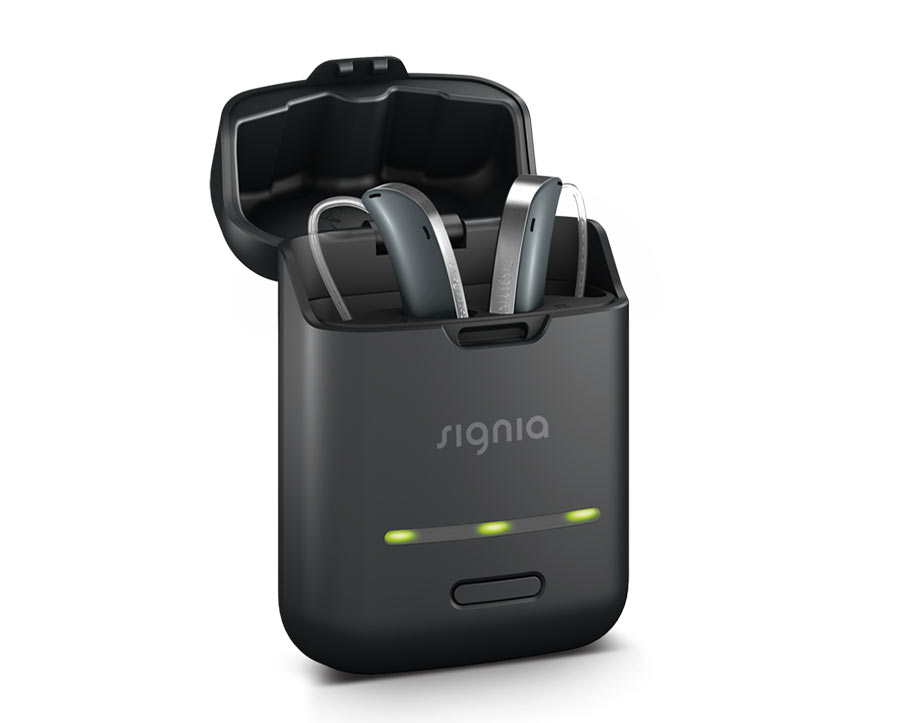
Signia have a lot of experience with rechargeable hearing aids and their rechargers are some of the best in the business. This charger is no different, it is an automatic charger which turns the hearing aids off when placed in it and on when they are taken out. It charges the devices in as little as three hours and it offers three extra charges. So if you go away for the weekend and you forget your plug, your charger will see you through.
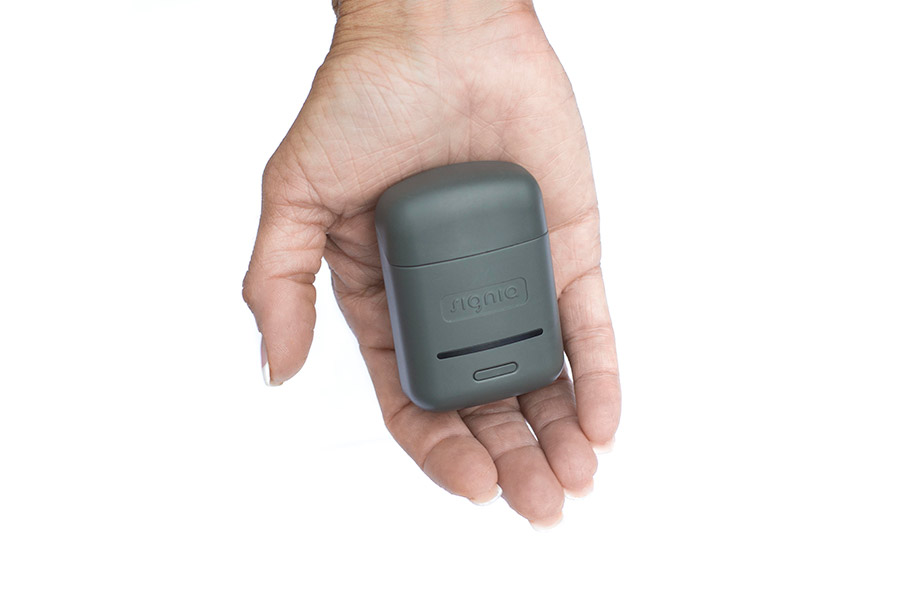
The charger is quite small, so it is ideal for throwing in a coat pocket or handbag. It has LED lights on the front which allow you to ascertain what the charge state is at a glance so you should never be caught out. All in all, it is a nice charger and you can see that some thought has gone into it.
Interesting Market Research
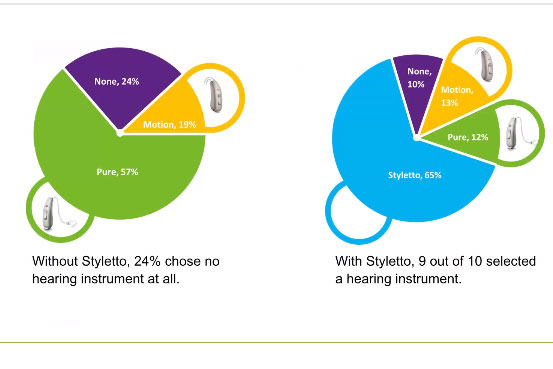
Signia have done some really interesting market research around the new Styletto which seems to show that it changes attitudes to hearing devices. In essence, they showed the group one range without the Styletto and one range with the Styletto included. The differences were a little startling. In the first group, 24% of the group did not choose a hearing aid.
When shown the second range with the Styletto included, the number of people who did not choose a hearing aid had reduced to 10%. That meant that nine in ten picked a hearing aid with many of them actually picking the Styletto.
Pros and Cons
For me, the size, shape or colour of a hearing device does not matter. I am famously in-different so I am not the best person to be discussing the cosmetic appeal. I do however realise that there are many people who are worried about discretion and cosmetics. For those people, this is a pretty discrete device when worn, while also being cosmetically appealing in that modern consumer electronics kind of way.
The new form factor does bring issues though. The receiver is fixed in the hearing aid and can not be replaced in the clinic. That means that you will need to take care of it to ensure it doesn’t fail. Generally, people do not take care of their receivers, we see them failing all of the time through user negligence. They get full of wax and moisture and die.
Double Wax Guard System
If that happens with these devices, they will need to be sent back for a factory repair. So if I were you, I would be very diligent about my clean and care routine. In fairness, Signia offers a pretty good wax management system. It comprises both a wax guard in the receiver and a grid guard in the tip. That’s really double protection, so if you do kill your receiver with wax, you really have been negligent.
The devices are to hit the market in early September and should be available at that time. I had a great experience with the Pure Nx, so I look forward to giving them a try.


 Itshearingaidknow