Researchers in America have started a clinical trial to test a ground breaking gene therapy which aims to treat hearing loss by restoring sound detecting cells that have been damaged by trauma to the inner ear.
Novartis, a Swiss drug company, is collaborating with University of Kansas Medical Center to run trials on human volunteers with hearing loss. As far as I know, this is the world’s first gene therapy trial for hearing loss.
The volunteers will get an injection of a harmless virus containing a gene that should trigger the regrowth of the sensory receptors in the ear.
“The holy grail is to give people natural hearing back,” says –>Hinrich Staecker at the University of Kansas Medical Center, who is leading the trial. “That’s what we hope to do – we are essentially repairing the ear rather than artificially imitating what it does.”
Hair cells in the ear can be damaged by loud noises, drugs and disease – in 2003, another group of researchers discovered that certain –>genes can transform the cells in the ear, causing them to grow back and improve the subject’s hearing. In 2013, Staecker and colleagues performed tests on mice with damaged hearing to see if one of those genes, called Atoh1, would regrow their ear cells. Two months after being injected with a harmless virus containing the gene, the rodents’ hearing ability improved by about 20%.
In October 2014 Staecker’s team got the go ahead to perform trials on humans and have performed a similar process on the 45 volunteers as they did on the mice: inject the viral gene package directly into the volunteers’ cochlea by peeling back their ear drum and passing a needle through a tiny hole made by a laser. “The biggest risk is that we interfere with residual hearing, so we’re starting with people who have lost almost all hearing already,” said Lloyd Klickstein, head of translational medicine at Novartis.
“Today’s medical treatments are largely limited to hearing aids and cochlear implants, which are essentially just sticking plasters,” says Ralph Holme, head of biomedical research at UK charity Action on Hearing Loss. “This is why the planned trial is extremely encouraging and offers hope to the millions affected by hearing loss that a cure is possible.”
If the human trial volunteers see the same 20% improvement in hearing ability then this treatment can help those with a severe hearing loss improve to a medium one, medium to mild and mild to normal hearing.
Hearing Direct are a Web-based company that provide hearing aids, amplified telephones and other products through their website. My Mum was not happy with her NHS-supplied behind-the-ear hearing aids so we decided to get a pair of in-the-ear aids from Hearing Direct. This is a review of the aids and a round-up of Mum’s experience of buying online.
Why we went to Hearing Direct
Mum has been wearing a pair of Oticon Spirits supplied by the NHS for a few years. She had two problems with these: She wasn’t particularly happy with wearing visible behind-the-ear hearing aids and she had recently had minor surgery to remove a growth from the outer part of one of her ears, which meant she could not wear one of the aids without it slipping off hear ear.
I had been wanting to see how the experience of buying hearing aids online worked for someone for a while but I am well outside of the fitting range of most online suppliers myself. I suggested to Mum she went through Hearing Direct as she could get a pair of in-the-ears for a decent price and she wouldn’t have to visit somewhere to get them fitted (which was something she wasn’t particularly keen on).
The order
Mum spoke on the phone to one of Hearing Direct’s in-house audiologists to determine which of their aids would be best for her, they decided on a pair of –>HD 390 aids. Hearing Direct either supply aids pre-programmed for “the most common hearing loss” or they can program a unit to an audiogram – Mum didn’t have a copy of her last audiogram handy, which would be quite out of date anyway, so the HD 390s were programmed for a common loss based on her age, the environments she wanted to hear in and also the fact that she had been a hearing aid wearer already.
The Delivery
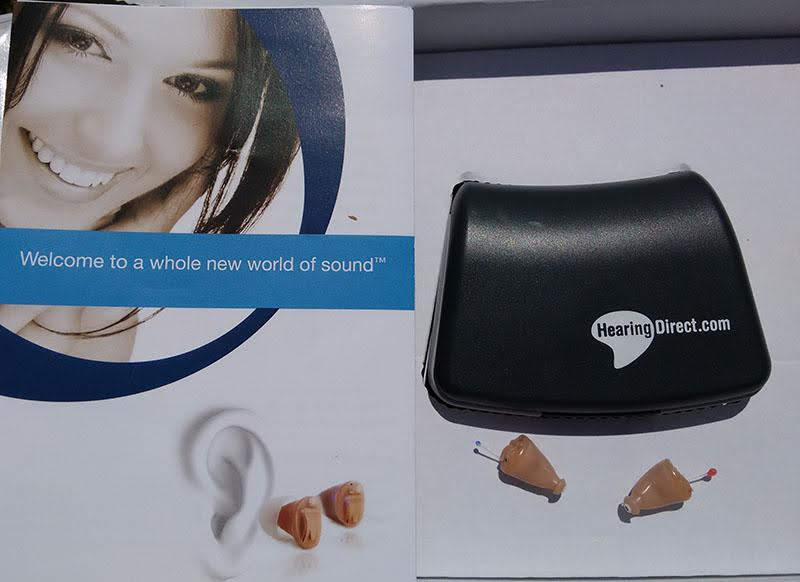
About two days later we received the aids. Inside the box were the aids themselves, some batteries, instruction sheets, replacement wax guards, rubber domes and a hard-shell carry case that can be used to keep the aids in whilst they are not in ears.
The aids were ready to go, we just needed to put the batteries in and pop them into ears. The rubber domes are optional and can be fitted onto the ends of the aids to make them more comfortable or to eliminate any feedback, Mum was happy without the domes and wasn’t getting any feedback. I did try and put the domes on, just to see how they fitted, and had a hard time trying to get them to stay on, but we didn’t need them anyway, so no problem.
There are some instructional videos on the Hearing Direct website that show you how to insert one of their aids, how to change the battery and how to clean them. These videos are really helpful and need to be watched, they do a far better job of explaining how to use them than the supplied instructions do, it is easier to watch an aid being put in and taken out than it is to read it being described.
Putting them in
Mum was used to fairly bulky behind-the-ear aids so putting in a small in-the-ear was a bit fiddly to begin with – after a few days this became second nature and the colour-coding on each unit (red for right, blue for left) makes it easy to get the correct aid into the correct ear.
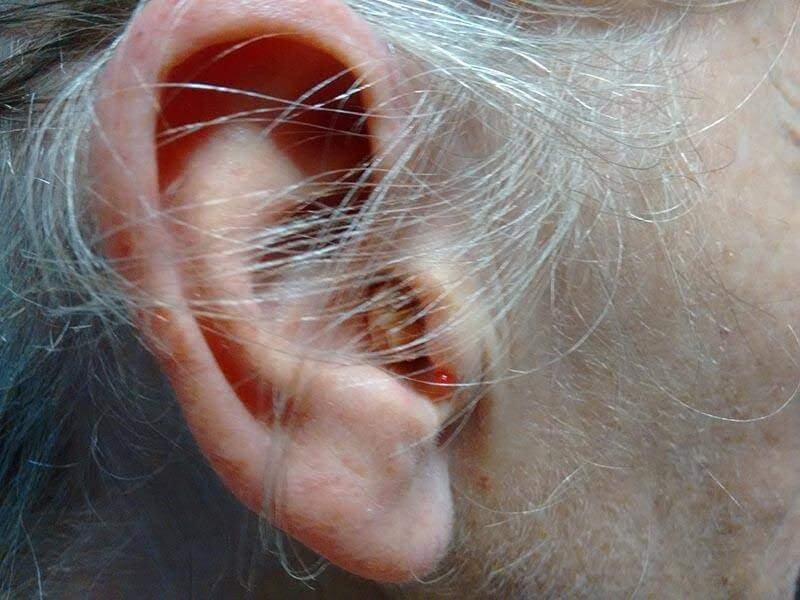
Taking them out was also a little fiddly at first. Each aid has a small wire coming out of it, which is used to pull it out of the ear. The wire is needed as the unit fits snuggly into the ear canal and goes far enough in that you would not have anything to grab onto without the wire. The end of the wire sits at the bottom of her ear and is just about visible if you are staring hard enough at her ear.
Listening
This was the real make-or-break point, did the aids help her hear better? In short, yes! She initially found them too loud, which is common when people are putting new aids in but after a few days she was used to the new sounds and not experiencing any sounds that were too loud. I was a little concerned that the aids may have been over-amplifying for her seeing as they were programmed to the common hearing loss and not hers specifically but after that initial period she is getting on with the sound level swimmingly.
I tried various tests with her to see how well she was hearing with the HD 390s in. I banged on a table while someone else talked to her (a repetitive background noise that the aid should suppress easily), she understood the speaker easily. We had her facing a TV whilst someone spoke to her from behind her at quite a distance away, again she heard the speaker OK, the TV was not especially loud but it was a good test of her ability to pick up sounds from behind with noise in front. We tried having many people speaking or making noise at the same time while she tried to understand what one of us was saying, this is a challenging environment for any hearing aid as the background noise is not a uniform sound that can be easily suppressed and it is also voices, which is what the user is wanting to hear, she heard OK with this test, she could understand what the person was saying but it was difficult, but I would expect this of any hearing aid.
She finds the telephone easier to use now. Having an in-the-ear aid means you can hold the phone at a much more natural position, i.e. actually on your ear, whereas with a behind-the-ear you have to hold the phone to the hearing aid’s speaker, which is at the very top of your ear. She hears much more on the phone but she does still like to go to a quiet room or turn down the TV to reduce background noise for calls.
Outcome
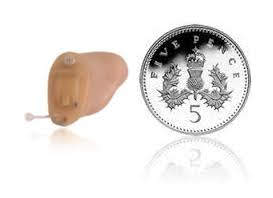
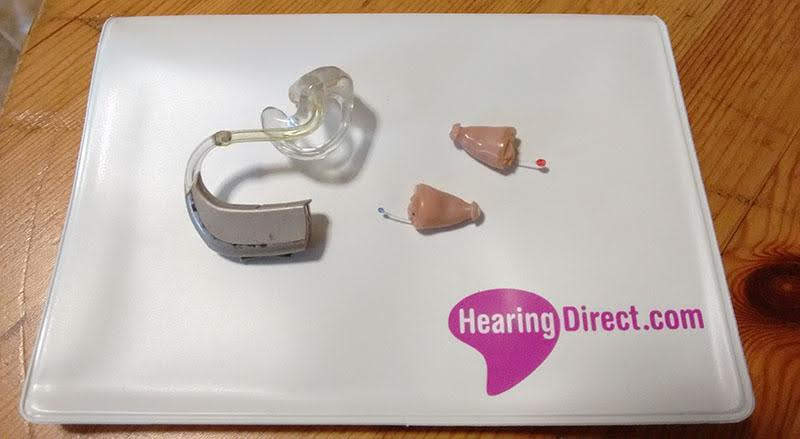
One happy customer! The in-the-ear HD390s are working extremely well for Mum. After a few days of learning how to get them in and out and changing the battery she is using them as comfortably as she did her BTEs, despite them being much smaller (the image above shows the difference in size). She is happier that they are less visible. She says the sound quality is better than her old aids and she can hear more with them and everyone around her is noticing that too, we don’t repeat ourselves so often and she is clearly more engaged in group conversations than she was before. I was slightly skeptical of using a pair of hearing aids that were programmed for a common loss rather than an individual hearing loss pattern but this is working very well for Mum. She has got a no-fuss pair of hearing aids delivered in a couple of days that has improved her hearing ability and made her happier.
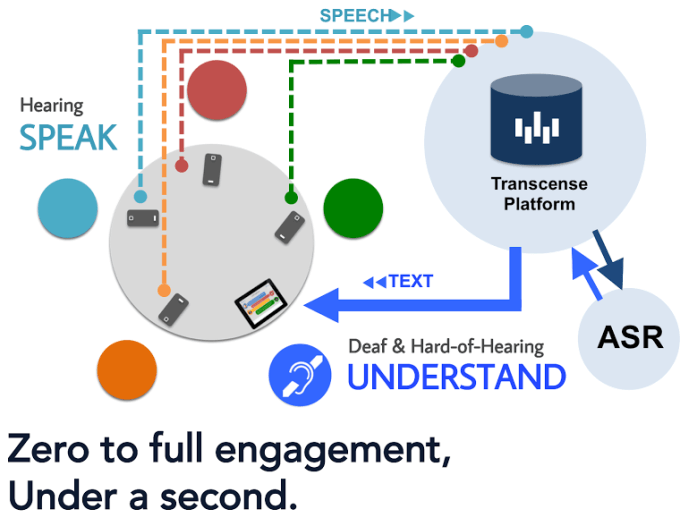
Transcense is a new app that accurately translates conversations in real time so the deaf and hard of hearing can participate in meetings, presentations and conversations. To put that another way: this app wants to provide real-time subtitles/captions where the captions are showing words from any number of people in a group.
Founders Thibault Duchemin, Pieter Doevendans and Skinner Cheng say one-on-one conversations are easy for the deaf. Either they are speaking with someone who can sign or they can just read lips. However, it’s very hard to follow group conversations with several people speaking at once. This makes it hard to catch things and converse during group meals with friends who don’t sign or at an office meeting where they might miss something important. This app is personal for two of the three founders. Cheng has been deaf since he was two and Duchemin is a coda, meaning he grew up with deaf family members.
The App works by catching conversations from the voices of different individuals and assigning them a color bubble so the deaf person knows who said what. It works with a distributed microphone system on all the devices using the app so that it can distinguish each person from another. It then translates those words and starts jotting them down in real time on the app. The deaf and hard of hearing can then read what is going on as it happens. But why tell you when we can show you this demo of how the app works:
Read the original article in full on TechCrunch. There’s also a conversation about the app, it’s use and it’s technical aspects on Hacker News.
Are you in Cork, Munster or Leinster and looking for a hearing aid? If you are, I highly recommend you check out Audiology Medical Services, they are a family-run independent practice offering the latest in hearing aid technology and a great service as well.
Charles Lewis and his family have been working in audiology for over 43 years and draw upon that experience to give great advice and help to locals looking for hearing aids, tinnitus treatment, hearing testing and earwax removal.
They have a nice rehabilitation programme (or journey as they call it), which is detailed here, to help you get used to your new hearing aids and get the most from them. It is care like this, from initial fitting of an aid, through the first months of wearing them, and afterwards that really helps people to get the full benefit from an aid.
They stock the Starkey, Widex, ReSound, Unitron, Phonak and Lyric hearing aid ranges so their should be something to fit anyone’s hearing needs and budget.
I think it is fair to say that most people don’t understand the problems associated with having a hearing loss. Most people will assume that hearing loss is just about volume, they won’t know about directionality, not being able to understand different types of sounds, noise problems and so on. And I think that is completely fine, it is totally unreasonable to assume that everyone else has a good idea about how to help you deal with hearing loss.I believe it is up to me to deal with my hearing loss, to let people know about things like background noise or telephones difficulties when the problem arises, I don’t expect people I meet to know how to deal with my lack of being able to hear them, I have to diffuse that situation and tell them how to make it work – which is definitely not always an easy or comfortable thing to do.Recently I visited Geoff, we were in McDonald’s for lunch and I was going to pay, the cashier told me the price but I didn’t have a clue what she said and responded with, “I’m sorry, I didn’t hear what you said”, she looked all embarrassed and confused and said nothing, I wasn’t sure how to proceed but Geoff chipped in and let me know she was telling me the price, so that problem was over. Was the cashier being unreasonable? I don’t think so, I’m guessing she probably doesn’t know anyone with a hearing loss or maybe she was just embarrassed about a “scene” as some of the other customers at the counter were looking over – that cashier has her own doubts, issues and problems to deal with, I can’t expect her to deal with mine too.I’m all for raising awareness of hearing loss and I think “National Hearing Month” and similar efforts are great, if they help people to come to terms with the hearing problem and seek help then that is fantastic, but I don’t think we, as individuals, can expect these awareness drives to result in everyone else understanding our problems. We’ve been saddled with a hearing problem, so we have to pucker-up and deal with it – harsh, but true.That’s not to say that other people don’t care about our hearing problems, I’m sure most people are sympathetic and would help out by speaking more clearly or whatever when they know what to do, but don’t expect them to intuitively jump to your aid, take control of your situation yourself.
On an overcast Chicago afternoon in August 2013, hip hop artist Kendrick Lamar sauntered out onto Lollapalooza’s Bud Light stage. As thousands of twenty-somethings roared with approval, he grabbed a gold-plated mic and cut straight into the intro of “Backseat Freestyle:”Martin had a dream / Martin had a dream / Kendrick have a dream…
Just off to the side of the stage, on a raised platform, 36-year-old Amber Galloway Gallego thrust her hands in the air, and twisted her body to the rhythm. Clad in a purple shirt, and sporting a pink-tinted pixie haircut, she was also in the midst of a dream: to make music — particularly rap — accessible to deaf people.
As an American Sign Language interpreter who specializes in music performance, Gallego has interpreted over 300 rap, R&B, and rock concerts, and has worked with everyone from Aerosmith to Destiny’s Child. After a deaf friend told her that “music wasn’t for deaf people,” she embarked on a quest to prove otherwise; today, she’s hired by major music festivals all over the United States to make auditory performances more relatable for the deaf.
To do so, she employs a tireless mixture of hand signs, facial expressions, body movement, and sensibility.
Read the full text of this excellent article at Priceonomics.
On 27 August 1883, the Earth let out a noise louder than any it has made since.
It was 10:02 AM local time when the sound emerged from the island of Krakatoa, which sits between Java and Sumatra in Indonesia. It was heard 1,300 miles away in the Andaman and Nicobar islands (“extraordinary sounds were heard, as of guns firing”); 2,000 miles away in New Guinea and Western Australia (“a series of loud reports, resembling those of artillery in a north-westerly direction”); and even 3,000 miles away in the Indian Ocean island of Rodrigues, near Maldives (“coming from the eastward, like the distant roar of heavy guns.”1) In all, it was heard by people in over 50 different geographical locations, together spanning an area covering a thirteenth of the globe.
Just listen to this radio clip. It’s only takes 50 seconds for the Franklin Institute’s chief bioscientist, Jayatri Das, to demonstrate something fundamental about your brain.
She starts with a clip that’s been digitally altered to sound like jibberish. On first listen, to my ears, it was entirely meaningless. Next, Das plays the original, unaltered clip: a woman’s voice saying, “The Constitution Center is at the next stop.” Then we hear the jibberish clip again, and woven inside what had sounded like nonsense, we hear “The Constitution Center is at the next stop.”
The point is: When our brains know what to expect to hear, they do, even if, in reality, it is impossible. Not one person could decipher that clip without knowing what they were hearing, but with the prompt, it’s impossible not to hear the message in the jibberish.
This is a wonderful audio illusion.
The reason is that we still think of our senses—sight, hearing, touch—as reflecting the outside world, purely. But they don’t. They provide us with a mixture of the world out there and our own expectations.
Hearing, itself, is thinking. Which makes it subject to the machinations of the rest of the brain, which are constantly priming the ears about what they should be expecting.
The ability to discern pitch and to hear the difference between similar-sounding words relies on specialised cells within the inner ear, which can be damaged.
For the first time, scientists have discovered what controls the cells’ development and pattering.
They studied the development of these cells in chickens, which unlike humans, have the capacity to regrow sound-detecting cells after suffering hearing loss.
A study by the University of Virginia School of Medicine and the National Institute on Deafness and Communication Disorders says that if scientists understand what causes chickens’ cells to redevelop they could one day replicate the process in humans to reverse hearing loss.
Jeffrey Corwin of the university said that if both a human and a hen were to be exposed to a sound loud enough to destroy the ability to hear a certain pitch, the outcomes would be very different.
‘We would lose the ability to hear that sound for the rest of our lives.
‘The bird also would lose the ability, but within 10 days, it would have its cells back – they would hook back up to the nerves and within a few weeks its hearing would be back and almost indistinguishable from before.’
I am excited to announce that I’ve been working with Geoffrey Cooling on a new product and service for audiology practices and hearing healthcare providers. Audiology Engine provides an easy-to-use Website Builder for practice websites and all the surrounding services that are needed to ensure that your website, and your practice, is a success.
Geoffrey is an industry veteran who has worked as a hearing aid dispenser and more recently as a Sales Manager for one of the largest manufacturers in the industry. He writes about the hearing industry, marketing and practice management at Just Audiology Stuff.
We are still busy putting the finishing touches to Audiology Engine but we do have a coming soon page up where you can leave your contact details should you wish to find out more or want to know when we launch.
Being something of a geek, I am more involved with the website provision side of things, whereas Geoffrey is putting together the content marketing, SEO, practice management and patient retention side of things. We will provide a web-platform that enables practices to quickly and easily create their own website that uses the latest and best technologies to ensure that their website is found in search engines, is user friendly, is fast and reliable, works on all devices from desktops to smarthphones and is a system that practice owners can work with easily to manage their online presence. A bit further down the line, we have plans to add practice management functionality, marketing tools and other features that will be extremely useful for any modern hearing practice.
If your practice doesn’t have a website, or does but you need something better, leave your contact details and we’ll let you know as soon as we launch.

 Itshearingaidknow