Completing a Degree in Communicative Disorders, Deaf Education, or Audiology

If you have a passion for helping people to communicate effectively but are unsure about which field of study to pursue, you might consider studying communicative disorders, deaf education, or audiology. By becoming an expert in any of these areas, you will facilitate expression and understanding between people who would otherwise have difficulty communicating. Furthermore, you will enjoy the opportunity to learn about deaf culture.

Begin by immersing yourself in this culture. Throughout your education, attend the related seminars that the university offers. Finally, check the university’s online listing of jobs and internships frequently to find ways to get more experience. This will help you determine exactly what you want to achieve.

Bachelor’s in Communicative Disorders

Some universities, such as Utah State University, offer an undergraduate degree in communicative disorders that may be completed either on campus or online. If you choose to pursue your degree online, it is important to research the licensing laws and job market for your individual location before entering the program, as they vary widely by area. Entry into a communicative disorders degree will likely require a minimum GPA, so watch all of your grades carefully.

Although a BA or BS will be adequate education to work as a clinical aide, many undergraduate degrees are largely designed to prepare you for graduate work in audiology or speech-language pathology. Due to the clinical nature of these fields, you will need to study anatomy and physiology, so be sure you have a firm grasp of life sciences.

Bachelor’s in Deaf Education

A BA or BS in deaf education prepares you to be a teacher, not a clinician. Therefore, you must emphasize sign language skills to effectively instruct your students. In addition, you will need to take classes about teaching methods.

Doctorate of Audiology

The field of audiology is expected to grow by 34% over the next decade, so it is a wise goal if you feel it is a good fit for you. You can choose between earning a regular PhD or an AuD. An AuD will emphasize the use of hearing aids, cochlear implants, and other listening devices. You will learn about these exciting advances in science through practical experience, where you will get a firsthand view of the immensely positive impact your work in this field can do.This was a guest post by Heather Jensen from Utah State University. Heather is an Audiologist and Clinical Assistant Professor for Utah state University.  She received her Doctorate of Audiology from Arizona School of Health Sciences in 2004.  She has been an adviser for the student academy of audiology organization at USU for 11 years.  Before coming to USU, she owned her own private practice, but decided she wanted to give back to the field of audiology by teaching students.  When she’s not working she spends time with her four children, she also enjoys doing hearing related humanitarian missions.
Amplifon urges greater understanding of diabetes and hearing loss link during Diabetes Awareness Week

A new study promoted by hearing specialist Amplifon has revealed that diabetes and hearing loss may share an often ignored link.

The Consensus Paper “Hearing and Diabetes”, promoted by Amplifon, puts in evidence studies in which type 1 and type 2 diabetes sufferers were discovered to be 2.15 times more likely to have a hearing impairment than the matched control group.

Diabetes patients seem to be more susceptible to noise-induced hearing loss and this may be due to impaired recovery from noise-induced injury, the study concludes. Amplifon suggests people with diabetes should be urged to undergo follow-up screening for prompt detection of any hearing loss.

Hearing loss in diabetic patients increases the risk of falls, social isolation, and the development of cognitive deficit or depression. For that reason, the study suggested that “the high prevalence of hearing impairment among diabetics merits consideration for a routine referral for audiometric testing”.

Commenting on the findings, Barry Downes, Professional Services Manager at Amplifon advised that a simple hearing test might help sufferers identify both problems earlier.

“Getting tested regularly can help speed up diagnosis of linked conditions such as diabetes, greatly improving the likelihood of managing symptoms in a way that least affects your day-to-day life.

“Here at Amplifon, we’ve put together a comprehensive guide to help people understand the correlation between the two conditions, as well as information on where to get your hearing tested. Taking a keen interest in your own health is really important, especially in older age”.

Read the full Hearing and Diabetes paper on the Amplifon website http://www.amplifon.co.uk/media/1189023/hearing_loss___diabetes_consensus_paper_2014.pdf

Young brains compensate for hearing loss more than older ones

People who lose the ability to see or hear often gain increased ability in their remaining senses – their brain compensates for the loss of one sense by enhancing others. Research has shown that younger brains are far better at compensating for a lost sense than older brains are. 

Professor Olivier Collignon from the Center for Mind/Brain Sciences at the University of Trento in Italy is studying
this effect, know as cross-modal plasticity, with a view to finding more effective ways to help people who have
severe problems with loss of hearing or vision. 

“It appears that the reorganisation in the brain is much more important in early deaf people” said Prof. Collignon, 
“and it is qualitatively different to those who may lose their hearing later in life”. Collignon is leading a project called CP-FunMoD, which uses functional magnetic resonance imaging (fMRI) brain scanners to study the difference in plasticity of people who lost their hearing later in life to those who were deaf from an early age.

The long-term aim of the project is to improve understanding of when clinical help, such as cochlear implants, can offer the best prospects of deaf people to hear.

Dr Jodie Davies-Thompson, also on the project team, said, “It is about understanding how the brain reorganises when hearing is lost, and how the parts normally involved in processing hearing process another sense instead, like vision”.

Doctors sometimes tell parents not to teach deaf children sign language, the thinking being that focusing solely on a visual language may cause the brain to focus on visial stimulas too much and cause difficuly with hearing and reproducing speech if they have a cochlear implant fitted later on. 

The project wants to find a more efficient way of identifying those who are more likely to benefit from a cochlear implant based on their cross-modal plasticity, so a better decision can be made early on.

“Once we understand how duration of deafness, age of onset and the influence of the extent of cross-modal plasticity affect the response pattern in different parts of the brain, we can start to understand the likelihood of a cochlear implant being successful.” said Dr Davies-Thompson.

http://cordis.europa.eu/project/rcn/197881_en.html

HearingTracker.com – find better hearing aids and better hearing providers

ht

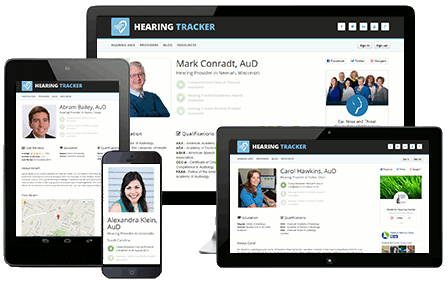
When buying hearing aids there are two things you need to get right: find the right hearing aid at the right price and find the right person to fit it for you. hearingtracker.com helps you with both, it’s a website that contains a long list of hearing providers and hearing aids, with patient reviews of both.

Hearing Tracker was founded by Dr. Abram Bailey, a registered audiologist, to help bring information and data to patients that helps us to make an informed hearing aid purchase. “We are 100% independently-owned, with zero influence from the hearing aid industry. We recently partnered with the Hearing Loss Association of America. The HLAA will be directing it’s members to our provider directory to locate nearby best-practice hearing providers, while Hearing Tracker will be educating consumers about the HLAA’s extensive (online and offline) support network, resources for those with hearing impairment, and advocacy projects.” he said.

Hearing Tracker has a directory of over twenty thousand audiologists and hearing aid providers, which can be searched by location, qualifications, services provided, hearing aids sold and so on. Us patients can leave reviews against any of the providers and rate them based on our experience – so it is a great way to find reputable local hearing aid providers. The find-a-clinic page has an interactive map, into which you can enter your preferred location and see ranked providers around that area.

The hearing list is incredibly thorough and contains a lot of information on each model along with reviews from users. Here, for example, is the Oticon Chili SP9 page, showing lots of info about the aid itself and user feedback.

Abram believes “that information is empowerment” and I very strongly agree, Hearing Tracker is a great resource to help you get the right hearing aids for you and the absolute best fitting to make sure they are working as best they can.

TIME magazine rates audiologist as best job in America

TIME magazine have been comparing jobs across America. They’ve looked at growth within an industry, stress-levels of workers and average incomes to determine the best and worst jobs. Being an audiologist came out top!

As it turns out, audiologists, medical professionals who treat hearing and balance problems, don’t have it so bad.

BLS projects the profession is expected to experience a 34% boost in jobs between 2012 and 2022. The median salary for audiologists is a stable $69,720. The projected growth is likely a reflection of the fact that as the nation ages — the over-65 population is expected to double by 2050 — the need for doctors who specialize in addressing that community’s ailments will only grow. And given millennials’ and youngsters’ tendency to blast music into their earbuds, which is partly to blame to the increasing levels of hearing loss among young Americans, the need for folks who can help us hear better will only grow.

Originally from TIME magazine.

Website accessibility for the deaf and hard of hearing

“How many times have you been asked this question: if you had to choose, which would you prefer to be: deaf or blind? The question illustrates the misconception that deafness is in some way the opposite of blindness — as though there’s some sort of binary representation of disability. When we look at accessible Website design for the deaf, it’s not surprising to see it addressed in a similar fashion to accessibility for the blind.

Video captioning by itself oversimplifies the matter and fails many Deaf people. To provide better user experiences for the Deaf, we need to stop thinking of deafness as simply the inverse of hearing — we need to understand deafness from both a cultural and linguistic perspective. Moreover, to enhance the online user experience for the deaf, we must understand how deafness influences web accessibility.”

The above is a snippet from an excellent article about website accessibility for the deaf and hard of hearing, it is written by Lisa Herrod, you can read it in full on the A List Apart site.

Taxi-cab company Uber make changes to support their deaf and hard of hearing users


uber

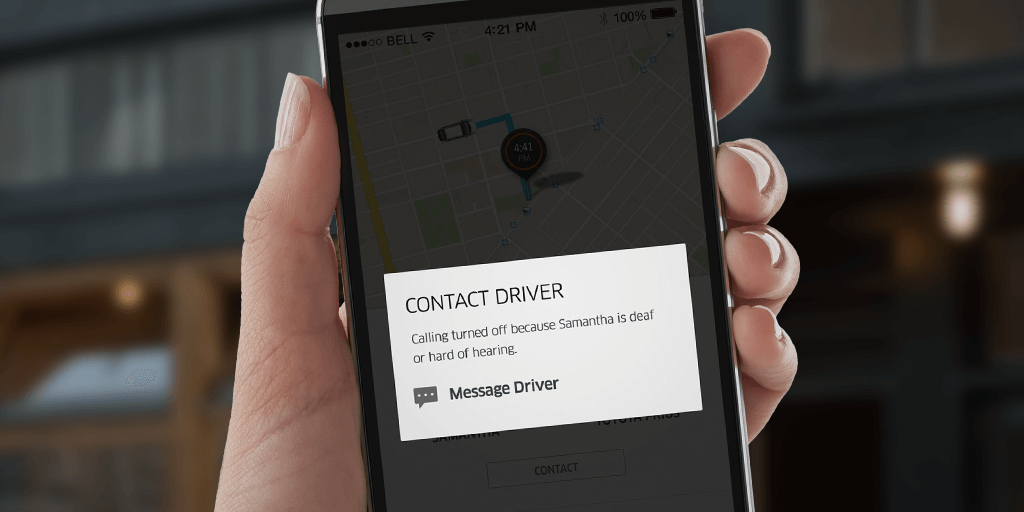
Uber is a technology startup that is making waves in the taxi-cab business – their Apple/Android app allows anyone to call a cab to their location, see how much the ride will cost and track pick-up and drop-off times.

Uber are currently testing an update to their app that contains features for their deaf and hard of hearing drivers:

– When a customer requests a pick-up, the drivers app will alert them to the request with a flashing light as well as an audio alarm.

– If a driver register themselves as deaf/HoH with the Uber app it will no longer let passengers call them, instead it lets the passenger know of the driver’s hearing difficulty and asks them to type a message instead.

When making these changes Uber consulted with some of their hearing impaired drivers and also with the National Association Of The Deaf, who said:

“The NAD applauds the efforts of Uber to promote increased work opportunities for deaf and hard-of-hearing drivers. Moreover, we commend Uber for enhancing their mobile app to improve communications between drivers and passengers, regardless of whether they are hearing or deaf.”

Great to see a company making an effort to support their hearing impaired users.

Changing your hearing aid battery in public

Unitron Stride M

Are you comfortable with taking your hearing aid out, changing the battery and putting it back in when there are other people about? Gael Hannan asked this question in her HHTM column and it got me thinking.

I don’t think I am comfortable with it, which is odd because I am more than happy to let people see my hearing aids, happy to talk about them and happy to write about them. But for some reason the act of touching them is different.

The office I work in at the moment is qute a challenging listening environment, it’s a small enough office that everyone can talk to each other without leaving their desks but big enough for people to be too far away for me to hear. There’s a radio at the other end of the office to me that is on most of the day, which adds to the problem. And finally, I sit close to a human-foghorn who drowns out almost everything else for at least 2 miles! All that means I am changing volume more often than I normally would and I’m not comfortable with fiddling with my aid to change it, I don’t know why, I don’t mind people seeing them, in fact that it useful as it draws attention to my hearing problem, but I don’t like being seen messing around with them. Luckily my Phonak v90s are smart in that when I change volume on one aid the other automatically changes too – so just one disguised volume change is needed, usually a turn of the head or a fake head scratch.

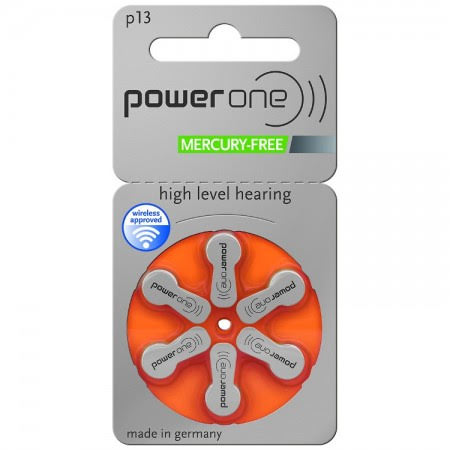
That’s just changing volume, changing the batteries would be even worse, not only would I draw some major attention by taking them out, people would also see the dreaded brown guck (copyright Gael Hannan!). I’ve been wearing hearing aids for about 25-30 years and I can honeslty say I have never changed the batteries whilst out in public, not once, never. I change the batteries every Monday morning and they have never died on me during the week, I have had a few duds that didn’t work when I put them in but never had one that didn’t last the week – which is pretty remarkable seeing as I have a severe hearing loss, so my hearing aids are working hard all the time. Thank you Rayovac for years of perfect service!

How the New Apple Watch Works in Conjunction with Hearing Aids

Disability rights groups have long been praising Apple for its dedication to developing accessible technology for people with visual and hearing impairments. Many people with these impairments have even gone as far as saying that iOS devices have dramatically changed their lives for the better.

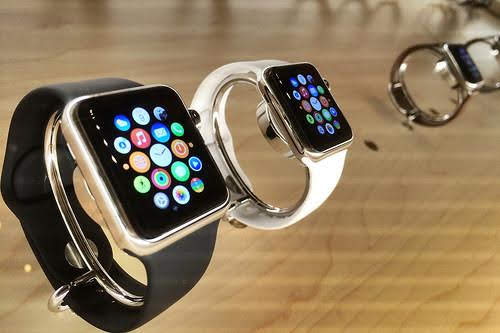
Apple’s newest device, the Apple watch, is the latest device to hit the headlines for its fantastic accessibility features, particularly for those with impaired hearing. The latest version of the watch can be used to set mono audio, sending both audio channels into a single ear, so that hearing aid users can hear missed music or notification sounds.

The watch also has a Taptic Engine, which can be configured with a specially designed Prominent Haptic setting, which pre-announces common alerts to those with impaired hearing.

The Apple watch is a great device for those with hearing impairments.

Fine-tuning sounds captured by hearing aids

Over the years, hearing aid technology has become more and more sophisticated. Today it’s even capable of adjusting the sound it picks up, depending on the environment. Hearing aid users can simply press a button on their device, which allows them to switch between modes.

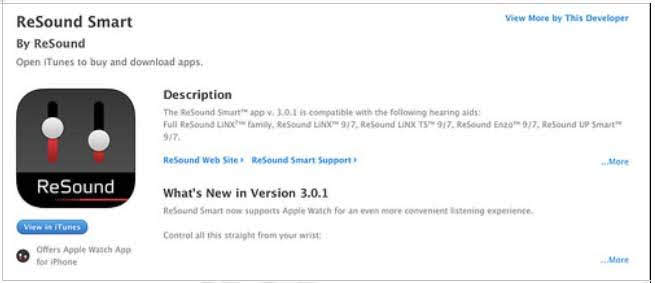
The ReSound Smart app is compatible with the Apple watch and allows hearing aid users to fine tune the sounds they hear.

More recently, an app for the new Apple watch, known as the ReSound Smart App [1], has been developed to allow hearing aid users to fine-tune the sound captured by their devices. For example, when speaking with someone, they can use the app to block out all unimportant sounds.

The app also lets you choose between different modes, including one where your hearing aid acts as a Bluetooth music receiver. This means you wouldn’t have to choose between listening to music and hearing other important sounds around you, like traffic.

This particular app is compatible with the ReSound LiNX2 hearing aid.

Streaming phone calls and music to your hearing aid

The Halo hearing aids by Starkey [2] have been designed for iPhone compatibility but the good news is that they also work with the new Apple watch. Using the TruLink Hearing Control App, hearing aid users can be used to allow  streaming from your phone, music and much more directly from their Apple watch or iPhone, straight to their hearing aids.

Quick addendum here, a guy named Richard Theriault from Los Angeles was onto us about the Apple watch and it’s streaming capabilities. In essence, Richard wanted to use his Apple Watch as the microphone when he took calls. So when he was in the car etc, he could talk easily to his watch. This is a feature with the Apple watch when you have their new iBuds connected. However, for some reason Apple have blocked this feature for hearing aids? Richard has a pair of Halo 2s (which he really likes) and he spoke to Starkey Support about it. They told him that their system is enabled for it but Apple doesn’t allow it. Seems really odd that Apple would do that and I hope to follow up and ask them why? It would seem like a pretty cool feature. Richard was further talking to us recently and he said “I since have had many a conversation with Apple and they informed me that they are listening and recommend others interested in streaming to the hearing aids while using the watch as the microphone send them an email to: accessibility@apple.com”

The app is also designed to facilitate intuitive hearing. Using Geotagged memories, it automatically switches the modes of the hearing aids when the GPS features on the Apple watch detects you are in a tagged location. For example, when you arrive home, the Apple watch will send a signal to the hearing aids to switch to home mode.

Like with the ReSound app, Apple watch users can also adjust the sound quality of their Halo hearing aids using the TruLink Hearing Control App. This allows you to make little adjustments to sound quality to suit the environment you are in through your personal preferences.

Finally, the TruLink Hearing Control App has a great feature known as ‘Find My Hearing Aids,’ which shows their most recent location and the time recorded on the Apple watch.

Benefits of the Apple watch for hearing aid users

The Apple watch benefits hearing aid users in many different ways. For starters, they are able to control and fine-tune their hearing aids in a much quicker and more convenient way than using an app on their iPhone.

Molly Watt [3], a woman who is both near deaf and blind due to Usher Syndrome has found that the Apple watch also provides a way of communicating with others. The Apple watch uses tiny vibrations (known as taps), which communicate with the wearer. Molly intensified these taps and made them more frequent on her Apple watch, so she would never miss any notifications. She has also found that it is a good way for her Mother to communicate with her (using her own Apple watch), without the need for sound or sight.

Molly had also said that she often uses her Apple watch to communicate with her friends, when they’re out and in a loud environment. Instead of speaking, she will send them a message using her Apple watch if she needs help or feels uncomfortable.

Conclusion

The Apple watch has a lot of potential to help those with hearing impairments improve their quality of life and we are already seeing evidence of this. Who knows what the future will hold? Maybe Apple will develop a full communication system for those with hearing impairments, on the basis of users like Molly and their experience with the tap technology?

Information written by Hearing Direct. UK based specialist of hearing aid batteries, accessories and devices.

[1] http://www.resound.com/en
[2] http://www.starkey.com/hearing-aids/technologies/halo-wireless-hearing-aids
[3] http://www.mollywatt.com/blog/entry/my-apple-watch-after-5-days

Overheard on Twitter

People will often tweet about things they’ve overheard in a bar, on a train or wherever – a good one I spotted in my Twitter feed today:

Overheard Muggle conversation: “I wasn’t that drunk.” “Dude, you were hugging an old man with a beard, screaming ‘Dumbledore you’re alive!’”

— Proffessor Snape (@ProfSnapeSev) March 21, 2015

Sometimes I feel like I need a reminder that most other people are hearing way more than I am, when you can’t overhear a conversation right next to you it is easy to forget that other people can hear yours. My Twitter feed should contain this at least once a day: