A recent article caught my attention because it reminded me of a young man I tested a couple of years ago. He had been doing some intense weight training when he had felt a pop in his ear. He quickly realised that he couldn’t hear from that ear and he came searching for answers. In the article, a Reddit user going by the name Unilythe talked about a similar problem he had after doing sit ups.
If you hear a pop in one ear and suddenly begin to suffer with tinnitus in that ear, you need to treat it as a Medical Emergency. Don’t take the chance that it is nothing, don’t take the chance that it will be alright.
In the article which can be found here, he details his recent problems at the Gym. In essence he was pushing himself to the limit to get his workout finished. He said that he was using bad form and wasn’t really using decent breathing control. As he undertook his last sit up, he felt a pop in his ear and his ear began ringing. At this stage, there didn’t seem to be any other symptoms so he shrugged it off.
When he woke up the next morning he seemed to be deaf in the ear and he was suffering really bad dizziness. In fact any movement he made, made him so dizzy that he was nauseus. After googling his condition, he was pretty sure that he had fractured his round or oval window. Two tiny parts of the Cochlea (inner ear). He attended his doctor and was sent on to hospital, it eventually ended in some surgery.
While his vertigo stopped, his hearing unfortunately was gone for ever and it won’t return. Like the young man I saw some years ago, the pressure build up in the body caused something in the structure of the ear to fail. The chap who saw me had some hearing in his ear, but his speech understanding in that ear was completely shot. While we don’t know what failed in the structure of the ear of the chap that saw me, it was felt the round window was fractured in the chap from Reddit.
Exercise Causing Vertigo
While many of us enjoy exercising to the max, or pushing the weight until your head pops, it isn’t healthy. If you undertake exercise and feel dizzy, you are doing it wrong. Remember that many structures in your body are delicate, including the membranes in your inner ear. By increasing your internal blood pressure by un-controlled effort you put those structures under serious pressure. Sometimes they give out.
Sudden Hearing Loss is a Medical Emergency
You should treat any sudden hearing loss as a medical emergency. Sudden hearing loss is something that needs to be treated within 72 hours for there to be any hope of a full recovery. In most cases this type of hearing loss is treated with steroids and possibly oxygen treatment. If it is treated within 72 hours there is a good chance of recovery, or at least, the chances of recovery are increased.
So first off this post is dual authored, because you deserve the point of view of a Dispenser of hearing aids and a user of hearing aids. First it is me Geoff up, when Steve pipes in we will make it clear. In case you don’t know I have over ten years of experience in the hearing aid profession as a provider and then as an employee of a major hearing aid brand. In the recent past we have written two articles about buying hearing aids online. While one was about hearing aids being sold on e-bay and the second about a new website called Wholesale Hearing in the UK. They were in fact both about the same organisation. Apparently they used e-bay as a test bed for their market research. The launch of the new site has caused a bit of furore in the hearing aid profession. However, this article is not about that furore, we want to talk about buying hearing aids online.
Wholesale Hearing
Good Independent Hearing Aid Advice
We pride ourselves on giving good, honest Independent and non biased hearing aid advice on Hearing Aid Know. We re-positioned the site last year to do just that because we felt that there was a need for good non technical explanations of hearing aids and their technologies. That’s why I wrote the hearing aid buying guide. Not just that, we also felt that people needed to be able to understand the difference between Providers of hearing healthcare so they could make educated decisions about their care.
We support Independent Hearing Healthcare Providers here and you will never see one mentioned on the pages of this website that we are not happy to send our Mammies to. That doesn’t mean that we don’t trust or recommend National Providers or Manufacturer owned Providers. We just figure they are big enough to look after themselves. Funnily enough, we also support your right to buying online if you want to.
We don’t think online sales of hearing aids are a bad thing when there is an infrastructure set up to cater for it. By that we mean that the online sales are supported by a testing and fitting infrastructure either online or offline. For instance, Blamey and Saunders in Australia deliver a system we would support as does iHear and Eargo in the US. These companies have purposely set themselves up and designed their technology to be delivered online. The support is clearly there.
Buying A Hearing Aid Online
The sales of hearing devices online is not new, as we said there are businesses around the world that sell hearing aids online direct to consumers. In fact, some of those businesses do an excellent job of it, in the main because they have that infrastructure in place to ensure the buyer’s success. That infrastructure involves remote testing of the buyer’s hearing and remote fitting and fine tuning of the devices.
However, what is happening right now is the sale of hearing aids from the big brands that are not really designed to be sold in that manner. The underlying technology to do this well with the main hearing aid manufacturers just really isn’t there right this minute. That doesn’t mean it won’t be in the future but right now to look after someone remotely is difficult at best. You need to be aware of that when you are making a decision. I am not saying it is impossible, however, it is difficult.
Tempting Prices
The thing that drives most consumers is tempting prices and we understand that. Who doesn’t like to save a few quid? I know we do. But there are things you need to consider when you are making a purchase decision. Because knowing all the information, allows you to make an educated decision. Before I tell you what I think you need to consider when buying hearing aids online, I want to give you some background. I still practice once a week selling hearing aids in Stillorgan, Dublin as a Locum for Connect Hearing. So I still get to see Patients. I would like to explain to you how both I and the people at Connect do things and more importantly why.
Selling A Hearing Aid
So what is the usual process of selling a hearing aid for me, of course the initial step is the hearing test. After I ascertain all that I need to ascertain, I make a recommendation. Generally for me, people go away, have a think and then come back and order (it has kind of always worked like that for me). The process from there is to get the order in to the manufacturer and normally within two weeks I will fit the hearing aids.
The Hearing Aid Fit
Fitting a hearing aid is not just about banging them in and turning them on. Initially, you probably would not like if I gave you the amplification you actually need. Because it would be too much for you. So I go through a fitting procedure, verifying your thresholds with in-situ audiometry (beeps and tones through the hearing aids) then setting the hearing aids to a low acclimatisation setting.
This ensures that you can cope with the sound of the aids. The rest of the session is about showing you the hearing aids, the functions, how to change batteries and how to put them in. That’s it for me at this time, I will tell you to read the manual but not to get freaked out. I won’t talk about clean and care or show you what the tools are, why would I? You have enough to be getting on with just wearing them everyday at this stage.
The Initial Follow Up
After two weeks, I will get you in for a follow up appointment, I will re-assess how you are doing at that stage and if everything is good, I will move your amplification up a notch in the acclimatisation. Again, I will not usually speak about clean and care at this stage, this follow up is really about starting to understand how you are getting on and your experiences.
Second Follow Up
This normally happens two weeks later, again I will want to understand how you are getting on and how you are rehabilitating to amplification. At this visit, I will move you up to full amplification and I will verify the hearing aids output to ensure it is delivering what it should. We will talk about cleaning and care of the hearing aid and I will ask the Patient to begin to take detailed notes about how they are getting on.
At the end of this appointment I will either make another appointment for three weeks away or if I am happy I will make an appointment for three months with the instruction to call us any time. The divergence here is usually down to how happy I am with the progress of the Patient.
Three Month Appointment
This is where we actually start to get real work done on really helping you to hear better. You have a lot of experience at this stage of all of the different sound environments that make up your life. You will also have pretty good notes about wht happened and where. I will take all of that information and make changes to the fine tuning of your hearing aids to ensure that they reflect your own personal preference and sense of sound.
Six Monthlies
After that appointment I will call you back every six months to ensure you are doing okay, service your hearing aids and make any changes that are needed. At least once a year I will scan test your hearing to ascertain any changes. If there is a major change I will schedule a full test to ascertain the changes and re-fit your hearing aid. This goes on and on until your hearing aid can no longer be repaired. Basically for years. All of this service is included in the price that you pay for the hearing aids and we factor it into our prices.
Why Do I Do It?
Simply because I feel this is the best way for my customers to get on well with their hearing aids for years. I believe that this is the level of aftercare and service that is needed. Not every hearing healthcare professional may agree with me and their way may well be as valid and successful as the way I do things. But there it is, I get high success rates with this approach and that is why I do what I do. Now, if you bear with us for a few minutes more, I would like to turn you over to Steve so he can explain his experiences.
I’ve been wearing hearing aids for about 30 years now and I’ve gone through about 8 or 9 pairs in that time. I’ve been to quite a few different practices for fittings and help and have had mostly positive experiences. I started wearing hearing aids way before online sales were a thing (well, actually, I was wearing them before the Web was really a thing!) – my hearing loss has steadily got worse over the years and is now so bad that I’m out of the fitting range for most devices that are sold online. I’ve worn quite a few different brands too: Starkey, Siemens, Oticon and Phonak.
So I’ve always had the pretty standard normal experience: go and see a hearing aid provider, have a hearing test, choose a set of aids and get them programmed to my hearing loss. Every time I have been fitted with a new pair of hearing aids I have always gone back to the practice multiple times for re-programming – in other words, I’ve not been happy with how my hearing aids sounded when they’d been programmed to the results of the hearing test. That’s not a negative comment about the person fitting them, but rather the hearing test results were always a good starting point for me, which we then used to fine-tune the hearing aids so I could get the best possible hearing experience.
We all have a a personal idea of how things sound, or how they should sound – I often wonder just how different what I hear today is from what someone with normal hearing hears. To me, what I am hearing when someone speaks is normal, it is how the world sounds but I am sure it is quite different to how others hear the same voice. But this is how I wanted to have my hearing aids programmed and it tooks me several visits to the audiologist to get them like this – it took changes to the hearing aid settings to get the world to sound like it should to me. There’s been times where I’ve been in a practice having my aids re-configured and whilst trying out different settings and testing them there is a really noticeable difference in how people sound – someone’s voice can go from quite high-pitched and tinny to a low growl at a flick of a switch.
It has always been important to me to find the right person to fit my aids. I’ve changed practice once or twice because I wasn’t happy with the service. I’d go in to see them as I wasn’t hearing very well and I’d leave still not hearing that great – it was easy to think that the hearing aids weren’t doing their job properly but once I’d gone to a different audiologist and had them adjust the aids settings in a different way I could hear really well again. I strongly believe find the right person to fit your aids is more important than buying the right hearing aid – there is a lot of great hearing aid technology out there, which work wonders but if you have them fitted by someone who doesn’t take the time to set them up just right for you then you aren’t getting the full value from them.
Supporting The Buyer
Steve’s views and mine coincide, in order that you get the best of your hearing aids, you need the care and attention of someone who is committed to helping you hear better. While I could fit and fine tune your hearing aids remotely with a bit of hassle, I could not verify the fitting or output. The tech to do so just isn’t available right now. Verification of fit is really important in the process. so, let’s finish this and give you our official line.
What You Need To Know When Buying Online
So here it is, this is what you need to consider when buying online, the first and most important thing is that hearing aids are not like glasses. You don’t just put them on and everything is wonderful. It simply doesn’t work like that unfortunately. You will need care and attention to get the very best out of your hearing aids for as long as you have them. That may well be up to eight to ten years. If you feel confident that the online retailer can give you that care and service and is committed to doing so, then you are onto a winner.
It is both my experience and the experience of Steve that to get on well with hearing aids people generally need the involvement of a good hearing healthcare professional. We have said it here before, our worry about buying hearing aids online was that people may buy the hearing devices and then find it difficult to get a professional to help them. This is a worry in particular from any site selling hearing devices from the major hearing aid brands. Because again, they are not really set up for remote care. So there are several things you really need to consider so you can make an educated choice before buying.
What You Need To Think About When Buying A Hearing Aid Online
Hearing aids aren’t glasses, they don’t just work
You will need ongoing care
Will someone give you a professional and in-depth hearing test?
How will you understand what are the best hearing aids for you?
Will someone make a recommendation on the best hearing aids for you?
Will someone fit them for you?
How much will the hearing test and fitting cost?
How much will it cost for aftercare visits? (you are going to need them)
How much will it cost for repairs to be handled?
Finally and the big one, will the extra costs of getting someone local to help you mean a net saving or loss for you?
Simply Independent Hearing Aid Advice
Listen, we aren’t telling you that buying hearing aids online isn’t a good deal and we most definitely aren’t telling you not to do it. What we are telling you is that you need to carefully consider everything we have discussed here before you make a choice. Once you have done that, our job is done. I really would urge you to discuss it with a hearing health professional before you do it. Discuss it with them and if they are willing to help you, get their agreement to help you, outlining what that help will be. You need to know that someone will actually take care of you. Because you will need it.
Just a last minute addition here, it struck me that the question I should answer is “Would I be happy to sell you hearing aids online?” That is the real test isn’t it? So I should answer it, I would be happy to sell you a hearing aid online if, and it’s a big if, the hearing aid manufacturers made the technology available that allowed me to do an in-depth hearing test. Allowed me to do a full fitting and verification of the hearing aids and finally and probably most importantly. That I was confident that you were able and tech savvy. Right now, those conditions don’t exist, so No, I wouldn’t sell you a hearing aid from one of the big manufacturers online right now.
Trying to choose hearing aids but unsure of which ones are right for you?
At Hearing Aid Know, we know that there is a lot of uncertainty, even fear, that you might get it wrong, however, we think there is a great solution to make your choice easier!
Unitron introduced a new and innovative hearing aid feature with the North Platform that we think has not got enough notice. It is a feature that will allow you to make decisions about the hearing aid solutions you need based on real time data and real world experience. What could be better than that? Getting to wear them for a week to really try them out? Well, for the feature to really do its job, that’s exactly how it works!
Log It All, Making You A Collaborator in Your Hearing Care
Want To Be In Charge Of Your Hearing Healthcare Decisions?
The beauty of this fantastic new tech is that it makes you a collaborator in your hearing care. It also puts you firmly in the driving seat when choosing the right solution for you. It does so by providing real world information on the situations you face every day and the hearing aid features that can help you to hear better based on your lifestyle needs. It is also a good thing for the hearing aid provider, because it gives them access to the real world information they need to really understand your lifestyle needs.
How Does It Work?
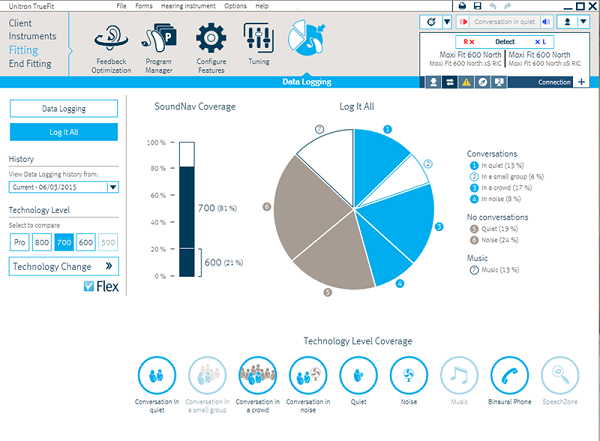
Log It All is just one innovation in a package of three that Unitron has introduced. They have also made solutions called FlexTrial and Flex Upgrade available. FlexTrial is a special set of hearing devices that can be customised for your loss and set to work for a week or two, the Flex Upgrade solution allows the professional to set the FlexTrial devices to any technology level you would like.
In simple terms, if you would like to experience the benefits that the Unitron North 800 would offer, the professional can configure a set of FlexTrial hearing devices to that level of technology and allow you try them for a week or two. This alone is of real benefit for people who are trying to make a decision, however, Log It All improves upon this.
Basing Your Choice On Real Time, Real World Information
It works in the background during the trial period, gathering real-time and real-world data on the sound environments that you face on a daily basis. At the end of the trial period, the hearing care professional can query the feature and show you the data as it presents it. Explaining the different soundscapes and what they mean. It is displayed visually in an easy to understand manner.
As we said, the data is completely based on your experiences during the trial period, so it makes custom recommendations for you. Recommendations that are based on your lifestyle needs. This is what dramatically changes things, for the first time, you can make decisions on actual real world information. Not a question and answer session. You can understand clearly what a hearing aid feature will do for you in the real world and why you might need it.
A Massive Step Forward For Hearing Aid Buyers
We think that this is a massive step forward for both hearing aid buyers and the professionals who provide them. So do some of our professional colleagues as you can see from this story from a Glasgow hearing clinic. We believe that this technology gives the professional a very clear understanding of what a customer faces on a day to day basis. It allows them to collaborate with a customer on choosing the right hearing solution based on concrete, factual information.
Clear, Independent, Factual Information
It also allows you to experience the hearing aid technology in real time and real life, what else could be better? This groundbreaking and unique innovation allows customers to become truly involved in the decision-making process for buying hearing solutions. It also offers you clear and independent, factual information on what your lifestyle needs are, what you might need in hearing aid technology and why. So the next time you are thinking about buying hearing aids, why don’t you ask about Log It All?
If you are looking for good, independent hearing aid advice, you should check out our e-book. It details the types, pros and cons, technology levels and features of hearing instruments in clear and easy to understand language. We think that you shouldn’t buy a hearing aid without reading it first.
If you like what you see, share it so others can benefit
I read a good article today by Geoffrey A. Fowler on the Wall Street Journal. He was talking about modern TVs and their rubbish audio. In essence he said that if you can’t hear the TV, the fault may not be your ears, it could be a combination of bad speakers and bad sound balancing on TV shows. He also made some suggestions for making the Audio better which included some after market add ons. It got me thinking though, sometimes even if your hearing is at fault, it might not be time for hearing aids, let me explain.
I regularly meet people in my clinic that talk about the TV being a major bone of contention. Everyone complains I have it too loud! This really is a big sign of hearing loss, however, the audio on TVs seems to have got that bad that it seems you don’t need a huge amount of hearing loss to have problems.
Watching the TV really should be a pleasure, it is one of the few things that people still do as a family. So when it is difficult, it is just one more event, one more activity in the life of somebody with hearing loss that is diminished. What I have noticed though is that more and more people who come and see me have very mild hearing loss issues. This is a good thing as far as I am concerned, it means that people are aware of their hearing and at the early signs of trouble they are finding out what is going on. But, it leads me to this:
Yes, You Have Hearing Loss, Nope, You Don’t Need Hearing Aids
I often say to people yes you have a hearing loss, explain it to them and why it is causing some issues with the TV and elsewhere and then tell them no, I don’t think you need hearing aids. Why? Because their hearing loss is at the very high frequencies only or it is in the high frequencies but very mild.
Surprised? You think we rub our hands together with glee anytime we see a hearing loss don’t you? Well, we don’t, not even when it is a hearing loss that needs hearing aids! But why Geoff? I hear you asking. Well it is simple, yes you have a loss, but it is either too mild or to frequency related to aid. It is as simple as that. It doesn’t mean that the loss may well give you some problems, it might.
A hearing aid might not be for you, but there still may be some help with that TV
And, if you are someone with one of the latest ultra thin TVs, it will probably affect your TV listening. But a hearing aid is not the answer for you. That doesn’t mean there isn’t something that can help. That is where we come back to the article by Mr Fowler. He had some really excellent suggestions for after market add ons that may well help you with that irritating problem.
Mr Fowler spoke about using speakers to help, in fact he spoke about soundbars in particular. One he mentioned caught my attention, the $250 Zvox AccuVoice AV200 is a basic soundbar that incorporates sound-processing technology similar to hearing aids. He said “In my tests, the speaker made voices louder and clearer than my TV speakers alone”. He also remarked that purchasing one from Amazon comes with a 60-day return policy that should allow trialling with confidence.
I think this is something I will look into in the future in a deeper way myself. Like I said, I am seeing this regularly and I can’t really offer a solution, I usually just explain the situation and talk about getting some decent speakers. I would like to be able to offer them myself, I mean, I am the hearing guy right?
I read a good article today by Geoffrey A. Fowler on the Wall Street Journal. He was talking about modern TVs and their rubbish audio. In essence he said that if you can’t hear the TV, the fault may not be your ears, it could be a combination of bad speakers and bad sound balancing on TV shows. He also made some suggestions for making the Audio better which included some after market add ons. It got me thinking though, sometimes even if your hearing is at fault, it might not be time for hearing aids, let me explain.
I regularly meet people in my clinic that talk about the TV being a major bone of contention. Everyone complains I have it too loud! This really is a big sign of hearing loss, however, the audio on TVs seems to have got that bad that it seems you don’t need a huge amount of hearing loss to have problems.
Watching the TV really should be a pleasure, it is one of the few things that people still do as a family. So when it is difficult, it is just one more event, one more activity in the life of somebody with hearing loss that is diminished. What I have noticed though is that more and more people who come and see me have very mild hearing loss issues. This is a good thing as far as I am concerned, it means that people are aware of their hearing and at the early signs of trouble they are finding out what is going on. But, it leads me to this:
Yes, You Have Hearing Loss, Nope, You Don’t Need Hearing Aids
I often say to people yes you have a hearing loss, explain it to them and why it is causing some issues with the TV and elsewhere and then tell them no, I don’t think you need hearing aids. Why? Because their hearing loss is at the very high frequencies only or it is in the high frequencies but very mild.
Surprised? You think we rub our hands together with glee anytime we see a hearing loss don’t you? Well, we don’t, not even when it is a hearing loss that needs hearing aids! But why Geoff? I hear you asking. Well it is simple, yes you have a loss, but it is either too mild or to frequency related to aid. It is as simple as that. It doesn’t mean that the loss may well give you some problems, it might.
A hearing aid might not be for you, but there still may be some help with that TV
And, if you are someone with one of the latest ultra thin TVs, it will probably affect your TV listening. But a hearing aid is not the answer for you. That doesn’t mean there isn’t something that can help. That is where we come back to the article by Mr Fowler. He had some really excellent suggestions for after market add ons that may well help you with that irritating problem.
Mr Fowler spoke about using speakers to help, in fact he spoke about soundbars in particular. One he mentioned caught my attention, the $250 Zvox AccuVoice AV200 is a basic soundbar that incorporates sound-processing technology similar to hearing aids. He said “In my tests, the speaker made voices louder and clearer than my TV speakers alone”. He also remarked that purchasing one from Amazon comes with a 60-day return policy that should allow trialling with confidence.
I think this is something I will look into in the future in a deeper way myself. Like I said, I am seeing this regularly and I can’t really offer a solution, I usually just explain the situation and talk about getting some decent speakers. I would like to be able to offer them myself, I mean, I am the hearing guy right?
I have seen a few people with dry itchy ears lately, sometimes life can be like that. It’s like buses, you don’t see one for ages and then the next thing you are falling over them. The question arises consistently, are my hearing aids making my ears itchy? The answer isn’t usually a simple yes. More often than not it is a yes, no maybe? Let me explain.
First Time Users Itch
Haha, it sounds like some sort of nasty medical complaint doesn’t it, “Mr Smith, sit down, I have something terrible to tell you, You have first time users itch!” Many hearing aid users complain of Itchy ear ear canals from time to time and it is a relatively common complaint. It often seemed to me though that if someone was going to have a problem it would be at the beginning. It makes sense, more often than not this is the first time that they will put anything into their ear canal for long periods of time. There has to be the potential for a bit of irritation. This type of itch normally settles down, if it doesn’t refer to your professional. There are creams that can solve the issue for most people.
The Seasonal Itch
Sometimes during the summer, when moisture levels can get a bit high, some hearing aid users begin to develop an itch. In this case it is usually as a result of higher moisture levels in the ear canal and the effect of the hearing aid being in contact with the ear canal. So yes, in this case, the hearing aids are a part of the problem. Again, refer to your professional and get some cream.
The Dry Skin Itch
Some people just have dry flaky skin in their ear canals, by that I mean excessively dry. Often these people don’t seem to produce much if any ear wax. In general, people with this issue always have itchy ears. Wearing hearing aids can sometimes make it a bit better, or, sometimes make it worse. The hearing aids trap moisture in the canal and that can help to relieve or exacerbate the problem somewhat. There isn’t any fast or hard rules on this one.
This type of dry skin can be a real problem, it is akin to a form of eczema and depending on how severe it is, the effects can range from unpleasant to downright painful. One of our Independent hearing healthcare providers in Leicester wrote a great article a while ago about someone with a bad case of dry itchy ear. She advised the gentleman to use Almond oil every day to help condition the skin in the ear canal. The gentleman involved had this to say:
“Following only two visits to successfully clear my ears with the hoover instead of the more intrusive water procedure, there was a vast improvement. The first visit was in July 2015, second visit in September 2015. Her advice on using Almond Oil, on a daily basis, was the secret to success. What a difference! my last check up was December 7th 2015, and both ears were beautiful and clear, no red soreness, no skin peeling off, and no excessive wax.”
In this case, the simple use of Almond oil made a huge difference to his condition. So if you do suffer with this type of dry skin problem, you should definitely think about trying Almond oil. There are several reasons why your ear canals might be itchy. Cleaning your ears too much is one of them, ear wax is there for a reason, if you clean your ears too much, it can cause the skin to become dry and itchy.
Nothing is Ever Easy!
However, too much earwax in your ear can cause the same problem! Nothing is ever easy. If that’s what ails you, schedule an appointment with your professional for ear wax removal. It is important that you try to keep the moisture balance in your ear canal right. Excessive moisture can serve as a breeding ground for bacteria and fungi, which can lead to an infection in your ear canal.
A fungal infection in your ear canal can be a really difficult thing to move. It tends to be a stubborn one to get rid of. No matter what you are using to help you with itchy ears, try to only use it at night, this should help keeping the stuff away from your hearing aids. More often than not, hearing aids don’t mix well with oil or creams.
Allergic?
It doesn’t happen very often, but some people can be allergic to their ear-moulds. I have never seen this happen with acrylic moulds, but I have seen it happen with silicone ear-moulds. For some reason, some people are simply allergic to the silicone. Many Receiver in Canal devices and open fit hearing aids use an instant tip made out of soft plastic or silicone. In very rare occasions I have seen people have a reaction to them. If you are one of the people who are allergic, talk to your professional and get another ear-mould or ear-tip solution. Acrylic type moulds should solve the issue.
If you like what you see, share it so others can benefit
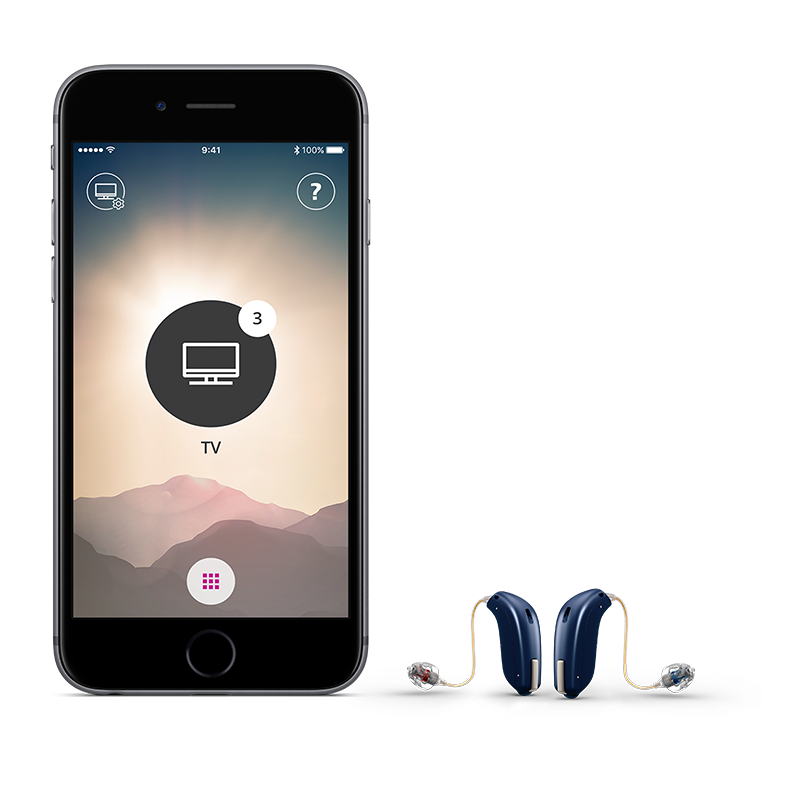
In my last article I discussed the Widex Beyond and the prolems it is having with the iPhone. In this one, we will take a look at the Oticon Opn, which is having similar difficulties. In fact the online forums and in particular the Apple community forum is abuzz with the issue. As with the Widex Beyond, the problem isn’t really the hearing aids, it’s the iPhone. Which is a shame, this is another case of a fantastic set of hearing aids being let down by a separate technology, just like the Widex Beyond.
About a month ago we became aware of a lot of issues around Made For iPhone hearing aids and connectivity to the iPhone. We have been researching the issues ever since. The issues reported with the Oticon Opn are similar in nature to the issues reported with the Widex Beyond. All of the problems seem to be related to the Bluetooth pairing of the hearing aids to the iPhone. During transmission of audio from the iPhone, it appears that the audio signal is dropped constantly by one aid or, it seems that the signal may jump from one ear to the other for no apparent reason.
Where there was a consistent signal to both hearing aids, it seemed that the call audio was of really poor quality. The other complaint was described as the stuttering or fluttering of the signal, like it was dropping and connecting again very quickly. In the case of the Oticon Opn, the problem seems to be particular to the iPhone 7. Again though, it may be specific to the ios version that is being run, not just the hardware. For instance, take a look at what Erin says on the Apple Community:
Hi there! I was wondering if anyone has recently updated to a new iPhone 7 who own Oticon Opn hearing devices? I previously purchased my Opns at the same time that I owned an iPhone 6s and had no trouble with the Bluetooth connectivity and features. Now that I’ve updated to an iPhone 7, I seem to have lost the ability to connect my hearing aids to my phone. This is problematic since I mainly purchased the Opns for the Bluetooth functionality. Let me know if you’ve found a workaround, or had any similar troubles. Thanks, Erin
However, Scott said that he had found a workaround and it seemed fine for him:
I’ve found that re booting my iPhone 7plus, then opening the battery compartments on my Opn MiniRites results in a good connection. I just paired my iPad mini2 to the MiniRites last evening following the same procedure. I use the Oticon Opn app on the phone and the iPad.
But many others are having serious problems, having to re-boot their hearing aids or their iPhone several times a day.
I purchased the Oticon OPN Minirite’s last October and to date I have had nothing but issues with Bluetooth pairing. I purchased the Oticon’s based on my positive experience with my first Oticon hearing aids, but that was 10+ years ago and BT was not a factor then. I have had the firmware update, gone the multitude of steps I have been given and frankly to have to redo the pairing multiple times a day is unacceptable
More Great Hearing Aids That Don’t Work With The iPhone
So it seems we have another fantastic hearing aid platform that just will not work well with the iPhone. There are numerous discussions across the web all detailing similar issues and problems. The real key here is that the Oticon Opn is a really outstanding hearing aid. The feedback from users and professionals alike is that the devices are outstanding. In fact when you look at all of the negative reviews, very few talk about any problems with hearing well. All of the issues are with the connection to the iPhone and many of the issues appear to be problems with the iPhone 7.
The Problem is The iPhone
There has been a great deal of articles written about the problems that the Apple is having with Bluetooth connectivity on the iPhone 7. Not just with hearing aids but with all types of Bluetooth hardware like Car Radios, Speakers, Headphones etc. The word out there is that it is a software issue and a new update to IOS will sort out the problem. I think we will have to wait and see.
Firmware Update of the Opn
If you are having problems with the Opn, it is advised that you ensure your hearing aids have the very latest firmware update applied. At present, and unlike the Widex Beyond devices, you will have to attend your Audiologist to have that update applied. The Opn app does not support the update of the hearing aids firmware via the app. Hopefully, Apple will push out the IOS update and all will be well.
Phonak’s recent innovation may point to the future of hearing aids
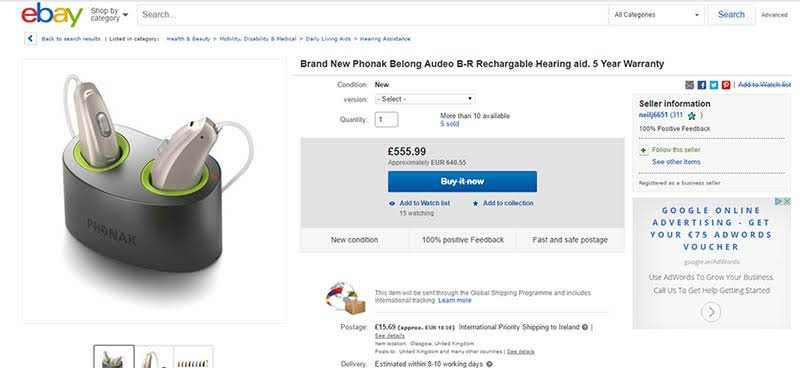
Phonak’s new rechargeable hearing aid range have proven immensely popular, in fact far more popular than even they thought they would be. It has left them scrambling to keep up with demand and I would say production schedules have probably been at least doubled. To be honest, we think Phonak has a real winner here, but what does that mean for the future of hearing aids?
The hearing aids industry is like an arms race, when one hearing aid manufacturer delivers something unique, a new innovation, every other manufacturer responds with their own version. That is how it has always been and how it will always be. So what will the apparent success of Phonak Lithium-ion rechargeable hearing aids have on the wider market?
Rechargeable hearing aids have been around for a while but some issues stopped widespread adoption
Rechargeable isn’t new
Rechargeable hearing aids are not new, Hansaton and Siemens have both been providing them for many years. GN Resound dipped it’s toe into the water many years ago with the Pulse hearing aid. Unfortunately that was an unmitigated disaster for them which was a pity. The system was really over designed and the problem was in the charger which failed with monotonous regularity.
The problem up to now has been the capacity and life of the battery technology available. You would be lucky to get through a full day of use, in particular if you used streaming accessories. They also had to be replaced once a year because they lost their ability to hold a charge. So up to now, they have really only been a novelty that most hearing aid providers stayed away from.
Lithium-ion changes the game
The introduction of Lithium-ion changes the game, the capacity and life is increased exponentially meaning that 24 hours of use is no problem and replacement will be few and far between. I believe that this will give hearing aid providers the confidence to recommend the devices, that will have a huge impact on uptake. Not just that, consumers will be hungry for what these type of devices represent and that is freedom.
Increased battery capacity and longer life changes the game and consumers will be hungry for what these type of devices represent and that is freedom.
Experienced users hate disposable batteries
It is a simple fact, most experienced users of hearing aids hate disposable hearing aid batteries. They are fiddly things to change and a regular cost for them. Okay, the cost is negligible, but it is a cost nonetheless and one that many would be glad to be rid of. Rechargeable hearing aids will mean less cost and less worry about the battery suddenly dying while they are out and about, something that happens often enough to be an irritant.
Consumers will want the joy of rechargeable, we guarantee it
Many of the hearing aid manufacturers know this, however, battery tech was not really good enough to do anything about it. With the introduction of Lithium-ion battery tech is now good enough. With the hype around and the seeming success of the Phonak product, I think you can bet every manufacturer is figuring this into their product road maps.
Rechargeable BTEs
I believe (and this is just an educated guess) Phonak will be looking at introducing a rechargeable BTE with their next Bolero range. It makes perfect sense to do so, and if they hadn’t already thought about it, the success of the Audeo B-R will be focusing their minds.
Size does matter, at least in the hearing aid industry, rechargeable custom hearing aids will be a complex proposition
Rechargeable ITEs will be the battleground
As I said, the success of the Audeo B-R will probably be focusing many minds in the hearing aid industry and I expect to see many new rechargeable variations introduced in the future. The real battle ground will be in custom hearing aids, providing a rechargeable option in a custom hearing aid will be a complex problem. Consumers (that’s you) want them small, the smaller the better! Size does matter, at least in hearing aids. Every ear is different, so to provide a rechargeable option that is small, will fit in every ear and still be functional is a complex problem.
I think it is a problem that many R & D departments are probably working on though.
This is the second part of my review of my new GN ReSound LiNX 3D 9 hearing aids –this discusses the sound quality and ability to hear.
A Natural Sound Experience
You shouldn’t really notice that a good hearing aid is in your ear. By that I mean: if a hearing aid is working really well you should be hearing comfortably in all situations and you shouldn’t notice the hearing aid doing anything other than delivering a natural sound to you.
Ignoring all other features of a hearing aid, the core thing it needs to get right is giving you speech recognition and sound quality when you need it, so that’s what this part of the review is about, I’ve tested my new LiNX 3D hearing aids in my normal everyday environments and here’s what I thought:
Annoying background noise……gone
This was a bit of an eye-opener for me, the LiNX 3Ds fixed a problem that I never realised I had: being bothered and not understanding speech so well due to background noise. And by background noise I don’t mean obvious noise problems like the din in a noisy restaurant, I mean everyday ambient noise like the humming of a computer fan, people’s shoes clacking on the floor, cars going down the road. It wasn’t till I started wearing the LiNX 3Ds that I realised I was being bothered by these sounds before, I was hearing them quite loudly in some situations and that was affecting my ability to hear speech.
Now, my everyday environments just seem so much more peaceful and relaxed – I’m hearing clearly things I want to hear and am not constantly getting an annoying low-level background of noise like I used to. A couple of times during the first few days of switching to the ReSound aids I had to click my fingers near my ear just to make sure they were still switched on!
I used to really enjoy taking my hearing aids out for a few hours during a day just to have a break from listening and get a bit of peace and quiet – I don’t really feel like I need to do that anymore.
Confused About The Right Hearing Aid For You?
Our buying guide, easing the confusion with clear easy to understand info, we guarantee it will help you pick the right hearing aid for you.
Discerning who is talking in a group
Working out which direction a sound is coming from is a classic problem for the hard of hearing and hearing aid wearers. In group situations I often found myself hearing some words fine but not being 100% sure who said it – so I’d be quickly looking around the group to see whose mouth was moving.
The LiNX does a good job here, it’s directionality features do a great job of focusing on sounds right in front of me but also giving me good hearing ability from all directions. This means that if I am looking at the person speaking to me then they are coming through loud and clear – but also if someone behind or to the side of me talks then I can pick them up and I know where they are. The hearing aids seem to deliver fantastic spatial awareness, again something I didn’t really realise I was missing out on.
Speech quality and recognition (in noise)
It’s quite a bit better than before, not a massive change but better. Voices sound similar to how they did before but I can now pick up some accents, which due to my severe hearing loss is not something I have been able to do for a while. Seems like an odd thing to write but since I haven’t been picking up accents for so long it is kind of cool to suddenly hear them. I’m also able to listen in on other conversations now! Great for anyone who is nosey. I’m writing this from a Costa and the guy on the next table is (probably) from Holland and is having a job interview for a sales position – I would never have been able to tell you that before.
Male voices sound a bit less gruff now – they used to sometimes be a bit muffled, deep and gravely. It’s not like men now sound like a Disney princess but the mid-to-high tones in their voices are definitely more prominent now – which makes them easier to understand.
Fantastic Speech in Noise Quality
Hearing and understanding speech in noisy situations, like a bar or restaurant, has been troublesome for me for many years – back when I had only a minor hearing loss it was pretty easy but as my hearing has got worse the problem of speech in noise has got worse. The ReSounds are giving me the best speech in noise ability I’ve had for years, it is still difficult to concentrate on people, but with a loss as bad as mine I always expect that – the directionality helps a lot, the noisy crowd fades away just about enough and the person in front of me gets the focus. I could probably do even better here if I switched to a programme that focused purely on the sound right in front of me and blocked out more from other directions – I will ask to get that added and try it out.
One situation that is vastly improved for me is being in the car. I cannot overstate what a difference there is for me here. I used to have a lot of trouble hearing people over the road noise and if a window was open or the stereo was on, the conversation was a no-go. Road noise is now a thing of the past, even with the window open it is reduced to a faint background noise that I can easily hear words over – I’m comfortable now talking to people whilst travelling. That is important to me because my time spent in the car with my family is no longer dead time, I can actually have a chat.
Noise reduction, in general, has been excellent, it works seamlessly and even with something really noisy, e.g. lawn mower, I can still hear other things, so the noise cancelling is cutting out the loud sounds but still letting voices and other things tones be heard. This is quite a step up in noise-cancelling tech, I’ve worn a few aids over the years where the loud sounds would be reduced enough to be comfortable but voices and everything else would be reduced too.
Music
As my hearing loss progressed I more or less gave up with music as it mostly sounded pretty awful and anything busier than Brandt Brauer Frick quickly gave me a headache.
Having My Music Back
LiNX 3D is giving me the music back. Busier and noisier tracks do not sound garbled like they used to and don’t give me a headache (although some of the guff my daughter listens to would give anyone a headache). I can now pick up most of what is being said on the radio and listening to music is enjoyable again.
The real game-changer when listening to music was using GN Resound’s streamer to transmit tunes straight into my hearing aids, more on this in the next review. This stuff rocks!
Summary
The ReSound LiNX 3Ds are delivering a great quality of sound across the board. Speech sounds natural to me but also clearer, sharper and easier to understand. Hearing in very noisy environments is still a challenge for me due to my severe hearing loss but they are definitely the best performing hearing aids I have had.
Our readers like to keep us on our toes here, test our knowledge. A while ago we wrote a post about the best invisible hearing devices, but we didn’t really speak about power output. Recently one of them asked which was the most powerful IIC (Invisible In Canal) or invisible hearing aid. To be honest, I couldn’t tell him off the bat because I don’t have much interest in these hearing instrument types. So, I had to do some research, I love research!
Hearing Aid Prices
Just to be clear, we don’t set prices here and they differ from Practice to Practice across the World so our expectations aren’t binding, they are just a guess and some research. Always remember, we all like to shop around, but always be clear about what is being delivered. You will need care and support, make sure you will get it. You will also need your hearing aid validated or verified to get the best experience, paying a little more to ensure your experience is good, is not wasted money. That’s our price rant for the day over, let’s talk about the devices.
The Most Powerful IIC is
To be honest with you I had a sneaky suspicion that Starkey would be the winner in this race. However, I was wrong, (oh my God Geoff, hang your head in shame!) in the case of this particular question, our reader was actually asking me which invisible hearing aid covered the most or largest hearing loss. That honour seems to go to the Insio Primax IIC from Signia (formerly Siemens).
An IIC For Severe Hearing Loss
The numbers on the Insio Primax mean that it is an invisible hearing aid that comfortably covers severe hearing loss. It covers from 90 dB (HL) in the low frequencies down to 110 dB (HL) in the high frequencies. That is pretty amazing coverage for something this small. It is rated at 65 dB gain topping out at 124 dB which means that it can deliver a lot of sound.
Those numbers though are on the outside edge of it’s ability and the coverage can only be taken into account for someone with a sensorineural hearing loss. Conductive losses need much more power to achieve results. In other words, if you had a conductive loss that fell within the hearing aids fitting range, because of the extra power needs the hearing aid may still not be suitable for you. Let’s take a deeper look at the Insio Primax IIC and how much you might pay for it
Signia
Insio Primax IIC
Signia Insio IIC Prices
We would expect the range depending on technology level, to be sold at prices from £1200.00 to £2200.00 in the UK depending on the Practice and location. We would expect the range to be sold at prices from €1200.00 to €3000.00 in Ireland. We would expect the range to be sold at prices from $1200.00 to $3200.00 in the USA.
Looking For an Invisible Hearing Aid? Visit Your Local Hearing Pro
Arrange a consultation with a trusted Independent hearing healthcare professional in your area
As I said, the Insio has bragging rights for the being the most powerful invisible hearing aid. Siemens / Signia introduced the Insio Primax IIC last year as part of the Primax introduction. It is rated to cover hearing losses well into the severe range which is quite unusual for an invisible hearing aid. It is available in three levels of technology the 7px, the 5px and the 3px. The Primax technology has been exceptionally well received around the world and there seems to be fantastic user feedback on the devices.
Wireless Invisible Hearing Aid
The Insio Primax is also a wireless invisible hearing aid.
The invisible hearing aids are pretty decent hearing aids, but they have their pros and cons. We have general details about hearing aid types including the hidden hearing aids and other types of devices in our consumer hearing aid buying guide. It also details technology levels and features of hearing instruments in clear and easy to understand language.
Moderate Levels of Hearing Loss For Others
Most invisible hearing aids will only cover down to a moderate hearing loss, it is a function of their size and placement. However, some are powerful enough to cover some losses into severe like the Starkey SoundLens Synergy. Even that really only covers down to 80 dB (HL) in the low frequencies and 100 dB (HL) in the high frequencies. Those numbers are the outside edge of the devices ability and the same rules apply for conductive hearing losses as before.
Comfortable With Fitting Them
The fitting range is not always the whole story here though, as you can probably guess from my comments about conductive hearing loss. Most providers would like to keep you well within the fitting range of a hearing aid. This strategy is designed to protect you, it means that there is plenty of wiggle room if your hearing loss progresses over the life of the hearing aid.
Protecting Your Customer’s Investment
Many years ago when I first started fitting hearing aids the rule of thumb was keep the hearing loss in the centre of the fitting range. Generally though we would be happy if the actual hearing loss was anything between 50 and 75% of the fitting range. Again this allowed us that all important wiggle room. Generally hearing loss doesn’t suddenly get worse from year to year or progress more than 10 to 15 dB over a few years. But hell, you never know so you protected your customer’s investment.
Choosing The Right Hearing Aid For You
So, the answer to the burning question has been given, however, I wouldn’t be happy until I gave my two cents. When you are choosing a hearing aid that is right for you, you need to balance up more than the fitting range. You need to think about a couple of things like:
Dexterity, have you got the dexterity to manipulate it and put the batteries in?
Clean and Care, do you have the discipline to ensure you follow a good clean and care routine?
Reliability, do you understand that some hearing aids types are more reliable than others?
Longevity, if the aid is running on max power are you happy that it may not be suitable for long?
Discretion, do you know that absolutely no one gives a toss that you are wearing a hearing aid except you?
Hey, if you answer yes to all of those questions then you are making an educated choice and my work is done here. I am still sticking to the advice buy your ass a BTE! As usual, any questions, don’t hesitate to contact us, even better buy our book! It really is a great guide to hearing aid types and technology, don’t believe me, someone even left a review!
If you like what you see, share it so others can benefit





 Itshearingaidknow