A possible new treatment for acute or sudden sensorineural hearing loss has showed promising results in animal trials. The company now hopes to press forward in their research with the end goal of developing a possible human treatment.
Sensorion, a French biotechnology firm has announced promising new preclinical results obtained with its investigational drug SENS-401. The drug is currently under development to treat acute or sudden sensorineural hearing loss. The results were presented at the Annual Meeting of the Society for Neuroscience (SfN) in San Diego, California, last week.
In the proof-of-concept study, animals were exposed to 120 dB of noise for two hours, then randomly treated over a forthnight with either a placebo or increasing doses (5 mg/kg, 10 mg/kg and 20 mg/kg) of the experimental drug.
After the 14 day treatment period, the placebo group had recovered an average of 7.1 to 12.9 dB, while the treated group had recovered an average of 20.8 to 29.2 dB. They reported that a dose-dependent effect was also observed, with greater recovery at the highest doses of of the drug compared with the lowest dose or placebo.
“On the basis of these positive results, we intend to continue the clinical development of SENS-401 in this particularly-debilitating pathology for which there is currently no effective treatment,” said Sensorion’s Chief Medical Officer, Pierre Attali.
Sudden sensorineural hearing loss is defined as the onset of unexplained one-sided hearing loss of more than 30 dB in three sequential sound frequencies in less than 72 hours. It strikes an estimated 5-20/100,000 persons per year.
While some sufferers spontaneously recover their hearing, many do not. The treatment at present for SSNHL is a tapering course of oral corticosteroids (prednisone or methylprednisolone). However, it is only effective if the condition is diagnosed early and treatment is undertaken immediately.
It is imperative for recovery that the treatment with steroids is undertaken quickly and there is only a short window or period of time to do so.
If you like what you see, share it so others can benefit
Update: 05/10/2018: Today, the FDA announced the approval of the “Bose Hearing Aid”, a new self-fitting hearing aid. Bose has been granted an unprecedented position by the FDA, the FDA has given Bose permission to market their new Bose Hearing Aid as a self-fitting hearing aid. The regulations governing this type of device do not exist and right this minute the over the counter (OTC) hearing aid regulations have not yet been finalized. More to follow.
BOSE have introduced a very interesting new wireless headphone product called Hearphones. Hearphones do much more than just allow you to listen to your music or phone calls. They also combine two hearing aid technologies, active noise cancellation and directional microphones, to help wearers hear better in noisy environments. While the devices certainly don’t fall into the category of hearing aids, it looks to me like a first tentative step into the hearing aid space. Let’s take a look at what the products are.
What is it
So, first off the device is a set of wireless earbuds or earphones type device not unlike many other wireless headphones. The earbuds are connected to a reverse collar, which is similar in nature to many found on most wireless sets. The collar contains the BlueTooth radio, the rechargeable battery (they say good enough for ten hours) the power button and finally battery level indicators.
As with all wireless headphones they can be paired with any BlueTooth enabled mobile devices, allowing you to stream audio to hear music or make phone calls. BOSE has placed a remote under the right earbud which is used to control the Hearphones features. It’s the features and the accompanying app that has brought the devices to the attention of many within the hearing aid world. Bose is known for its noise-cancellation technology, but with Hearphones, they have done it differently.
Users can pick and choose what outside noises they want to hear instead of the norm which is to block everything out entirely. Bose says ‘Focus, amplify or reduce real-world sounds to the level you want.’ It even boasts the headphones can help with everyday chats. ‘Active Noise Reduction improves the listening comfort of conversations and takes the edge off the background noise.’
Listen to the world your way
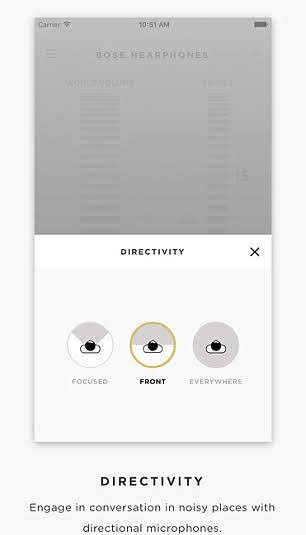
The HearPhones can be used to listen to the ambient sound of the situation you are in, as I said they have directional microphones which allows a user to use the product to focus them in different ways to help them follow conversations. This feature also allows the active noise reduction to reduce noise from different directions.
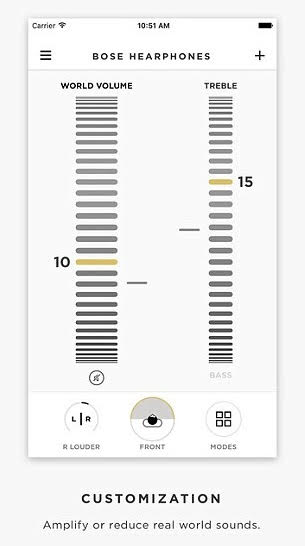
While you can control the features from the small inline remote under the right ear bud, the real power is delivered by the app. The Bose Hear app lets users customise sounds and create different presets for various environments that you may go to regularly.
On the images above you can see that the user can change the direction of the focus, volumes and ambient sound levels. In the directionality feature Focused is designed for one-on-one conversation, Front is for talking with a group and Everywhere lets you hear sounds in all directions. It is interesting to see that you can also change the balance of the sound using simple treble and bass.
Bose has even provided what they call a Boost function, which gives emphasis to high-frequency sound. It makes perfect sense to do so, most sound systems would have the ability, but being able to turn the treble up may well help with clarity for someone who has a mild to moderate high-frequency loss.
Not deaf enough
Let me explain that a little bit deeper, some people attend my clinic and they do indeed have a hearing loss. However, while it may be mild or indeed moderate it is in the higher frequencies only such as 4k or 6k and 8k. They are having some problems, maybe in really noisy situations or with the TV, but they aren’t necessarily candidates for treatment with hearing aids.
I often tell these people to adjust the treble on their TVs and sound systems to deliver more clarity for them. It will work up to a point, however, it makes their experience better. For people like these, I would most definitely consider talking to them about a product like HearPhones. Well back to the app and the product
Different presets
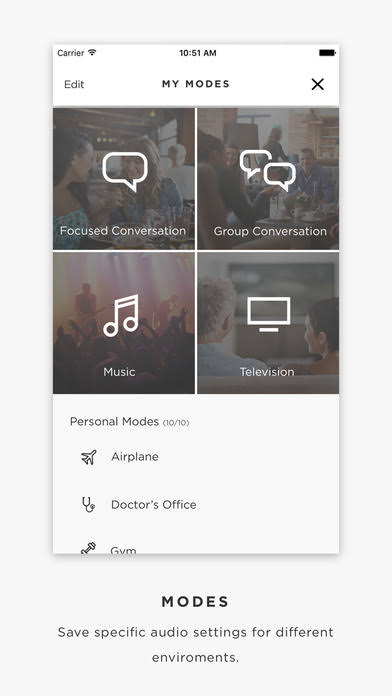
There are different preset modes on the app so you can quickly choose a mode that best fits your situation. Each mode delivers different directionality and sound options. These settings seem to include, focused conversation, group conversation, music, television, airplane and doctor’s office among others. It appears these presets are designed with the optimum functionality of directionality and noise cancelling for the different situations.
Not on sale
The device is not yet on general sale, and only available to try at a series of ‘exclusive events’ at the company’s HQ for the moment. However, I think BOSE are taking this quite seriously and I would expect to see them go on sale soon enough. BOSE has recently advertised for a research Audiologist to join their R&D team, I think BOSE are probably focused on how they can expand this idea.
BOSE hearing aids?
Will we see BOSE hearing aids in the future? I don’t know if they will consider delivering mainstream hearing aids. HearPhones kind of fall into the personal amplifier market, expanding within this market would probably make more sense for BOSE. It is quite a large market which doesn’t involve nearly as many FDA hoops to jump through. While there have been many new entrants to that market, none have necessarily really dominated it.
Funnily enough though, with the advent of Here headphones, a whole new market has begun to open. For simplicity purposes, we will call it augmented reality. In essence Here and Bose with HearPhones are offering devices that allow you to adjust and augment your audio reality. It seems that this is attractive to more than just people with some hearing loss.
A solution for people with mild to moderate high frequency loss?
Are they a solution for people with mild to moderate hearing loss in the high frequencies? I would have to say they probably are2, they might not be an ideal solution but I think the appeal is in the multiple functionality of the devices. They will give a boost to clarity, they will actively suppress noise and the added directionality will make a real difference in noisy situations.
They will also allow you listen to music and talk on your phone, what’s not to like? If and when the products become available in the market I would be interested in testing them out, I have a high frequency hearing loss and I wear a set of hearing devices. However, my loss is such that if I wasn’t in the business, I probably wouldn’t wear them.
I am in that grey area, where I have some problems but I don’t necessarily need hearing aids. I think, that for people like me, HearPhones could be an excellent solution and I would definitely talk to Patients who presented with hearing loss like mine about them.
If you like what you see, share it so others can benefit
I was recently introduced to Patient Insights from Unitron, I had heard about it and thought to myself, “Hey that’s a good idea”. Then promptly went about my business meaning to look into it. Never happened, hey what can I say, I was probably drunk and the early onset dementia is creeping in. Then when we attended Unitron Engage a couple of weeks ago I got a closer and more in depth look at it. I was blown away by it, not just by what it is right now, but what it could become in the future. Let’s talk about it and why I think it will change the face of hearing aid fittings forever.
Be more involved with your hearing care
I think the feature is already a powerful way for you to collaborate with your hearing care professional to improve your experience of and control over your hearing aids. I also think that the feature if expanded in some ways and combined with cloud computing could change the first fit and fine tune of hearing aids forever for the better.
This could result in better first fits and stronger and effective fine tuning of hearing devices, ensuring that the experience with hearing aids is a good one from the beginning. Combined with some user fine tuning ability (yep, that’s you) it could also increase your collaboration with your healthcare professional while also giving you more control, let’s talk about Patient Insights and possible futures.
In effect, it is designed to allow you to collaborate on your hearing care, I know that is not for everyone, but for the frustrated, it is a god send.
What is it and what does it do?
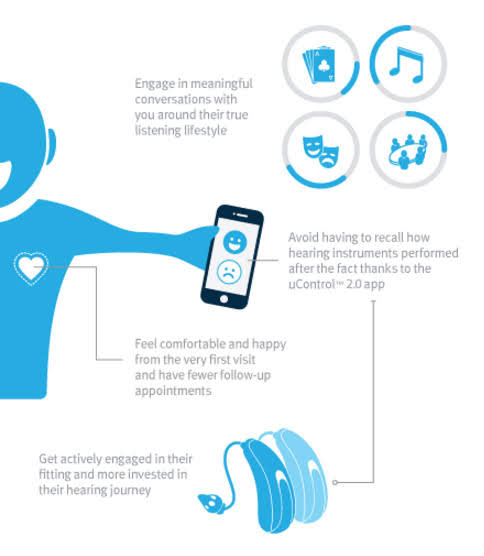
Patient Insights is a feedback system that lives on the U Control app (which can be downloaded on the PlayStore and the App Store) on your smart phone, it allows you to give your own feedback on how well you are doing in the moment with your digital hearing devices and the sound situation you are in. It registers the sound settings the hearing aids are in, and records your comments. It then sends that information to your hearing care professional’s software, allowing them to see exactly what is going on with you in a real-time situation.
In effect, it is designed to allow you to collaborate on your hearing care, I know that is not for everyone, but for the frustrated, it is a god send. It has to be activated and set up by your hearing professional, and of course you also have to have a streamer such as the U Stream or the U Direct and the U Control app on a smart phone. However, I think it is worth the investment and the learning curve.
The benefit to you
I think the current benefits are clear, you are more involved in your hearing care and for the professional, it is reliable feedback in relation to how well you are doing. It also clearly tells them about your experiences in real time situations and flags up what they may need to look at when you go in for follow up and fine tuning. Up to now it has always been difficult for the professional to get good info, the users memory and ability to explain an experience that happened a week ago has always been a problem.
Simply better fine tuning, hearing aids that are better fit for you and a far better experience moving forward
I always asked my Patients to keep a sound diary, giving them headers to record the information under which prompted them to write the things I need to know. This method helped a fair bit, however, if I had access to what the hearing aids were doing at the time, it would have been the second part of the puzzle. It would have been data I would have rejoiced for believe me. It should result in better fine tuning, hearing aids that are better fit for you and a far better experience moving forward.
How Could It Change Things Forever
I recently spoke about the future of hearing devices, I think I will need to update that section pretty regularly. What could Patient Insights mean for the future of hearing instruments? I think a better one, a future of hearing devices that automatically change and upgrade the solution they are providing.
This tech already gathers some good data, but if it was increased to include a detailed picture of the sound environment it would dramatically increase our understanding of the situation you are in. If it was combined with some fine tuning ability on your part, it would also give us a clear understanding of what you did to make your experience better in the moment.
That would be fantastic data, it would allow us to see real time data on preferences, if it was tagged with simple info like speech clearer, more comfortable, it would also allow us to understand what the changes had done for you.
Usable data
If that data was combined with some artificial intelligence in the cloud it would allow the data to be used to change first fit protocols and fine tuning protocols for hearing aids. It would allow decisions about hearing aid features and function be based on real-time data from thousands if not millions of users. I really think that this could change the face of hearing aid fits forever (sorry giddy nerd moment there). The cloud solution could be then used to update the hearing aids on a continuous basis with new and better settings that made the hearing aids better and more customised for the user.
The future of your hearing aids
Unitron have introduced another unique feature here, one that is focused on collaboration and the user experience. However, I think with just some imagination they have also pointed the way towards a possible future for hearing instruments. Right now, Patient Insights is an ideal solution for you to engage with your professional in a deeper and more effective manner.Only the imagination of Unitron and the other hearing aid manufacturers limits what it could be.
If you have a set of Unitron North hearing aids and you don’t have the U Control app, think about getting it sorted out. I think this feature is fantastic during the initial period when you purchase your hearing aids, however, I also think that it has continuous benefit for a user. Let us know what you think, contact us on info@hearingaidknow.com with your own experiences and thoughts.
If you like what you see, share it so others can benefit
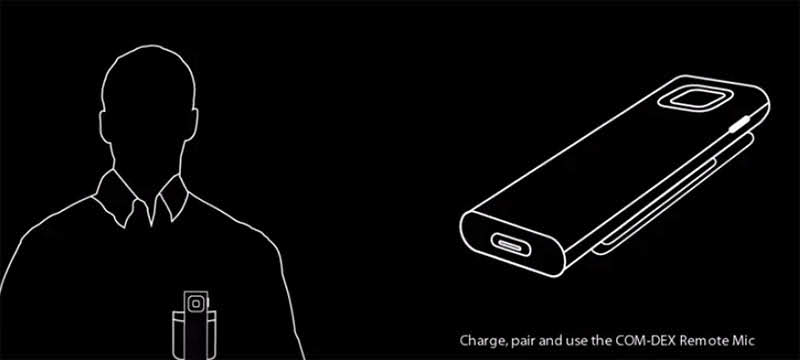
It appears that Widex is finally about to introduce a remote microphone system if a video that came across our desk a couple of days ago is anything to go by. The new Com Dex Remote Mic is probably going to be introduced at EUHA (massive hearing aid conference and exhibition in Europe). It’s about time, it is the only thing that their Dex line up has been missing and no doubt it will be a welcome addition.
Com Dex Remote Mic To Be Introduced
The video details the working and pairing of the new Com Dex Remote Mic and it appeared on YouTube a couple of days ago. The remote mic appears to be quite slim and reminiscent of the Com Dex to which it will connect. As per usual with Widex it appears they have put plenty of thought into the design and functionality of the device. Here is the video:
The device will be a welcome addition to the Dex line up. Remote Mics are fantastic accessories to wireless hearing aids and their ommission in the Dex line up always seemed strange. A good remote mic can mean the difference between hearing in noise and not when you are wearing a lower technology hearing aid. This is something I have discussed before but it is worth saying again.
Everyone would like to buy top of the range hearing aids, however, not all of us can afford it. Buying a cheaper technology level but adding a remote mic to it can be a life saver for people who would like to hear in more complex sound situations. We will keep you updated if and when we hear more about the Com Dex Remote Mic
If you like what you see, share it so others can benefit
Super Power Hearing Aids, Accessories and The Possibilities Inherent in Sensors
I undertook an interview of Dave Fabry recently, he is Vice President, Global Medical Affairs for GN Hearing and ReSound. We had a chat about the new Enzo 3D, the needs of people with severe to profound hearing loss, the use of accessories for hearing aids, the advancement of technology and the customisation of Patient experience and finally the future of hearing aids. Audio isn’t bad, but is a bit rough because it was recorded on a transatlantic mobile phone call.
Dave has been in the profession for many years and he has a deep understanding of Patient needs, the changing face of the business and indeed the technology that is involved. So it was pretty fascinating to shoot the breeze with him.
Focus on Severe To Profound Hearing Loss
In the initial part of the interview we discussed the new Enzo 3D and the commiment of Resound to what is a niche market, people with severe to profound hearing loss. I said that I was consistently impressed with the focus of both Resound and Phonak on this cohort of people. Too often people with severe to profound hearing loss are the very last people to get technology years after it is introduced.
An Ecosystem Approach To Better Hearing
Dave spoke about an ecosystem approach for people with severe to profound hearing loss, meaning not just a hearing aid but easy to use accessories. It is with this ecosystem approach that people with very little residual hearing can excel in their daily life. This is something I want to cover later, because I realised that we have never really done a definitive article focusing on the technology available for people with profound hearing loss.
Changing Technology & Serving The Customer
We also discussed the introduction of Resound Assist and how both I and he felt it helped us better serve the customer (that’s you). Technology like this allows the customer to get ongoing hearing care on their terms and I believe it can only be a good thing for both my customers and I.
Navel Gazing, Sensor Sets, Hearing Aids So Smart They Take Your Temperature
Unfortunately, nerd that I am, couldn’t prevent myself from talking about the future of hearing aids, you can catch that about twenty minutes in. My own pet idea or concept is that hearing aids and sensor sets will evolve in order that we as hearing care professionals will actually help you to monitor your general health.
If you like what you see, share it so others can benefit
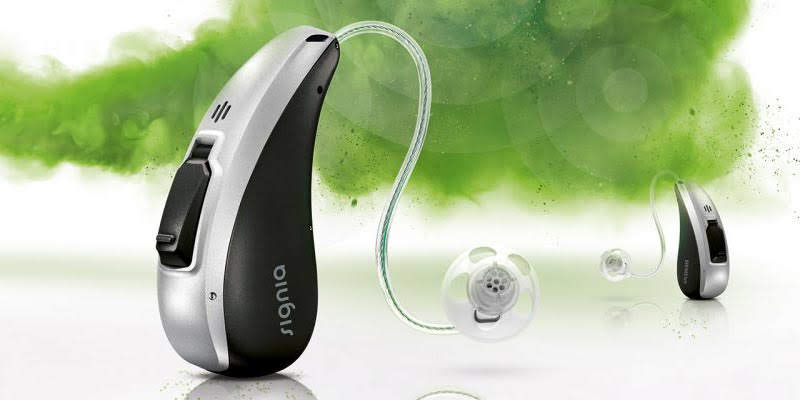
Lithium-ion rechargeable hearing aids are definitely one of the big stories of 2016. They have been exceptionally well received across the industry and by consumers. Signia have just launched their own Lithium-ion powered range called the Cellion. Let’s take a look at them.
Signia, formerly Siemens has been famous for rechargeable options in the past. They are really the only mainstream manufacturer that have offered rechargeable options consistently. However, there was never widespread adoption of the technology by professionals because of the limitations of the battery technology. That of course has all changed with the introduction of Lithium-ion power packs.
Signia
Cellion Hearing Aids
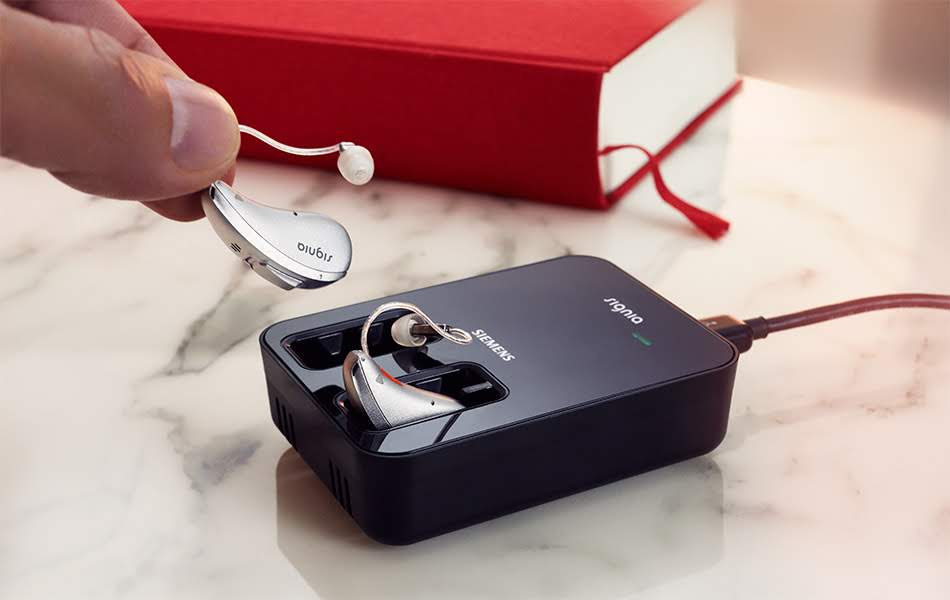
Signia say that the Cellion™ primax™ is the world’s first hearing aid with lithium-ion inductive charging. Inductive charging is undertaken by proximity, so there is no need to line up the hearing aids carefully because there is no contacts. The Cellion devices start charging automatically as soon as they are placed in the charger.
The devices have been designed to be smart, they turn off when dropped into the charger and turn on automatically when they are taken out again. The rechargeable lithium-ion power cell lasts 24 hours straight without charging. The Cellion is a Receiver in Canal hearing aid range and it can be used with a variety of receivers which will allow them to cover hearing losses from mild to profound.
We assume, but are unsure at this stage that the devices will be available in three levels of technology, the 7, the 5 and the 3. The devices are also rated to ip68 which is for all intent and purpose almost water proof.
What are the key features
Rechargeable lithium-ion power cell
Auto on when taken out of the charger
Auto off when placed in the charger
24 hours continuous use with unlimited streaming
Contactless, inductive charging
Unique OneShell design
The inductive charger fully recharges Cellion primax hearing aids in four hours. They say that a full charge will ensure that the hearing aids deliver 24 hours of continuous outstanding hearing with unlimited streaming. LED indicators clearly display the status of both hearing aid power cells. During the charging cycle, the charger will also dehumidify the devices for better care and longer service life.
As we said the devices automatically turn off when charging begins and is reactivated when removed. The power cable for the charger is a simple micro USB connector. It will mean less cables to carry when on the move. It has three LEDs which clearly show the different charging progress statuses. The charger is pretty small and light’ it is no bigger than a business card, that and it’s weight means that it is ultra-portable.
Four hours in the charger will deliver a full charge. A 30-minute top-off if needed will provide seven hours of use. Signia have not designed a specific power pack for the Cellion, however, because of the micro USB connection it will compatible with a host of commercially available power packs for mobile devices. In essence this will probably cut down on the equipment you need, if you already have an emergency power pack for your mobile phone, it will double as a power pack for your Cellion devices.
This is the second manufacturer to enter the fray with Lithium-ion rechargeable hearing aids, but we don’t believe it will be the last. Signia have a lot going for them, in the past Siemens was seen as a catch up company. However, since Sivantos have taken the helm they are very much switching to innovation. The release of the myHearing app with remote fine tuning and fitting facilities is a huge step forward that is sure to be emulated by others. I for one would like to hope that they won’t rest on their laurels and I am fascinated and a little excited by what they might do next.
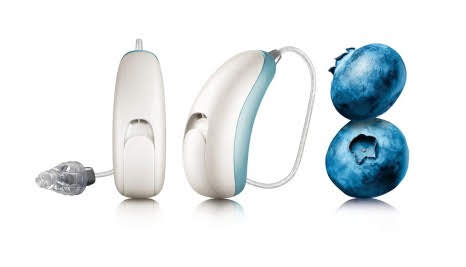
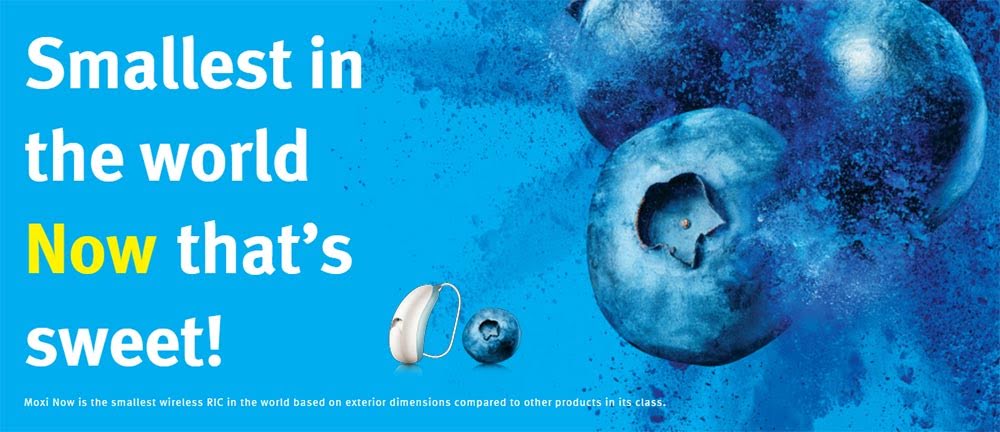
Unitron has just announced the release of a brand new addition to their hearing aid line up called the Moxi™ Now and we recently got to play with it. It will be introduced in the UK and Ireland from mid October and it is the world’s smallest wireless receiver-in-the-canal (RIC) hearing aid.
Moxi Now is the latest addition to Unitron’s line up of Moxi RIC hearing devices and will be launched on the North Platform. It is to be available in the Pro, 800, 700 and 600 hearing technology levels. While small, the Moxi Now will be a powerful addition to the range with a choice of two levels of receiver. The devices will be suitable for hearing losses up to severe.
As you can see from the lead picture of the article, the Moxi Now really is small. According to Unitron, Moxi Now measures just 20.2mm tall and 6.5mm wide. 39% smaller than their own next smallest RIC, and 14% smaller than the next closest competitor. While small, it delivers comfort, discretion, power and most importantly, functionality. I am not mad about these digital hearing aid types , they have their pros and their cons. However, once you take good care of them they will not let you down.
It really is a discrete device on the ear and it’s ergonomic shape ensures that it lies well on the back of the ear. After a couple of minutes it is easy to forget that it is on entirely. The shape of the receiver wire and the device itself seems to ensure that the hearing instrument stays on the ear. Although small and light, I never felt worried about losing it, it felt very secure on the ear.
The new device was designed to offer complete discretion and ease of use. It is a fully automatic wireless hearing instrument designed to appeal to people who just want to put their hearing aid on and forget it. I have to admit it was very difficult to see the hearing aid on, the receiver wire hugs the face well and is difficult to see. The aid body sits very well on the back of the ear and even with short hair you would have to be looking for it to notice.
I think this might be the aid for you if you are looking for a discreet option but need the versatility and power that a RIC hearing device can offer.
If you like what you see, share it so others can benefit
Japanese researchers have discovered a process to turn stem cells into cochlear (inner ear) cells. This breakthrough could lead to the replacement of damaged haircells in the cochlea reversing previously untreatable hearing loss. They believe that they may be able to deliver a treatment in five to ten years, however, first they have to identify a way of delivering the cells to the cochlea safely and effectively.
The initial research is based around finding a cure for a specific type of congenital (from birth) hearing loss caused by a genetic mutation. The work, which is being carried out in a laboratory at Juntendo University in Tokyo, Japan, aims to correct a mutation which accounts for deafness or hearing loss for one in a thousand children.
In some parts of the world, mutations of this gene are responsible for as many as half the instances of congenital hearing loss. Professor Kazusaku Kamiya and his team have engineered and grown stem cells to replace human cochlear cells without this mutation. Hereditary hearing loss is often caused by a genetic mutation in the hair cells of the ear, which are found in the inner ear, or cochlea, and are the sensory receptors of sound. Acquired sensorineural hearing loss is caused by damage to the very same hair cells.
Professor Kazusaku Kamiya, a specialist in ear diseases who is leading the research, said: “I am very excited by what we have done. We hope this work will lead to a cure for a form of hereditary deafness.
The key will be to find a safe and effective way to deliver these new cochlear stem cells to the cochlea. One possibility is through injection into the cochlea, however, it will have to be done surgically. While the breakthrough brings us a massive step forward towards curing hearing loss, there will still need to be delivery methods designed and clinical testing to be undertaken.
It will be a step by step process, because even if the researchers can get the cells into the ear and it leads to the growth of new inner ear haircells. We don’t know if those cells will act as normal passing sound information to the brain. However, within the next few years we may well have answers to all those questions.
If you like what you see, share it so others can benefit
My recent conversation with Dave Fabry got me thinking, we don’t really cover solutions for severe to profound hearing losses on the pages of Know. I plan to fix that, over the next while we will put together central cornerstone pages with the pertinent information. Having said that I wanted to cover a concept that we talked about, the ecosystem concept specifically for people with those severe hearing losses.
What’s an ecosystem approach?
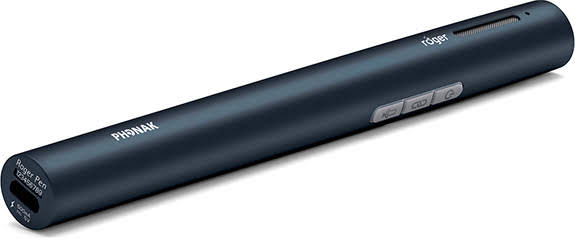
In essence when we talk about an ecosystem approach what we mean is a hearing aid with connected accessories. Those accessories would probably include a phone solution, a tv solution and a remote microphone solution. Each of these different devices will offer a person with very little residual hearing the best possible hearing in different situations. Things like the Phonak Roger Pen below.
Because often the hearing aid isn’t the answer
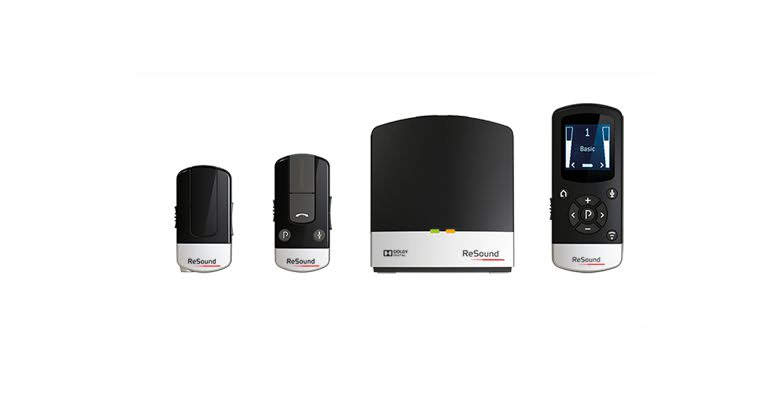
Simply put, in cases where there is very little residual hearing, the hearing aid is not going to be the full answer. No matter how good it is, or how technologically advanced it is, it has very little to play with. Don’t get me wrong, the latest Super Power hearing aids from sonme of the big hearing aid brands are exceptional. Again though, this is a tough hearing loss to help and delivering all of the nuances of sound can be difficult. That’s why the people who specialise in these losses also specialise in a host of accessories to deliver the best results. Below you can see some of the devices offered by Resound.
These devices offer a comprehensive solution for people with profound hearing loss, they all offer slightly different help for different situations. They aren’t just an answer for people with severe to profound hearing loss though. If your budget only stretches to a set of low end hearing aids, invest in a wireless accessory to ensure you get better hearing in the situation you most want it. As I said, we will put some cornerstone content together on both the hearing aids and the accessories that will help.
If you like what you see, share it so others can benefit
We had an email from a lady named Jennifer Scott talking about a couple of articles she had read and the information in them. She thought that they were good articles for us to cover, we thought she was right. So in the first of a couple of articles like this we decided to look at an article on Forbes in 2015. 4 Game-Changing Technologies For The Deaf And Hard Of Hearing by Robert J Szczerba talked about 4 different technologies that were designed to make life easier, we decided to take a look at what happened to them.
MotionSavvy UNI
MotionSavvy was founded by a team of students from Rochester Institute of Technology’s National Technical Institute for the Deaf. Their system UNI translates American Sign Language (ASL) into speech, and speech into text. This is a really cool concept aimed at Deaf people with little or limited speech ability. It is similar in concept and design as a tablet. It was to utilise a special camera to track the location of both hands and all ten fingers of the person using sign language. Graphic representations of their hands come up on screen to provide live feedback and to ensure gestures are being captured correctly. It still is a fantastic concept, however, they still haven’t brought it to market yet which many of their original backers have found infuriating. In their defence, they have released constant updates and explained where they are during the process so far. I truly hope they get to launch the product this year, because it looks like a fantastic piece of kit.
Solar Ear
Solar Ear have been around for a while and they are driven by the mission to deliver low cost hearing devices to low income areas of the Globe. So what exactly drives them? The current production levels of hearing aids meets less than 10% of the global need, and the cost of hearing aids and batteries has often been beyond the reach of the poor, it is a simple as that. Solar Ear is a solar-powered hearing aid battery that costs a fraction of what traditional batteries cost, and lasts for 2-3 years (rather than one week). One of the key things for people with hearing loss in the third world is access to the tech. There are many different foundations that provide free hearing aids across the Third World. However, the problem of access to hearing aid batteries remains. While affordability might be an issue, simple access to somewhere to buy them is also a major concern. Solar Ear decide the best way forward was to deliver rechargeable batteries. Rechargeable batteries that are solar powered which deals with the problem of access to electrical power. The company also offers complete hearing aids at greatly reduced prices. Solar Ear continues to go from strength to strength.
ISEEWHATYOUSAY
ISEEWHATYOUSAY (from Digital Army Devices, Inc.), again this is a great concept, it captures spoken language on a smartphone and converts it into text, and sends the text via Bluetooth to a special user device. The company originally offered a specialized receiving device about the size of a flash stick, and it then begun to offer apps to receive the text on smartphones and wearables. The apps are still around however, they never really gained traction. The last updates on them were in 2014, I am kind of sorry to see that because I think it would be a cool idea. Perhaps though it was an idea before it’s time, I mean smartwatches have only really begun to make an impact in the last year. I think this concept when paired with a set of hearing aids could make a lot of sense. It’s something that I would like to explore maybe later in another article.
Hayleigh’s Cherished Charms
At the age of ten, a girl named Hayleigh noticed that her many of her classmates at a school for the deaf and hard of hearing hid their hearing aids behind their hair. She said “I wanted to make my hearing aids shine and be fancy and proud of my hearing aids,”. So she started designing jewelery that can best be described as \”hearing aid bling\”. Hayleigh’s Cherished Charms are available in a variety of designs and colours, including some for cochlear implants. Hayleighs Cherished charms goes from strength to strength and her simple idea has at least helped to change the ideas that kids have about their hearing aids.
So, two out of four of the technologies covered have really moved forward. Unfortunately one has more or less fell by the wayside and the other hasn’t delivered yet. That is often the case though in tech, great ideas are sometimes hard to deliver. I am hoping that the MotionSavvy UNI is released to market soon, I think it really is a fantastic device, I hope even more that it is used across all public buildings and eventually every business. If it worked, it would finally give the signing Deaf unfettered access to the services they need. How cool would that be?
If you like what you see, share it so others can benefit



 Itshearingaidknow