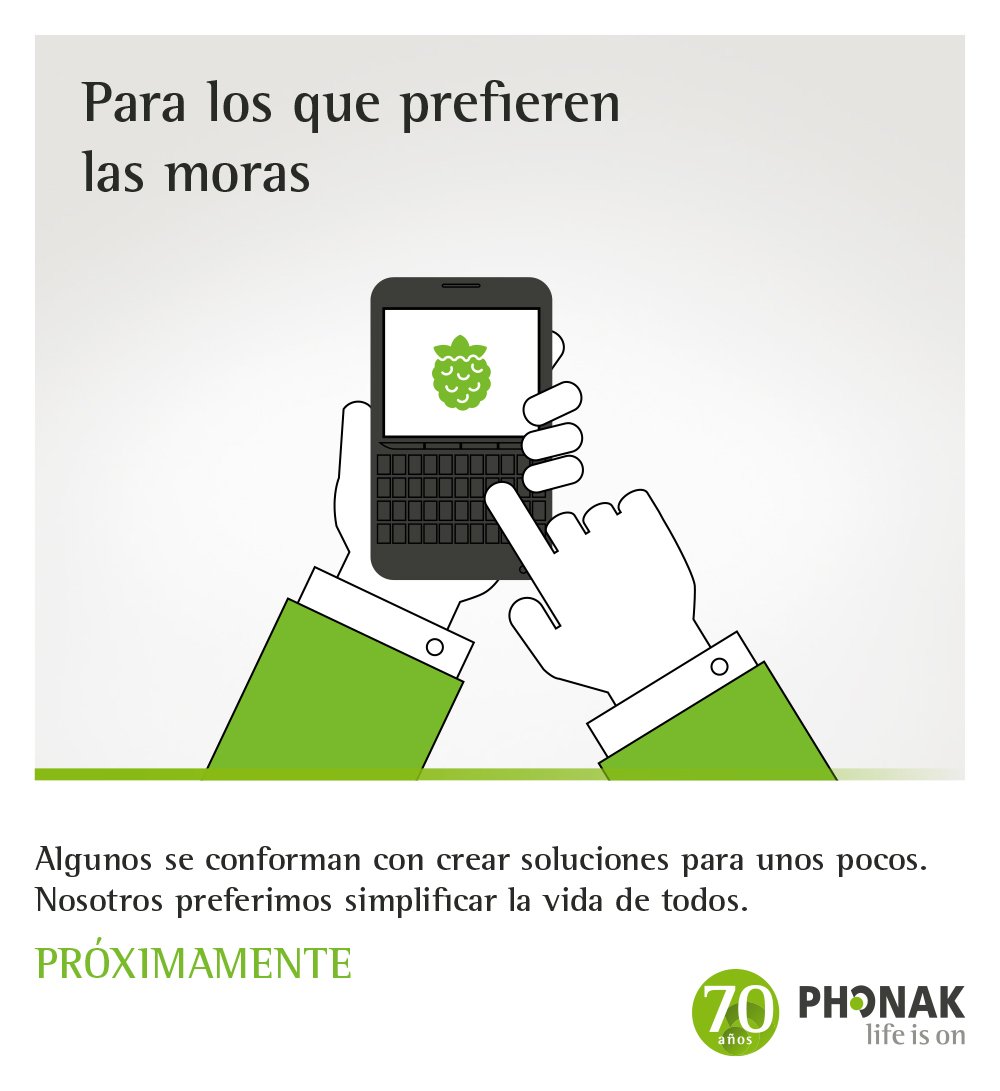
I saw a share from Phonak Spain today and I have a sneaking suspicion that Phonak have done the un-doable. That’s not a phrase we hear often. The image is below and I think it may mean that Phonak may be about to completely change our ideas about Made For, forever. Have they finally cracked the Bluetooth connundrum? I don’t know, but I really hope so!
So basically, are you ready for the change? accompanied with an image of a Blackberry. If that isn’t a hint, I don’t know what is. I mean up to now I was thinking Made For Android, but what if it is made for any phone? Imagine a hearing aid that would stream from any mobile phone without a streamer? I know that many of my Patients would like that, in fact many give out about having to use a streamer.
The innovation would also put Phonak at the leading edge. I mean that Phonak are an innovative company, in fact all of the big brands are. However, recently all the manufacturers have innovated within the space. Apart from Oticon maybe with the internet connection. Not one of them has really delivered something out of left field. If Phonak have cracked Bluetooth, that would be shockingly out of left field. i hope they have, one way or the other, we won’t have to wait too long to find out.
A recent article on NYU.EDU on nursing homes saddened me greatly. The article was about a study undertaken which seemed to suggest that nursing homes ignore their resident’s hearing loss. In essence, it is believed that many people in nursing homes have a hearing loss that is simply ignored. My own take on this would be that the problem isn’t negligence, it is lack of knowledge. While the article was saddening, it didn’t, in fact, shock me. I have had a lot of experience with Patients who are residents of nursing homes. Some of it bad and some of it good. In fact, the article reminded me of one such experience recently.
An Old Friend
Recently a new Patient came to see me looking for new hearing aids, I recognised the face, but the name meant nothing to me (typical really of me, faces not names). Anyway, it soon became obvious that the person was an old Patient of mine from before I went to work at a hearing aid manufacturer. The Patient is now living in a nursing home and was looking for an upgraded solution that would help them hear clearly.
The TV Was Important
As I was speaking to the Patient, it became very obvious that the TV was important. The nursing home that they live in offers what are basically one room ensuite. There is a TV in the room but they very rarely enjoyed watching it because they just could not understand it.
Widex Unique 110 and a TV-DEX
Anyway, I recommended Widex Unique 110s and a TV-DEX. The Patient only needed basic hearing aids for their needs, however, the requirement for the TV meant that a wireless device was a requisite. I chose Widex because their audio streaming using the Widex-Link is the best I have ever experienced.
Pure Delight
The result was pure delight, I attended the nursing home, programmed the hearing aids and set up the TV-DEX. I first checked that everything was okay and that the user could hear well at different levels of speech. Then I turned on the TV-Dex and checked that the audio streaming was working and that they could hear clearly.
The look of pure delight was both a confirmation and a reward in itself. I showed the Patient how to control the audio inputs and the volume of the streamed audio. The Patient was truly delighted, such a simple thing that we take for granted, but the loss of it had affected them greatly. The look of unadulterated joy brought a lump to my throat (I think I am hormonal or something, this is happening a lot lately), in fact, it drove a huge sense of joy and wonder in me.
Sometimes It’s The Simple Things
It reminded me that sometimes it’s the simple things that mean so much. The Patient wasn’t very mobile and interaction with others was difficult enough. While they loved reading, their degraded eyesight made that infuriatingly difficult. The TV was difficult because it was hard to understand. For all intent and purpose, the Patient was experiencing no interaction or very little that was not strained. Isolation is maddening, what stimulation can there be with little or no communication?
The TV Isn’t The Answer
The TV isn’t the answer here, but it’s a damn good start, the hearing aids will allow better one to one interaction during the day as well. The next job for me is to help set up some audiobooks on CD for her. So that the Patient can begin to enjoy books as well.
Training The Staff
One of the most important things that I did that day was to train the staff about the hearing aids. The Patient can’t manage them, so the staff will have to. I showed them the working parts, explained how to change batteries and wax guards and showed them how to get them in the ear. The next time I go, I will refresh them on the subject and give them some handouts.
The staff involved with nursing home care need to be made aware of the communication difficulties that any Patient is having. Not just that, they also need to be made collaborators in the process of hearing better. Because if they don’t understand what is at stake, how can they act?
Our Job
I have begun to think more and more that this will be our job, we in the profession will need to engage with nursing homes and nursing home staff to ensure that they have a rudimentary understanding of hearing aids. That is a matter for another day, but if you have someone in a nursing home with hearing loss there is something that you can do.
The Damned Loneliness of Isolation
If you have a loved one in a nursing home with a hearing loss, make sure the staff understand the vagaries of their hearing aids. Because if they don’t, they can’t help. The one thing that really struck me from my recent experience is the isolation and loneliness forced upon people by hearing loss. It doesn’t need to be that way, especially if they in fact actually have hearing aids. Because life without the simple joy of communication must be intensely hard.
Make sure they are used, make sure they work, make sure the professional is called if they don’t.
If you like what you see, share it so others can benefit
Announced today, William Demant (the owners of the Oticon and Bernafon brands among others) say that they may enter the OTC hearing aid market. In an article by Reuters it was stated that CEO Soren Nielsen told Reuters “should sales of products like these become substantial … we will produce some as well,”
The First Hearing Aid Brand To Respond
William Demant is the first mainstream hearing aid brand to make any comment on the introduction of OTCs and possible market activity. In essence, Soren Nielson said that they would keep a watching brief and respond accordingly based on market size and outlook.
Could All The Big Hearing Aid Manufacturers Do Likewise
I would expect if one manufacturer enters the OTC market, or in fact if they even look like they may be entering the market, then all of the big six will follow. In fairness though, they nearly all have responsibility to their shareholders. So if the market for OTC hearing aids explodes, they will all need to respond to it. The outlook for the market appears to be generally pretty good. There certainly seems to be a lot of interest in the States in relation to the devices.
When Can You Expect Them?
While the legislation will pass, there will still be some time before we see OTC devices appear. Regulation will need to be put in place and that could take up to three years. Although, it is expected to be expedited and there are some that expect to see OTC hearing aids available next year.
Again, this is a departure from the norm, in this article we have a review of multiple hearing aid products. Barry Nance of Network Testing Laboratories contacted us with a review that the had done of several devices. The choice of devices was a little eclectic, to say the least, however, he explained why he chose those devices in particular in his article. While I don’t necessarily agree with all of what Barry had to say, in particular, the buying of hearing aids online, it was more than interesting.
The problem with it though is that it is probably complete bullshit (Irish Technical Term), because Barry approached Phonak for a free set of Virto B-Titanium 90s (top of the range) for the review and they told him no. Then Barry told them that if they gave him the hearing aids he would make sure the Phonak hearing aids won hands down. If not, he said Signia would win it and he would thrash the Phonak product. Hey, read on and I think you can figure out what happened.
You see this really irritates us, because we try to ensure that this site is full of honest, impartial advice and reviews, and then a F@#$wit like Barry comes along. Just a quick update here, I have been contacted by Signia, they just wanted to make it clear that they had no involvement with the review or Barry Nance, they just seem to have been caught up in it.
Introduction
This independent (unsponsored), objective review of five hearing aids looks at price, quality, comfort, technology and features to help you hear better. (You see you can tell he is lying, his mouth is moving)
by Barry Nance
Executive Summary
The Siemens/Signia Silk Primax hearing aid easily won this competition. It uses advanced technology, sophisticated Digital Signal Processor (DSP) programming and a superior design to deliver clear, natural sounds.
The Signia Silk Primax device is
• Clear and natural-sounding
• Comfortable
• Highly configurable
• Packed with useful sound processing features
• Cost-effective
Impressively, the Signia Silk Primax device outperformed the other hearing aids in every category.
Eh? What did you say?
If you think hearing aids are embarrassingly unsightly, far too expensive and awkwardly inconvenient, we have news for you. “In-The-Ear” (ITE) hearing aids, which are suitable for many (but not all) people, are virtually invisible. Even your hair stylist/barber may not notice you have hearing aids. Internet hearing aid retailer discounts of 50 percent to 60 percent are easy to find.
These discounts drop the price of a high-quality, full-featured pair of hearing aids to about a dollar a day. And wearing the devices becomes second-nature. You’ll often forget you’re wearing them. Hearing aids (often referred to as “hearing devices” or “hearing instruments” by hearing aid manufacturers and hearing care professionals) are actually tiny computers that continuously process the sounds around you.
The devices supply your ears with loudness-adjusted, clarified sounds. Using a computer-memory-stored configuration that’s personalized for a specific ear, a hearing aid increases (or decreases) loudness, filters out noise and distinguishes between voices, music, wind, echoes and other types of sounds.
The ideal hearing aid gives a person a perfectly natural hearing experience. From the lowest double bass violin note to the highest piccolo note, from the lowest male voice to the highest female voice, from the lowest peal of thunder to the highest chirp of a bird – a perfect hearing aid knows what sounds you have trouble hearing and compensates accordingly.
The ideal hearing aid is so comfortable in your ear that you forget it’s there. The hearing aid is not a factor when you brush your hair or someone ruffles your hair. It recognizes and enhances voices for the sake of clarity and understanding, while it filters and de-emphasizes sounds like wind noise and background clatter. The ideal hearing aid is durable and reliable. It can be configured and personalized to your exact hearing loss both now and in the future, as your hearing changes over time.
We decided to evaluate five hearing aids in our test lab. The five were:
• Personal Sound Amplifying Products, or PSAPs (as a group)
• Audicus Uno
• iHear Medical HD
• Signia Silk Primax
• Phonak Virto B Titanium
The Signia Silk Primax device easily surpassed the competition in this review. It gave us the clearest, most natural sounds. Silk Primax was comfortable to wear, it was easy to configure (once we’d studied up on frequencies, amplitudes and compression) via Signia’s Connexx Eight software and it was brimming with thoughtfully-designed, useful features. The Signia Silk Primax price of just $1,100 per device (over the Internet, from http://www.BuyHear.com) was a nice bonus.
Why Review Only “In the Ear?”
Devices that sit completely inside the ear canal (“ITE”) rather than behind the ear (“BTE”) have several significant advantages. They are of course invisible or nearly so. You can prune shrubs and trees, brush your hair, let someone ruffle your hair, wear headphones, use earmuffs and walk (or run) under low-hanging trees without worrying about losing them. You can insert them and forget them – ITE hearing devices are the ultimate in convenience. … And What about Bluetooth? And TeleCoil?
Wireless hearing aid protocols are over-rated. People with normal hearing use telephones and attend public gatherings without special equipment. You want the same experience. Having to select a special program when the phone rings, trying to share the phone conversation content (when you’d otherwise just switch to speakerphone mode) or – especially – needing to give the phone call to another person are all problematic with BlueTooth.
Signia Silk Primax
Signia, a division of the Sivantos company, makes three levels (models) of Silk Primax devices – 3, 5 and 7. Because it’s suitable for most people’s degree of hearing loss, we primarily focused on level 5 in our testing (See the “How We Tested” section of this review).
The Silk Primax devices gave us the clearest, most natural sounds in every one of our tests. People’s voices, including higher-pitched female voices, were perfectly understandable and intelligible. Music of all types was crisp and clear. Outdoor sounds such as bird songs, rustling leaves and arguing squirrels were pleasant and distinct.
Sports events were enjoyable, and announcer’s voices were sharp and clear. We could easily focus on and understand conversations in public places, from the workplace to restaurants and bars.
Impressively, all the testers agreed that the invisible, in-the-canal Silk Primax micro-miniaturized computers identified, enhanced and delivered pure, true sounds to our ears – sounds that would otherwise have been muffled, indistinct or even completely absent.
Technical Data: The Silk Primax 3 has 24 channels with 12 handles, the Primax 5 has 32 channels with 16 handles and the Primax 7 has 48 channels with 20 handles. Each channel or handle is a frequency range (such as 1,500 cycles to 1,750 cycles/sec, or 2,000 cycles/sec to 2,250 cycles/sec).
Configurable parameters for each frequency range tell the Silk Primax how to boost, compress or otherwise process sounds in that specific frequency range.
The high number of channels and handles is especially helpful for a person who hears normally across a range of frequencies but, beginning at a specific frequency, has more and more trouble hearing different sounds. An example: Fred hears well from 250 cycles/sec (a low musical note) to 1,000 cycles/sec (some male voices). He sometimes can’t quite understand 1,250 cycles/sec male voices. 2,000 cycles/sec and higher female voices are a problem for Fred, and he can’t hear high musical notes and many bird chirps at all. Fred needs frequency-specific amplification beginning at 1,250 cycles/sec and increasing through higher frequencies.
In addition to compensating for frequency-specific hearing loss, a Silk Primax device can recognize and either emphasize or de-emphasize speech, music, feedback, wind noise and several other types of sounds. Moreover, for people suffering from Tinnitus, the person configuring a Silk Primax device can choose from multiple Tinnitus therapy signals, including Signia’s own rather uniquely effective Notch Therapy.
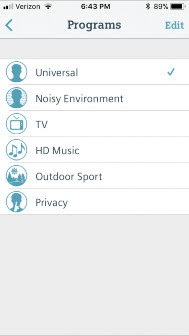
You get six user-selectable programs in the Silk Primax:
Universal
Noisy Environment
TV
HD Music
Outdoor Sport
Privacy
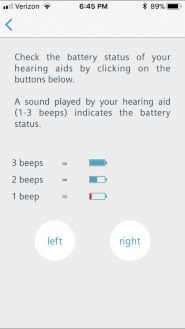
You choose a specific program in the free Signia “Touch Control” smartphone app or by pressing a button on the optional “Mini-Pocket Remote.” Our testers greatly preferred using the smartphone app to select a program. As icing on the cake, the Signia “Touch Control” smartphone app additionally let us check battery status (i.e., charge level) whenever we wished.
Signia’s smartphone app for program selection, battery charge information and other functions
The (default) Universal program supplies most hearing-challenged people with virtually normal hearing. While Universal is perfectly useful and effective in all listening situations, the other programs offer supplemental sound enhancements you might find helpful. Noisy Environment minimizes background noise and clatter in restaurants, bars and even bowling alleys.
The TV program boosts voices and music when you’re watching TV. HD Music enriches and heightens whatever music you listen to. Outdoor Sport is appropriate for stadiums and ballparks. And the Privacy program de-emphasizes sounds in your environment so that you can more easily concentrate on something without the distraction of background sounds.
We found the Silk Primax durable, sturdy and well-made. We expect the device will last many years. We appreciated the ability to reconfigure the device to accommodate ears whose hearing profile and acuity change over time.
Wearing a Silk Primax is extraordinarily comfortable. The flexible silicone sleeves (large, medium or small, vented or non-vented) conform softly but securely to nearly any ear canal. Even forgetting to take them out at bedtime wasn’t an issue (except for the extra battery usage). The Silk Primax’s comfort is nearly as impressive as its digital intelligence.
Setting up a new, out-of-the-box Silk Primax device the first time consists simply of attaching a click sleeve, inserting the device into the ear and then configuring the device’s amplifications for different frequencies as well as its several options.
Configuring the Silk Primax device (what audiologists inaccurately refer to as “programming”) was a breeze with the Signia Connexx Eight software. We quickly set up a BlueTooth link between the computer and the ConnexxAir hardware, which in turn used ultrasonic signals (a protocol that Signia terms “e2e”) to send configuration data to the Silk Primax devices.
If you arm yourself with a good understanding of sound and hearing (frequencies, amplitudes and compression) and if you can operate a Windows application, we think you’ll find using Signia’s software a cost-saving alternative to having an audiologist configure your devices.
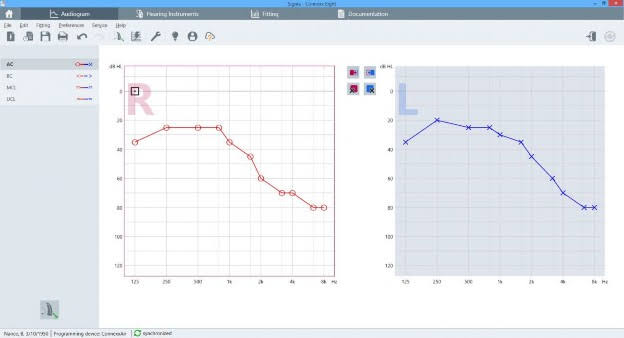
The Connexx Eight software, which runs on Windows, offers three increasingly fine ways to configure Silk Primax devices. At the first (most coarse) level, you point and click with a mouse to enter audiogram datapoints (e.g., 30 decibels of hearing loss at a frequency of 2,000 cycles).
Entering audiogram data via Signia’s Connexx 8 software
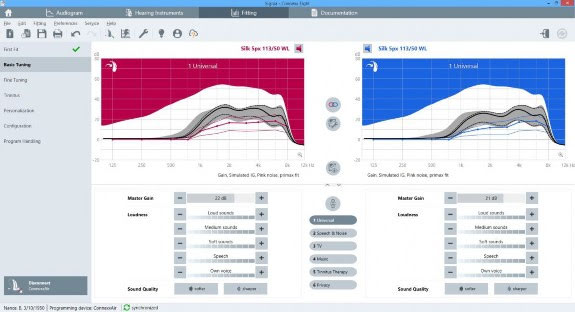
You perform the optional second and third configuration steps if you want to make additional adjustments. At the second (somewhat finer) level, you use plus/minus buttons to adjust the loudness for loud sounds, medium sounds, soft sounds, speech and your own voice.
Adjusting sound levels in Connexx 8
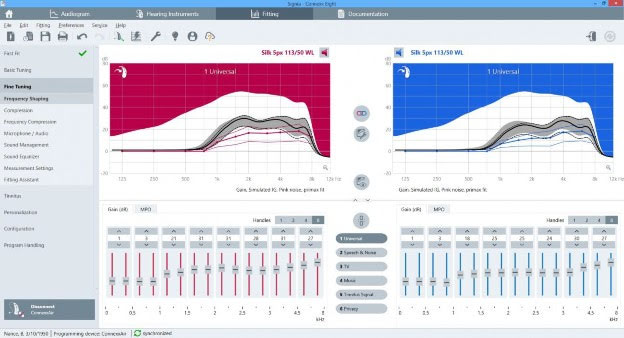
At the third (finest) level, you use the mouse to move frequency-specific sliders (each slider is a channel/handle) up or down. You click a button on the screen to tell the Connexx Eight software your changes apply to both devices or just to one device (if you’re configuring a device pair). With another button, you indicate whether the Connexx Eight software should apply your changes to all programs or just one.
Frequency band fine-tuning in Connexx 8
You use other configuration screens to adjust the Silk Primax devices’ behaviors when they detect wind noise or mixtures of speech and noise.
Signia’s Tinnitus Notch Therapy is a novel, advanced approach to the stubborn problem of tonal tinnitus. Other manufacturers’ traditional tinnitus treatments typically require months of listening to recorded white noise or ocean waves for a few hours each day.
In contrast, Notch Therapy integrates into one or more of your hearing devices’ everyday programs. Basically, it works by avoiding the amplification of natural sounds that occur at or near the frequency of your tinnitus.
Notch Therapy uses the science of cortical lateral inhibition, a neural mechanism that reduces the activity in the over-stimulated region of the brain responsible for many types of tinnitus. The result is a continuous, daily tinnitus treatment that neither adds nor masks sounds to your listening experience.
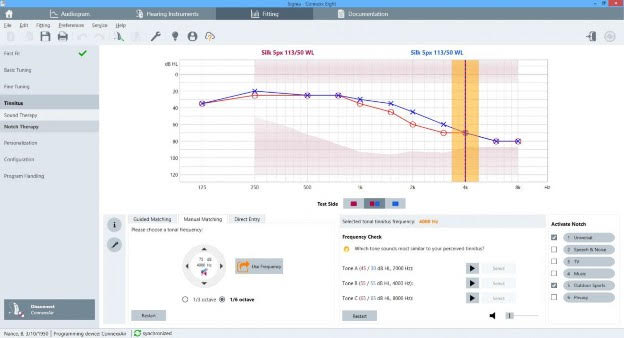
The Silk Primax can be configured three ways: Notch Therapy at a specific frequency and amplitude, the classic noise-or-ocean-wave therapy or no tinnitus therapy at all.
Tinnitus therapy selection with Connexx 8
Silk Primax 5’s suggested retail price is $2,500 per device, but you can buy a pair on the Internet for typically $1,100 each. The ConnexxAir hardware for configuring Silk Primax is $250.00. With a lifespan of about six years, the Signia Silk Primax’s daily cost is only about a dollar.
Audicus Uno
The Audicus Uno is actually manufactured by another company, Hansaton. Audicus private-labels the devices for sale on the Internet. The Uno is a no-frills, rather basic hearing aid that’s one step above Personal Sound Amplifying Products (PSAPs). The Uno can selectively amplify sounds in a small number of frequency ranges, but it lacks features that would make those sounds seem as natural and genuine as people wished. We concluded that the Audicus Uno is best used as a back-up, or substitute, for those times your regular hearing devices are being repaired (if of course you can afford to buy a back-up pair).
Update
Just before we finished this review, Audicus posted “Audicus is not currently offering the Uno, as of 2/1/2018” on its Web site. We don’t know when Uno sales might resume. We’ll leave the Uno in this review for when it or its similar replacement returns to the market.
Our testers reported that the Audicus Uno helped them hear and distinguish many sounds and several voice types. However, some musical instruments’ notes were louder than they should have been, while others were fainter. Testers sometimes said their own voices were hollow-sounding. And two testers could not understand certain words spoken by high-pitched female voices.
The Audicus Uno worked well at sports events, but noisy public places were a challenge. Conversations in such environments were often unintelligible.
The consensus of our testers: Audicus Uno is a somewhat helpful device, but it has limited usefulness when you’re trying to understand conversations in noisy environments or trying to enjoy music.
Technical Data: Audicus Uno has 8 channels, no user-selectable programs and no ability to provide any tinnitus therapy. The device incorporates a low-end, inexpensive computer chip (a Digital Signal Processor, or DSP). The Uno’s DSP chip is much slower than that used in most hearing aids, and it doesn’t respond quickly to sudden loud sounds or other sudden changes in the listening environment. The Uno’s DSP chip is also less capable and offers very few configuration settings. To accommodate noisy environments and other listening situations, the Audicus (Hansaton) software running in the DSP samples incoming sounds, tries to identify them and dynamically changes the sounds before they reach your ears.
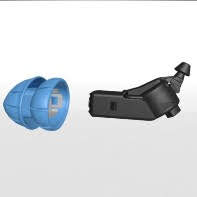
The Audicus Uno is a hard shell beige plastic hearing device. A detachable, replaceable soft plastic dome helps the Uno sit comfortably in the ear canal. Audicus ships the device with six such domes – small, medium and large in both “propeller” and “mushroom” shapes. We found that the domes lost their flexibility and resiliency within a week or two, which meant the domes needed replacing more often than we would’ve liked.
Audicus uses an audiogram that you send to the company to configure a new Audicus Uno for a particular ear’s hearing loss. Thereafter, if you need any additional “fine tuning” of your new device, you must ship the Uno back to Audicus.
You cannot choose a program (listening mode) with the Audicus Uno. Instead, it automatically adjusts the sounds you hear based on its moment-by-moment analysis of your listening environment.
Audicus’ price for each Uno is (was) $499.
Phonak Virto B Titanium
Phonak, a division of the Sonova company, manufactures two models of Virto B Titanium devices – 70 and 90. We tested the model 70 device, which Phonak says is a sophisticated, computer-chip-based hearing aid that’s custom-moulded for each ear.
The Virto B70 Titanium hearing aid promised many features and capabilities at the beginning of our review. Unfortunately, the device didn’t live up to its promises as we put it through daily use.
For the sale of strength and durability, the Phonak Virto B Titanium incorporates a 3-D- printed titanium shell rather than an acrylic (plastic) shell. The titanium shell is supposed to fit securely within the ear canal.
To customize the shape of the titanium shell for a particular person, an audiologist squirts silicone gel into the ear, lets it harden, removes the resulting ear canal mold and sends the mold’s shape and size data to the manufacturer. Phonak uses the mold dimension data and a 3-D printing process to encase the hearing aid electronics and circuits inside a shell of thin titanium.
Titanium 3-D Printing
3-D printing, also known as “Additive Manufacturing” (AM), incrementally melts and then deposits extremely thin layers of powdered material, such as titanium, on an object. The result can be a unique metallic shape fabricated to close tolerances.
However, because of the granular nature of the surface of an AM part, such objects can exhibit weaker fatigue and static strengths than conventionally-milled components. This is one reason for the cautious adoption of 3-D printing.
To our disappointment, the titanium shell didn’t retain its shape as it should have. Micrometer measurements of the device after the initial fitting and then after testing revealed slight deformations in the thin titanium in only a few months of use. Also, one of the devices failed during testing when the wax guard holder fell out (with the wax guard still inserted).
Moreover, both occlusion (hearing one’s own voice as a hollow, abnormal sound) and feedback/whistling were frequent problems with the Virto B Titanium devices.
Technical Data: The Virto B70 Titanium device has 16 channels and the B90 model has 20 channels. The AutoSense feature is designed to detect and accommodate these listening environments: Calm Situation, Speech in Noise, Comfort in Noise and Music. A magnet, in the form of a manufacturer-supplied mini-remote “MiniControl” hand-held unit, can manually select one of the listening modes or Acoustic Phone. Other features are designed to block whistling, feedback and wind noises.
The Virto B Titanium devices’ tinnitus therapy consists simply of generated noise (i.e., white noise or pink noise) at a pre-configured loudness and frequency. The generated noise can be set to appear in all listening mode programs or in a separate custom program.
The Virto B Titanium hearing aids have the following programs that are selectable with a magnet (the accompanying handheld mini-remote “MiniControl“ unit):
Comfort in Echo (only on the model B90)
Calm Situation
Comfort in Noise
Music
Acoustic phone
The MiniControl is a keychain holder containing a magnet that you can extract from the keychain holder. To switch programs, you unscrew the magnet from the keychain holder and insert the magnet into your ear close to the Virto B Titanium hearing device. You then promptly remove the magnet from your ear when the Virto B Titanium hearing instrument aurally signals that it’s using the program you want.
The mini-remote “MiniControl“ magnet does not help you know how much battery life is left. Phonak does not offer a smartphone app for selecting Virto B Titanium programs.
The customized shape of the Virto B Titanium device, based on the audiologist making a mold of the ear canal, made the insertion and removal of the hearing aid a simple process. However, a tester reported the metal shell was often uncomfortably cold during the first minute after insertion.
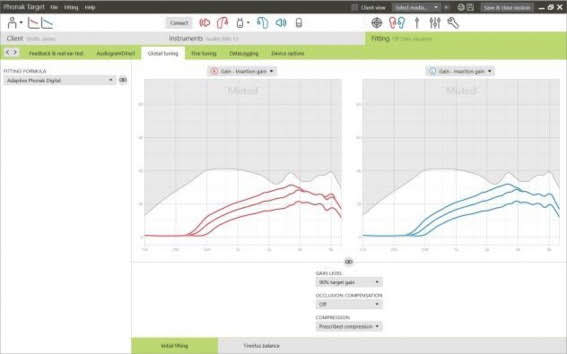
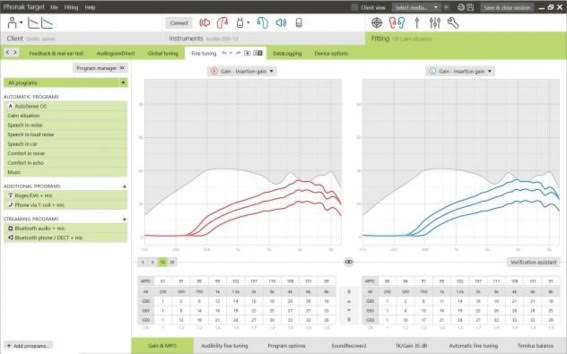
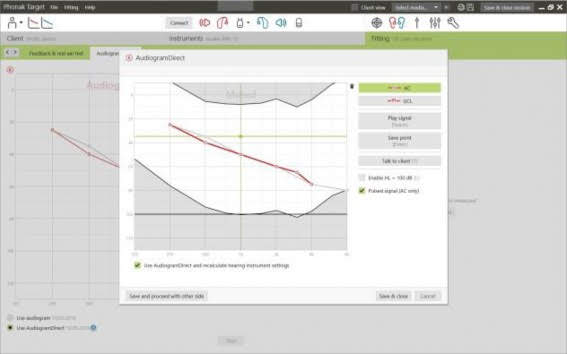
Once you obtain and then connect a “Hi-Pro 2” hardware device to both your computer and your Virto B Titanium hearing aids via a special cable, configuring the Virto B units is fairly straightforward. Just as with the combination of Signia Silk Primax devices and Signia Connexx 8 software, you can enter audiogram data and perform fine-tuning steps with the Virto B Titanium devices and Phonak Target software.
Audiogram data in Phonak’s Target software
Phonak’s Target software – frequency range adjustments
Phonak’s Target software – frequency fine tuning
The MSRP for each Phonak Virto B70 is $3,100, although you can buy one on the Internet (online) for as low as $1,800 ($3,600 per pair). However, if you’re contemplating an online purchase, keep in mind that you’ll still need to see an audiologist to have him or her make the silicone gel mold of your ear.
iHear Medical HD
iHear Medical both designs and manufactures its hearing aids. The company calls its in- the-ear device the “HD.” It has just four frequency ranges (channels) and four programs. Just as with the Phonak Virto B devices, a magnet held close to the ear changes the program. The HD hearing aid is a rectangular, hard black plastic unit that uses proprietary (available only from iHear Medical) batteries. Unfortunately, we found the HD to be badly designed and poorly made.
To our huge disappointment, as we tested a pair of HD devices, the one for the right ear failed. It randomly changed programs, causing us to have to reset it on a frequent basis. Just as its replacement arrived from the iHear Medical company, the left ear device fell apart – literally.
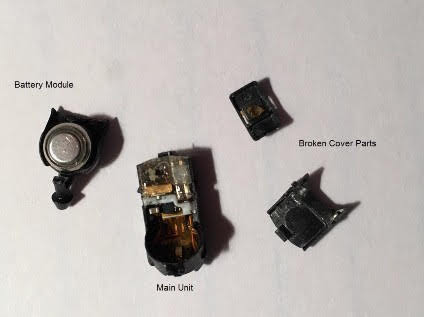
iHear Medical’s HD device broke during normal use
To compound the problem, iHear Medical used a slow ground shipping service for both the returned right ear device and the replacement device, leaving us without a working hearing aid for nearly two weeks.
Even when the devices were working, we found them problematic. The four frequency ranges did not coincide closely enough with any of our tester’s hearing losses. As a result, many sounds were louder than they should’ve been, while others were too quiet. Whistling and feedback occurred often.
Technical Data: The iHear Medical HD device has just four channels. These rather broad frequency ranges were (1) zero to 875 cycles/sec, (2) 875 to 1,625cycles/sec, (3) 1,625 to 3,625 cycles/sec and (4) anything greater than 3,625 cycles/sec. Range 1 represents a male voice, range 2 is a low female voice, range 3 is a high female voice and range 4 represents bird chirps.
The HD’s Digital Signal Processor (DSP) is a rudimentary, not-very-capable and very inexpensive chip (ON Semiconductor’s Rhythm SB3229). The iHear Medical HD comes with a magnet that changes the HD’s program (listening mode). These programs are Main Profile, Volume Cut, Speech Enhancement and Volume Boost. Volume Cut decreases all frequency range amplifications by 6 db. Speech Enhancement decreases range 1 amplification by 12 db and range 2 amplification by 6 db. Volume Boost increases all frequency range amplifications by 4 db. The HD relies on a person’s own natural accommodation for wind noise, and the device has no tinnitus therapy.
An HD wearer positions the supplied magnet close to each ear’s HD device, one at a time, to cause the HD to jump to the next program. For example, changing from Main Profile to Speech Enhancement requires two magnet touches in each ear. Changing back to Main Profile requires two magnet touches in each ear.
iHear Medical does not offer a smartphone app for choosing a program or for knowing how much battery life is left in each device.
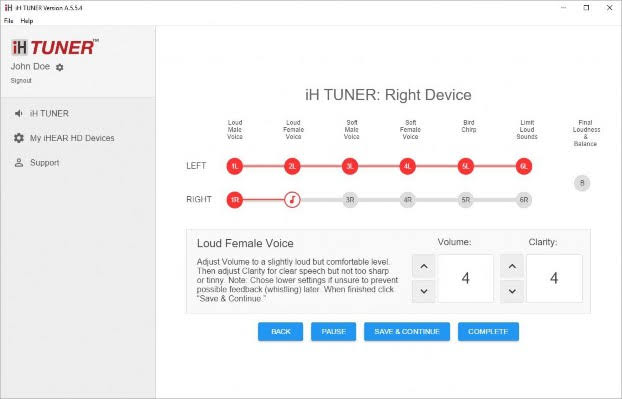
To configure the HD devices at home, you purchase the manufacturer’s Tuning Kit. Confusingly, our Tuning Kit arrived in a box labeled “Hearing Test.” To use the configuration software, you remove the proprietary batteries from each device, connect the HD devices to your computer via cables and re-insert the devices in your ears. You then respond to a series of sounds and simple questions to indicate how much amplification (or compression) each frequency range should have. The test sounds include male voices, female voices and bird chirps.
iHear Medical’s Tuning Kit questions
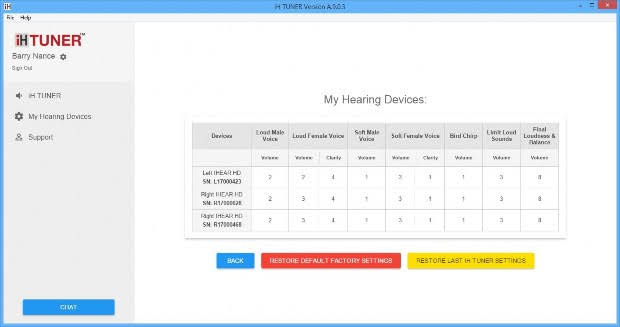
iHear Medical’s Tuning Kit summary screen
The iHear Medical HD hearing aids are fairly comfortable once they’re inserted in the ear canals, but they were not so comfortable that we could forget that we were wearing them. We found handling them for insertion and extraction somewhat difficult. The HD’s rectangular, sharp-edge surface definitely makes manipulating them with the fingertips a challenge.
iHear Medical sells the HD devices on the company’s Web site for $399 each. The at- home programming kit is $150.
PSAPs
Be aware (beware?) that Personal Sound Amplification Products (PSAPs) indiscriminately amplify all sounds, both high and low. Do you have trouble understanding soft voices in a noisy place? A PSAP will amplify both the voices and the noise. A PSAP does not distinguish tubas from flutes, low male voices from high-pitched female voices or growling dogs from bird songs. A PSAP amplifies them all equally.
Most PSAPs do not even compress loud sounds. A sudden, very loud sound – that you would’ve heard perfectly well without the PSAP – can be painful, possibly damaging, when amplified by a PSAP.
Here are just a couple of random examples of in-the-ear PSAPs available (February – March 2018) on Amazon. You’ll find dozens if not hundreds for sale on the Internet.
NewEAR Hearing Amplifier Ear ITC (Pair) “Extra Small” Second Generation
Amazon price: $37.43 & FREE Shipping
Easyuslife Extra Small In-The-Canal (ITC) New Digital Hearing Amplifiers
Deciding to buy a PSAP might seem economical and budget-wise, but you’re unlikely to be happy with the result. In addition to the blanket amplification of all low-pitched sounds, all high-pitched sounds and sounds that are already very loud, a PSAP lacks listening modes (programs), recognition and abatement of various kinds of noise as well as configurability.
Our testing of several PSAPs showed that many under-amplified high frequencies and over-amplified low frequencies. Since most people have difficulty hearing high frequencies, a PSAP would not help most people hear better. A cheap PSAP might even make your hearing worse.
You may find that replacement domes and even batteries are difficult to obtain. The PSAP may not be durable and well-made. And it may not be quite as comfortable in your ear as you’d like.
Finally, according to the FDA, “PSAPs are intended to amplify environmental sound for non-hearing impaired consumers. They are intended to accentuate sounds in specific listening environments, rather than for everyday use in multiple listening situations.”
PSAPs can range in price from $10 to $500. At any price, however, we urge you to exercise great caution if you’re thinking of buying a PSAP.
Conclusion
The Signia Silk Primax hearing aids easily emerged the winner in this competition. They are feature-rich, comfortable, digitally sophisticated, durable, and – for the technically- minded – a breeze to configure. The $1,100 price for each one, spread across five or six years of expected use, makes them cost-effective. We highly recommend the Signia Silk Primax.
Report Card
Signia Silk Primax
Audicus Uno
Phonak Virto B Titanium
iHear Medical HD
PSAPs
Hearing
A
B
C
C
D
Comfort
A
B +
A –
C
C
Durability
A
A
C
F
?
Ease of configuring
A
D
B
B
F
Price
A
A
C
B
B
Average
A
B
C
C
D
How We Tested
This review is perfectly independent. We received no sponsorship, no compensation of any sort and no free devices from any manufacturer.
We evaluated these hearing aids primarily for their ability to compensate for hearing loss. We looked at how comfortable each device was in daily use and how easy (or difficult) insertion and extraction was. We assessed each device’s design and manufacturing quality. We tested the ease with which we could configure the device’s sound processing parameters and options. We also judged the device’s cost in relation to its breadth of features and its expected lifespan.
Our test environment consisted of six people with varying degrees of hearing loss.
We used notebook computers running Windows 8.2 and Windows 10 to run each manufacturer’s configuration software. Our smartphone platforms were an iPhone 6s and an iPhone X.
About the Lab and the Author
Established in 1989, Network Testing Labs performs independent technology research and product reviews. Its network laboratory connects myriads of types of computers and virtually every kind of network device in an ever-changing variety of ways. Its authors are networking experts who write clearly and plainly about complex technologies and products.
Network Testing Labs’ experts have written hardware and software product reviews, state-of-the-art analyses, feature articles, in-depth technology workshops, cover stories, buyer’s guides and in-depth technology outlooks. Our experts have created industry standard network benchmark software, database benchmark software and network diagnostic utilities.
Barry Nance is a networking expert, magazine columnist, book author and application architect. He has more than 35 years of experience with IT technologies, methodologies and products. Since 1989, working on behalf of Network Testing Labs, he has evaluated thousands of hardware and software products for ComputerWorld, BYTE Magazine, Government Computer News, PC Magazine, Network Computing, Network World and many other publications. He’s authored thousands of magazine articles as well as popular books such as Introduction to Networking (4th Edition), Network Programming in C and Client/Server LAN Programming.
He’s also designed successful e-commerce Web-based applications, created database and network benchmark tools, written a variety of network diagnostic software utilities and developed a number of special-purpose networking protocols.
If you like what you see, share it so others can benefit
Cotton buds (or Q-Tips depending on where you live) are a unique product: they are commonly used for the one thing that the manufacturers explicitly warn you not to do. Cleaning your ears with them. Most makes of cotton bud have a explicit warning on the packet.
Using Q-Tips to clean your ear can feel great, if you’ve got a bit of an itch then it gives it a good scratch. But the dangers are real, buds have caused 10000s of visits to medical centres for people with ear infections, hearing loss, ruptured ear drums and damage to their middle-ear bones. It. Happens. A. Lot.
I found this great video on Twitter today from @Clearwax. The video shows Neel Raithatha from The Hear Clinic removing a cotton-ball end of a Q-Tip that has been stuck in someone’s ear for 10 years (10 years!) and causing them hearing problems.
The US Senate passed H.R. 2430, the FDA Reauthorization Act of 2017 by a vote of 94-1, on August 3, the bill includes the Over-the-Counter Hearing Aid Act, which provides for the federal regulation of over-the-counter hearing aids for adults with perceived mild-to-moderate hearing loss. The bill will be put forward for the President to sign and then it will become the law of the land. So, once the law of the land has changed, will you be able to go to the store to buy one? The answer is no, the FDA now has to set out regulations for OTC hearing aids and it has up to three years to do so. Although no one expects it to be that long.
OTC Hearing Aids Don’t Exist
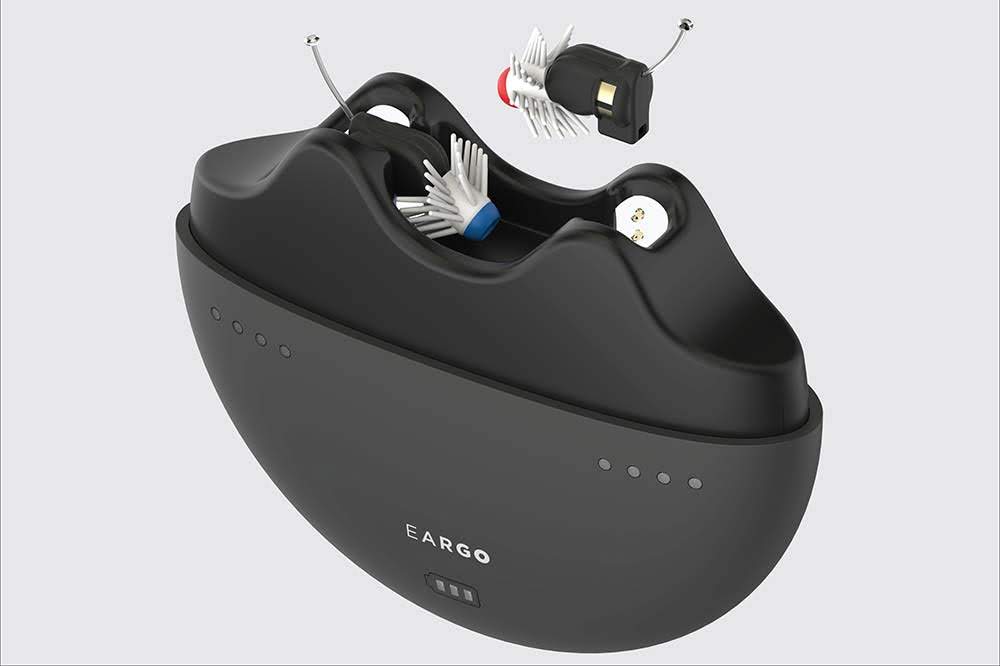
The other thing is that Over The Counter hearing aids don’t actually exist as a product line. Oh yes, there are plenty of PSAPs and there are even a few hearing aids sold online, but they are a whole different kettle of fish. OTC hearing aids are a brand new concept, in fact, they are a concept that there are no guidelines for so far. Once the FDA has finished its work though, I would expect to see many of them hit the market pretty quickly. At present, you can buy devices like Eargo, which I discussed in Eargo, Do They Live Up To The Hype? and iHear. I have also spoken aboutonline hearing aids sales and what you need to think about in Buying Hearing Aids Online? Here is What You Need To Know
What Can You Expect From OTC Hearing Aids?
We don’t really know yet, I would expect that they will be a self fit hearing device that you can also fine tune in some way. I would imagine the fitting and fine tuning software will be smartphone and possibly PC based. Again for prices, we have no idea until they begin to hit the market. The same goes with how well they will deliver. What we do know is that there are plenty of people on the sidelines waiting to deliver them to what they think will be a growing market. Many people have been quoting a particular study pretty loosely to say that OTC hearing aids have proven as good as traditional hearing aids. That isn’t quite true, I discussed the study in the article New Study Says Over The Counter Hearing Aids as Good as Professionally Fitted. The study didn’t quite prove what people are saying it did. Give the article a read and make up your own mind.
Suitable For All?
I have spoken about this before, I think that OTC hearing aids, like self fitting hearing aids will be suitable for some. But, I am not sure they will be suitable for all. There will need to be some understanding of technology to get on with them. The other thing is that many people need ongoing care with hearing aids, their success depends on it. What ongoing support will be available with OTC, in fact what if any support will be available? These are all questions that remain to be answered.
I look forward to seeing how this goes, will traditional manufacturers enter the fray? Will hearing healthcare providers offer the devices? Will hearing healthcare providers offer differing devices with similar care packages? Hell what will the care packages be with OTC hearing aids?
Break Downs & Warranty
At the moment when a hearing aid breaks down under warranty, you come back to us and we handle the repair or the replacement with no cost to you. With OTC or online sales, that may not be the case, it could be that you will need to pay post and packing. If we offer a similarly priced product, with no frills and little support, how would you feel if we charged you for a warranty repair for post and packing? I don’t really see that happening, but I had to ask it.
No matter what happens, who enters the fray and who reacts to what, we will keep you informed. I for one am really interested in what comes on the market, how it is delivered and what the people (that’s you) do with it.
We have seen many so-called Hearables arrive on the scene, however, there have only been two that have focused on helping you hear better. The now-defunct Here One from Doppler and IQBuds from NuHeara. I got my hands on a set of the IQBuds recently and I have been trying them out for a couple of weeks. I have to say I like them a lot, the Audio Streaming is outstanding with pretty good quality. What is really interesting though is the speech processing and the noise reduction ability. These devices aren’t quite hearing aids, but they function quite like them. Are they as good as a dedicated hearing aid? No, but for a price tag of sub 300 Dollars, they do a pretty good job. Let’s talk about the IQBuds.
Boost Speech & Control Noise
The IQBuds are very good for listening to music, I mean really good, they are also fantastic for hands-free phone calls. I think though that the most interesting feature for us is their voice augmentation. The company says that the IQbuds’ primary purpose is to help people control noise and boost speech.
I was talking to a guy from the company and he asked me did the devices meet, or exceed my expectations. I had to reply that they exceeded my expectations. I mean I wasn’t expecting a lot for a device that was going to cost me less than $300 really. I am glad to report I was wrong.
These Aren’t Hearing Aids
These devices aren’t hearing aids and the company don’t pretend they are. They are not sold as medical devices nor do they claim that they will restore hearing. However, they boost other people’s speech volume and they do separate speech, from background noise. So if you are looking for something that can help you with hearing speech in noisy environments, then these might be the devices for you. However, as with everything, there are pros and cons. Before I delve into them, I want to talk about the devices and the app that goes with them.
The IQBuds
Inside the IQbuds’ box, you’ll find the earbuds themselves, a portable charging case, and a 12-inch USB charging cable. The earbuds themselves are pretty solid, they are relatively light but they are big enough. The earbuds have L and R indicators on their inner surfaces to make it easy to tell them apart. My wife has smaller ears and they didn’t quite fit her. For me though, they were a pretty good fit. They come with four sizes of earbuds, S, M, L and XL which are both in a round and oval shapes.
Confused About The Right Hearing Aid For You?
Our buying guide, easing the confusion with clear easy to understand info, we guarantee it will help you pick the right hearing aid for you.
The Occlusion Effect! Not So Much
Picking the right size earbud for you is important, you need to pick the one that fits you snugly. For the IQBuds to work to their best, you need a good tight fit on the earbuds. The aim is to fully block the ear canal without sacrificing comfort. Here is the rub, this is one of the downsides, the tight fit is occluding, which causes the occlusion effect. However, I was surprised to see that it was not nearly as bad as I feared it might be. While I did suffer some occlusion, it wasn’t completely maddening or distracting.
The IQBuds have a dual microphone system and the microphone ports are quite obvious on the outside. The front-facing microphone port is quite big and the mic is protected by a large recess. The rear mic port much is smaller and the mic itself is well recessed in the port. You will need to clear this ports as time goes on, so get yourself a hearing aid cleaning kit with a small brush in it. Every so often you can just brush the ports to brush away any detritus that may have accumulated. It would also be a good idea to check the ear tip for wax build-up as well. Same thing, use the brush to brush it off when it drys.
The Charging Case
The charging case is a very nice piece of design, it is just the right size to fit in a coat pocket or handbag. The case has four LEDs on its front which can both indicate the charge status of the case itself or the status of the charge of the earbuds. The different indications are delivered by pressing the button underneath the LEDs for differing amounts of time.
Using Them
So, the first step is to charge the earbuds fully in their case. It takes a couple of hours to ensure they are fully charged for the first time. After that, it takes around 2 hours to charge the IQbuds, and about two more hours to fully charge the case. In essence to get them and the case charged up, you need to leave them for about 4 hours. As I said, you can check the charging status by pushing the button in front, a short press shows the earbud charging status and a longer press shows the case charging status.
Setting up The App
Search for the App on the App Store or the Play Store and download it. In order to pair the IQbuds with your phone, open the IQbuds app, put in the devices, and touch and hold the outer surfaces of both for 5 seconds. The devices will announce “pairing,” and then you complete the process using your smartphone’s Bluetooth settings. The procedure is simple enough and the app brings you through it with prompts. The app itself is pretty damn good, it is a little complex and it takes a little while to get used to, however, once you have, it gives real power over how you hear. More on that later.
Touch Tap
The earbuds have a really cool system that allows you to control both their function and the function of streaming audio. A simple tap on the side of each ‘bud controls different features. This tap feature is fully customisable in the app. A single tap on the left earbud plays or pauses music from your phone. If a phone call comes in, music shuts off, and a single tap answers the call. A long tap rejects the call or hangs up a call in progress.
Single-tapping the right earbud toggles voice augmentation mode on or off with an announcement of world off. A long tap switches the hearing settings which are based on location profiles. Double-tapping either bud activates Siri or Google Now, once activated you simply talk to tell it what you want.
The App
All other controls and configuration settings are handled in the smartphone app. Apparently, Nuheara added the Custom Tap Touch feature to the IQbuds with firmware release 1.2.0 on October 3, 2017. This part of the app allows you to configure the tap touch controls in both buds based on your own personal preference. Eight different functions (four for each ear) can be set to work with single, double, long, or short taps with the left or right earbud.
The different functions are World (surrounding sound) on/off, volume up, volume down, next track, back (previous) track, play/pause, change location (surrounding sound setting), and activate Siri/Google Now. Configuring Custom Tap Touch in the IQbuds is pretty simple with the Tap Touch menu. First, pick one of six tap touch choices — for example, Left Double Tap. Six choices for that tap choice are presented, with Google Assistant, in this case on an Android phone, showing as the default or current choice. To select another action, such as Play/Pause, simply tap on the action box for that choice and the change is made on the buds immediately.
Sound Settings/ Locations
There are seven location-based settings available, they are Home, Driving, Restaurant, Office, Workout, Street and Plane. Each one is set up for the sound situation. You can add four as favourites that can be selected directly from the IQbuds with a tap. You set them up by selecting them in the app as favourites by tapping on a heart icon beside them.
Each of the eight sound settings is pre-set, however, you can configure them to your own needs. The IQVolume, which basically controls the ambient sound uses a circular slider. You can change the volume of the world by simply sliding the slider to less world. Next, you set what Nuheara calls Super Intelligent Noise Cancellation, or SINC.
This is the setting that helps separate voices from the surrounding sound. Last you can click Live EQ on the top right of the app screen and use another circular slider to adjust noise cancellation based on frequencies. The beauty of the system is that while you can set the pre-sets, you can always reconfigure the location settings through the app, and they reset in the earbuds.
This part of the app is a little complex and took a while to get a handle on. I would say I am tech savvy, however, it took me a few go-rounds to sort this all out. It took me about a week of using them in different locations to get the sound settings right for my hearing. However, once I had the devices set up, I made few changes on the go.
Personal Profile
One of the app screens is called personal profile, this allows you to set the amount of high-frequency boost you need. Personally, I was at five for both ears. There are also two vertical sliders, one for each ear which allow you to set differing volumes for each ear if you need it.
Sound Transparency
When you are listening to music or taking a call, you can still clearly hear your surroundings if you wish to. You can either turn the world off completely or adjust the settings to make sure that if anyone does speak to you, you can hear them clearly.
Battery Life
The IQbuds last for around four hours playing continuous music and up to eight hours with just the sound filters on a single charge. There are basically four charges in the charger case when it is fully charged up, so technically you should get around sixteen hours of music and thirty-two hours of hearing help from one full charge of the case and buds.
I wore them a lot because I need high-frequency amplification, however, most people won’t be wearing them all day. I think most people who would find these attractive would be interested in situational support, so they will wear them when they need them, and keep them in their case when they don’t, that will make it easy to keep them charged.
Are These Hearing Aids?
In a short and succinct answer, no. However, they will help someone with a mild to moderate high-frequency hearing loss. They will also help someone with no hearing loss in a noisy situation. As I said, for sub 300 Dollars, these are pretty cool devices. They are not something you would wear all the time, they are situational aids in that they will give you a boost in certain situations. You will suffer occlusion from them, as I said, I felt it but it didn’t drive me mad. I am pretty stoic though, so I am not sure how other people would react to it.
Should You Buy Them?
That depends, if you are looking for a fantastic set of wireless earbuds that happen to boost speech a little and cut down background noise, well then hell yeah.
If you are having real problems hearing speech in noisy situations and you think everyone is mumbling, well then you probably need a set of hearing aids.
We Like Them So Much
If you like what you see, share it so others can benefit
I remember when my kids were growing up, it seemed like one or the other had an ear infection at some stage. I swear they were tag teaming us! It isn’t a laughing matter though when you have a crying child in pain at 4 in the morning running a temperature. The problem was you never knew when it was going to strike. With the introduction of a new kickstarter device, those days may well and truly be over.
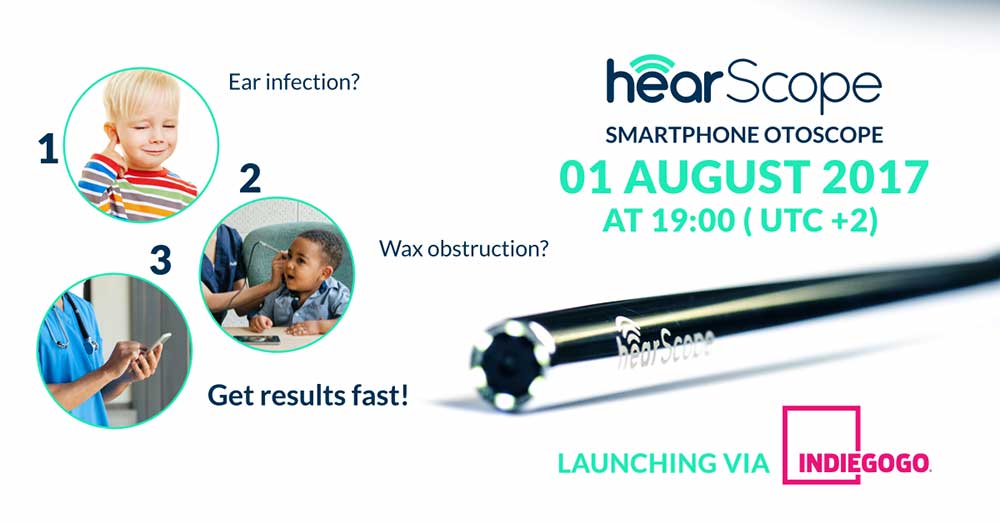
I found an interesting device recently on the inter web. The hear scope from a company called the hearx Group. It is a video scope which is used to look into the ear canal and attaches to an android mobile phone. While that’s pretty cool in itself, it goes one step further, it can be used to remotely diagnose middle ear issues and flag them. Considering most children suffer with a middle ear infection at least once by the time they are two, this could be a pretty cool warning device. While this type of device is a boon for parents, the application really shines in remote areas where there may be lack of healthcare professionals.
Hearx Group are dedicated to providing healthy hearing for everyone, everywhere, the hearX Group offers innovative, clinically validated smartphone hearing test solutions. In fact, the group says that they have provided access to hearing healthcare to more than 70 000 people who traditionally do not have access to healthcare. This is made possible with their digital health solutions using smartphone and cloud technologies for cost-effective, user-friendly services combined with data management and tracking.
In an recent announcement they said the following:
The hearX Group would like to announce the broadening of their product “scope”.
Middle ear infection (Otitis Media) is one of the most common reasons for visiting a doctor. Its complications are a leading cause of preventable hearing loss in the developing world and globally hearing loss associated with middle ear infections, affects 330 million people every year. An otoscope is the most common tool for diagnosing ear disease and our digital technology is revolutionizing this tool for use with a smartphone by anyone, anywhere.
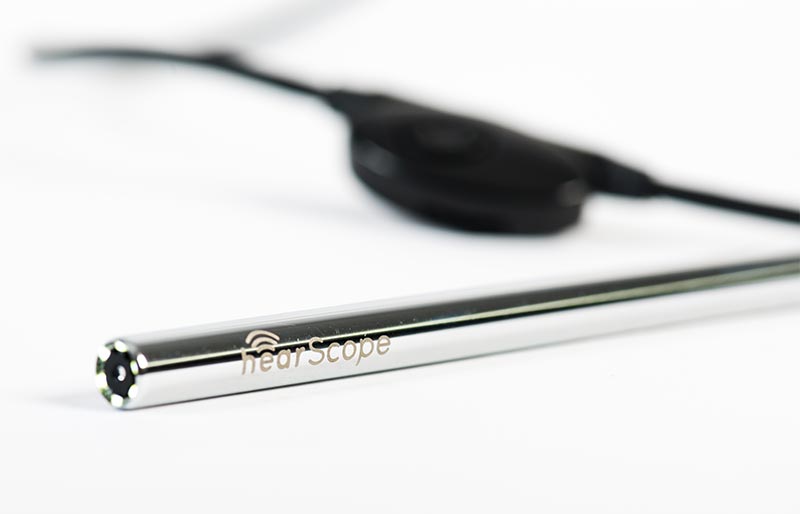
hearScope is a smart, affordable, easy to use, mobile solution for accurate diagnosis of ear disease. The high-quality variable magnification otoscope “pen” connects to a smartphone running the hearScope application. hearScope is a diagnostic aid for doctors, nurses and healthcare providers but can also be used by parents to track and monitor their children’s ear health. In future, hearScope will be enhanced by our image analysis software and artificial intelligence systems to provide accurate, automated diagnoses of the most common forms of ear disease (Coming soon, early 2018). hearScope aims to shed light on ear disease.
A Mini USB Video Ear Scope
The device is a thin mini USB video scope which comes with a selection of specula. The zoom ability on the device is reported to be incremental up to a staggering 200x. They say the image quality will be crystal clear. While this in itself would be a boon to professionals, the extended power of the system is what offers parents and consumers the real benefit.
Cloud Powered Artificial Intelligence
The images are uploaded to a cloud system where the company uses artificial intelligence to assess the canal and ear drum and diagnose any issues. This is what delivers the real power to both professionals and consumers. For professionals it is a second set of eyes as it were, for consumers, it is an early warning system.
To Arrive Early 2018
The devices are expected to come to market over the next couple of months and we will review one here on hearing aid Know later in the year. Update, the devices have now been launched on Indiegogo. They were introduced at a discount rate of $149, but that is sold out, there are still some reserves left at $169, but you probably need to move quick. The retail price is going to be $230 according to the site.
Our friends at the Invisible Hearing Clinic in Glasgow support and run the BTA Glasgow Tinnitus Support Group. Alan Hopkirk, the Clinical Director of the Invisible Hearing Centre runs the group and it will meet at the Pentagon Centre on Wednesday the 20th of September between 6:30pm and 8:30pm.
Support and Understanding
The group offers the opportunity to speak to other people with tinnitus and hyper-acusis. It also offers up to date information on current treatment and any breaking news in the tinnitus space. If you are interested in attending please contact Alan or Katrina on 0141 226 2268 or email btaglasgow@invizear.com.
Details
The Pentagon Centre Suite 316, 3rd Floor 36 Washington Street Glasgow, G3 8AZ
According to the Times of India, another hearing aid manufacturer has now said that they will enter the Over The Counter (OTC) hearing aid market. In fact, they went one step further than Oticon in their statement. GN Store Nord said Thursday it actually plans to manufacture over-the-counter (OTC) hearing aids in the U.S., as the market for cheaper products develop. Unfortunately we published this article based on it, it isn’t quite true.
Update here, I said that I couldn’t get a confirmation of this story anywhere. I finally found out the full details and context of the phone call. The phone call was a tele conference with institutional investors detailing the quarter 2 results of the business, not as described a call with Reuters. What in fact Anders Hedegaard said was a little different from what was reported. In response to a question about OTC and whether remote fine tuning made the company better positioned for it. He said that the company was aware through experience that the absolute majority of people who use hearing aids need counselling delivered to them one way or the other. He went on to say that therefore the traditional role of the Audiologist will remain secure in the market.
He also went on to say that 80% of the people who need hearing aids don’t have them. He said that there is a need for hearing aids for that group. He felt that GN was ideally suited with their combined experience of audio and hearing to tackle that. He said that basically no one would know what the game was to be until the FDA outlined the regulations. He went onto say that they are looking at it from a broad perspective, but exactly how the market would be it was difficult for him to project or guess. You can hear the segment in the audio clip below
So not the equivocal we are going to make OTC hearing aids that was first reported.
The original article reported that chief executive officer Anders Hedegaard told Reuters in a telephone interview “We expect there will be a market for OTC, and we of course want to be a part of it. GN Store Nord is well geared to seize the challenge and enter the OTC market due to the connection of its Hearing and Audio businesses”. As you can hear from the captured udio segment, that isn’t quite what he said.
I said that if one manufacturer enters the OTC market, or in fact if they even look like they may be entering the market, then all of the big six will follow. As I said earlier, all public companies have a responsibility to their shareholders. So if the market for OTC hearing aids explodes, they will all need to respond to it.
GN Ideally Placed
I believe that of all the manufacturers, GN is in fact poised exceptionally well to deliver OTC hearing aids. Their combined experience from Jabra and Resound probably gives them an edge on all of the other big manufacturers. There experience of consumer electronics and digital signal processing will allow them a head start on any OTC project. The outlook for the OTC market appears to be good and many in hearing aid advocate circles are celebrating the pass of the legislation.



 Itshearingaidknow