I can’t do without my hearing aid for two weeks

When my car goes in for a service or repair I get given a courtesy car to use while mine is out of action. It’s a given that the courtesy car will be available, all garages are offering one these days.

So what about when my hearing aids need servicing? Can I get courtesy aids to use while mine’s away? Because there’s no way I can go two weeks without my hearing aids, I need to go to work, I need to hear.

My choices are: hear nothing for two weeks, don’t ever service my aids or find someone who offers a courtesy pair.

I’ve been wearing aids for the best part of thirty years now and I’ve never had a pair serviced, I just can’t do without them for two weeks.

Hearing loss changes the brain

Scientists at Virginia Commonwealth University have discovered that hearing loss leads to a remodelling of the brain in which auditory regions are overtaken by the sensory system that corresponds to touch. This cross-model plasticity could explain why some people with hearing loss struggle with therapies. Alex Meredith, lead scientist on the study stated, “Our study indicates that hearing deficits in adult animals result in a conversion of their brain’s sound processing centres to respond to another sensory modality, making the interpretation of residual hearing even more difficult.” Even if a person retains some ability to hear, the brain restructuring makes it difficult to process sounds.

Hearing Aid Market – buy/sell/give hearing aids online

Firstly, I want to to say sorry for not writing much recently and thanks for waiting it out and not unsubscribing from this RSS feed.

Even though I haven’t written much I have not been totally idle. I’ve been building a new part to the site called:

Hearing Aid Market

Don’t know if you remember but I wrote a long time ago asking if people would buy/sell or give hearing aids through this site – a lot of people replied saying that they would. I even managed to put someone who wanted an aid in touch with someone who was giving one away – it was a good start.

So, I am writing this to ask you a massive favour: Could you try out Hearing Aid Market and let me know what you think?

It’s not quite finished yet, I’m still working on a few bits of code and I also need to add text (especially on the about screen). Even though it’s not 100% I would be unbelievably grateful if you could take 15 minutes and register on the site, add a few hearing aids, try the contact us page, browse around, try and break stuff, do whatever you want! All of the user accounts and hearing aids will be deleted before it gets released to the general public so feel free to sign up as Mickey Mouse or whatever.

The address is: http://market.deafness-and-hearingaids.net/

If you can spare 15 minutes to give it a go then please, please give honest feedback. If you think it stinks then please tell me! All feedback to steve@deafness-and-hearingaids.net

:)

And, finally, a big thanks to Sarah for testing it already 

Getting that look… you know the one?

I walked into the office yesterday morning and walked straight into a conversation between a few people. I said hello and answered a question from one of them and then walked over to my desk. I took my coat off, grabbed my cup to make a tea (I’m English, we do a lot of tea), turned around and….

I got the look from a few people

That look that means I instantly know that someone has spoken to me and I didn’t hear them.

I’m not sure I can describe the look but if you’re hard of hearing that I bet you know what I’m talking about? The look is kind of part embarrassment, part indignation and part amusement. In fact, I don’t really know what it is but the look is always the same, no matter who’s doing it. The picture on the left is about the closest I could find!

I’ve been getting the look for years. It used to annoy me a lot when I was younger, I would get really upset and either storm off or have a bit of a go at the person giving it. But I’ve learned to brush it off, in the office yesterday I just said, “you what?”, answered the question after it was repeated and went to get my tea.

One thing I still don’t get though is why do I still get the look? I mean, everyone knows I’m partially deaf and I wear hearing aids – certainly most of the people having the conversation in the office yesterday morning know. So what is the look for? Is it because they don’t know how to respond after I’ve not heard them? Are they too embarrassed to speak up and re-ask the question? Did they think I was ignoring them on purpose? Was it just funny that I didn’t hear? Guess there’s only one way to find out, ask them.

Do you ever get the look? How do you handle it?

Silence really is golden

I got fitted with a new pair of hearing aids the other day (more on these soon) and one thing that really struck me almost straight away was how much quieter silence is with them on.

Seems like a weird thing to say. Silence is silence, right? It’s no noise. That’s what I thought but the difference in my perception of a silent room while wearing my old Starkey Destinys and wearing these new aids is amazing.

What I used to think was a silent room was actually being filled with tiny buzzes and sounds from things like computer fans, people tapping, shuffling etc. It’s difficult to explain but now that I’m wearing new aids I can really appreciate just how much ambient noise I was hearing that I didn’t need to. That’s not to say that I’m hearing less with my new aids, I’m just hearing a lot more of the sounds I want to hear and much less of the ones that I don’t.

With my new aids environments seems calmer. There’s less of a rush of competing sounds. Less of a cacophony. Which is fantastic because when someone is talking or there’s another sound that I actually want to hear then there’s less sounds competing for my attention.

When I used to think about noise reduction features in hearing aids I always thought about them reducing, for example, music at a party so that you could hear speech, or reducing road noise while your driving. In the last week I’ve realised that noise reduction does much more, so much more – all the little noises count too.

Silence really is golden.

Where to buy a hearing aid in the UK

Below is a list of some of the hearing aid sellers in the UK. I’ve listed the major high-street chains but there are also many, many independent audiologists and sellers operating all over the UK as well.

Specsavers have hearing centres in more than 600 of their branches. I’ve found that this normally means that they have an audiologist onsite on certain days, depending on how popular the store is – I’ve asked in some branches and the audiologist is only in once day every two weeks, other branches it’s twice a week. You can book an appointment online. To find your nearest hearing centre, go here.

Hidden Hearing have been providing hearing aids for over 35 years, they have 75 stores nationwide. Their website is here. You can find your nearest store by going here. You can book an appointment at a branch or a Hidden Hearing audiologist can visit you at home, look here for more info.

The Hearing Company have been providing hearing aids for 50 years. They have over 400 outlets nationwide, mostly within opticians such as: Scrivens, Ronald Brown, Dollond and Aitchison and Conlons. You can find your nearest store here or visit their main website.

Amplifon have brances throughout the UK, you can find your nearest by going here. You can make an appointment with them online. They also have a nice online hearing test on their website.

Concerns of a hearing aid buyer

The comment below is from Paul Weston, he originally wrote this as a comment on here but I felt it was worth posting separately as it raises some good points. I don’t necessarily agree with everything he is saying but moving his comment to its own page gives people room for comment.

A quick straw poll of friends shows that of four people that have had hearing aids fitted, four of them are not used. The hearing aid has not been adjusted in a way that gives acceptable sound. 100% dissatisfaction.

I’ve just been fitted with a hearing aid. The specialist said I needed two at $3200 (12 channel) each. I opted for one (6 channel) at $1600. The process has shown severe deficiencies in the ability of the audiologists involved and possibly in the quality of sound from what I consider an expensive aid.

First, the audiologist ignored my specification for a vented tip. When I complained at the first fitting I was told that I wouldn’t get a good result from that type – but that wasn’t mentioned when I ordered the aid. Then a dodgy demo ‘proved’ that a vented tip was prone to feedback – but the closed tip also caused feedback until correctly calibrated.

The adjustment seems very primitive. I would have expected that the aid would be adjusted to match the hearing in my better ear (that has 90% function.) Instead, the aid is reefed up in volume to the max that it will take. I was told I have to ‘maximise’ my hearing. My wishes for a more holistic approach are ignored and the body language of the audiologist is “sit down shut up and accep what WE know is best for you.”
As a result, my ’sound picture’ is distorted. I should perceive a central sound centrally, but with high volume on the right ear, everything is shifted to the right.

I’ve been told to return in 3 weeks for fine adjustment. So I have to suffer what I perceive as too high an amplification and not enough compression (sound smoothing) for three weeks? This is the typical approach used to wear down customers – with such protracted visits they eventually give up and throw the unit in a drawer.
The $1600 hearing aid sounds like a $10 novelty amplifier.

I have been told that it is normal for it all to sound strange and over amplified. What a lot of horse apples. Has it not occurred to the hearing ‘professionals’ that a hearing aid can be introduced at a lower volume for initial comfort and then slowly, over a week or so, brought up to whatever volume the user finds he or she can adapt to?

In my case, with one ear only amplified, surely the aim would be to match the response of the ‘good’ ear. I’d be happy with 90% in both ears instead of 90% in one and a viciously over amplified 120% in the other.

All this talk of 6 and 12 channels sounds impressive but it’s only a graphic equaliser and it wouldn’t surprise me at all (call me a cynic) to discover that a 6 channel hearing aid is a 12 channel hearing aid with 6 channels disabled. These are digital hearing aids. The frequency response is controlled by software.

Then there’s the matter of price. The street price of these aids varies enormously ($800 to $1200) – which leads me to wonder if they’re made for $100 in a factory in Korea.

I’d also question the mechanism by which a money back guarantee is made. I can return the hearing aid and get an almost complete refund. What happens to that hearing aid? I bet it’s not destroyed and I wasn’t offered a refurbished unit. Is the ‘new’ unit I paid for actually new? The package I was given had been opened and the cord used for the recharger had been undone and re-done.

I pay full price for the hearing aid but am I not given the connectors or the software to access the functionality of the unit because obviously I’m old and stupid and ripe for exploitation?

I think it’s time for a big enquiry into the hearing aid industry. My first impressions are of incompetent service and an over priced product.

Beware of over-amplification

Be careful not to have your hearing aids turned up too much and put excessive strain on your ears.

If you find yourself wincing at loud noises while wearing your hearing aids, if you start to get ringing in your ears, or if your ears hurt then you should see your audiologist and get them to test your hearing and check your volume settings.

If your aid has a manual volume control then don’t be scared to turn it down a bit when you know you will be in noisy surroundings – you don’t have to stay on the same volume all the time.

Many modern digital hearing aids will have the ability to dampen or cut out excessively loud noises and stop over-amplification occurring – if your aids don’t have a feature like this then you need to control it yourself by turning your volume control down or switching programme to something quieter.

Hearing aid prices and the perception of value

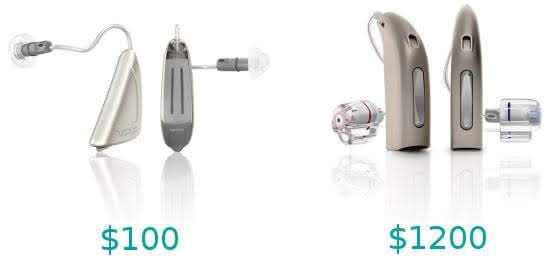
Hearing aids are too expensive, right? Right. Below is an image I created for my totally-made-up hearing aids store:

What do you think of the two hearing aids for sale here? One is $100 and the other is $1200, which one is better? Which would you buy? If you are like most people then your gut-feeling is that the $1200 hearing aid is much better than the $100 one simply because it is more expensive. We think that more expensive is better.

Many studies have shown that we don’t make rational decisions when we buy things, we don’t thoroughly research all our buying options and go with the cheapest and/or best option for us – instead, we go with gut-instincts, predefined ideas about how much something should cost, make comparisons based on side-by-side offers, basically we make bad snap-decisions. But it’s not our fault, it’s the way our brains work! See thisthis or this for examples. Two great books that go into how and why we make bad decisions when we buy are: Predictably Irrational and Influence.

Some companies are starting to offer more affordable hearing aids, both online and on the high street. Because hearing aids have been so expensive for so long the common thinking is that they are expensive because they need to be, because they are high-tech or because they are difficult to make and fit. We’ve been trained to believe that hearing aids are expensive items and this will give the people who are starting to offer lower prices a problem: How do you sell at a lower price without making it look like you are offering an inferior product?