How I cope with hearing loss

I started losing my hearing at the age of 5, I’m now 36 and have a moderate/severe loss in both ears – it started with a mild loss and it has got steadily worse over the years. Apart from a few years in my early teens, I’ve been wearing hearing aids the whole time. I’ve developed a number of coping strategies, often without even realising it, that help me get through conversations with other people.

It would be easy for me to write on here that you should always ask someone to repeat themselves when you haven’t heard – in fact, I have written that before and you should ask them, but once your hearing and listening ability gets bad enough it become too much of a chore to keep getting people to repeat themselves. It’s annoying for you and it’s annoying for the people talking. Instead of doing that I:

1. Read lips on the sly

I think I’ve become a pretty good lip reader. I never stare directly at someone’s mouth as I think a lot of people get unnerved by it and I like to look someone in the eye when I’m talking to them. Yet I still stealth-read their lips, I pick up just enough from my peripheral vision to help me work out their words.

2. Read facial expressions and body language

It’s amazing what you can pick up when you watch someone closely. I often use this to work out if someone is expecting an answer from me or if they are just talking at me. If I know they want an answer and I heard nothing at all then I can ask them to repeat it.

3. Fill the gaps

I do this a lot. I might have heard a couple of words of a sentence and if I’ve picked up enough to get an idea of what they are on about I just go with that. Yeah, it leads to mistakes and sometimes embarrassing out-of-context answers but it works often too.

4. Just nod or say Yeah

I do this far more than I should. If I’ve heard a bit of what someone is saying and I don’t think it’s worth making the effort to fully understand then I just respond with a generic answer and let it go.

5. Get in early

If someone is talking too quietly and I can’t hear anything they are saying then I have to cut straight in as quickly as I can and tell them I can’t hear them. The longer you leave them talking the harder it is to tell them that you didn’t hear a word of it.

6. Look for the good places

Different places have different acoustics and people sound differently in different situations. There a few meeting areas in our office that are small and have glass-panel sides so people are close and the sounds bounce stay boxed in – I always try and hold meetings there.

7. Face people

My hearing aids are set up so that I can hear more from in front of me than I can from the sides or back so I always turn to look at the person talking – this can mean a lot of head-swivelling in groups!

8. Use others

Maybe I can’t hear the person talking so well but I can hear someone else in the group. I listen more to the answers from the other person to work out what the person I can’t hear is saying.

9. Stay quiet

It’s all too easy to lost the conversation in a group and it is much harder to ask someone to repeat themselves when the rest of the group heard OK and the conversation moved on. So I just drop out of the conversation altogether.

10. Look busy/grumpy or avoid

If I see someone I know I have trouble hearing and I don’t have the energy for listening I occasionally look like I’m in a bad mood or am busy to avoid conversation or I avoid being near them altogether.

Why do I do all these things?

I don’t do any of these things to hide my hearing loss or hearing aids, I have no problem with people knowing that I wear hearing aids – in fact, I go out of my way to mention it to a lot of people. I do it because I don’t always have the energy to hear everything I want to. It is hard work. I am incredibly grateful for the times when I can listen to someone and understand without making any effort, the times when listening is easy – I can relax then, but that happens less and less as the years go by.

What everybody ought to know about hearing loss

Hearing loss

A list of things that everyone with hearing loss needs to know. Useful for those having problems with their hearing aids or those thinking of buying their first pair.

Hearing aids won’t give you back the perfect hearing you had as a child

By far the most common type of hearing loss is sensorineural hearing loss ; this is damage to the tiny nerves in the inner ear that pick up sounds and send them to your brain. A hearing aid amplifies and changes sounds coming into your ear but those sounds still have to pass through the damaged nerves. A hearing aid will do a great job of changing speech sounds so that you have a better chance of understanding them, but your broken ear still has to process them and that’s why a hearing aid won’t fix your hearing loss and give you back the hearing you had when your were ten years old.

We hear with our ears, but listen with our brains

Our ears collect sounds and send them to our brains. Sounds come into the ear and brush against those nerves (the broken ones) and when those nerves move they send messages to the brain. The important thing is: It’s our brain that interprets those sounds, recognizes words and allows us to understand speech.

Understanding what people say is a bigger problem than hearing them

Louder is not always better. Have you ever asked someone to speak up and you still couldn’t make out what they said even though they were loud enough? When you have damaged nerves sending information to your brain you are not receiving all the information that you need to understand speech – so even though you can hear someone you cannot understand what they are saying. Using a hearing aid is not just about making things louder – if it was then fixing hearing loss would be easy.

The longer you leave your hearing loss untreated, the less effective hearing aids will be

Many, many people will not seek help for their hearing loss for many years after they first experience problems. This is a very common problem. What people don’t realise though is that by putting off getting fitted with hearing aids they are reducing their ability to understand speech even after they have been fitted with aids.

If you sit on a sofa all day every day then your leg muscles gradually reduce in size because they aren’t being used. If you don’t often do arithmetic then you lose the ability to quickly add up numbers. If you aren’t getting well-formed and understandable sounds into your brain then, over time, your brain stops being able to understand them. It’s kind of the opposite of practice makes perfect. If you don’t get hearing aids when you need them then you are spending more time hearing “mmpppnnnppphhhhh” instead of what was really said and you gradually lose that understanding.

It takes time to adjust to hearing new and different sounds

When you get fitted with a new pair of hearing aids you will be experiencing a lot of sounds that you haven’t heard in a while. It takes time for your to adjust to hearing and understanding those new sounds – different people take different amounts of time and it also depends on how bad your hearing loss is.

When buying a new pair of hearing aids you absolutely must use them as much as you can during your trial period to give yourself the best chance of getting used to them and deciding if they are the right ones for you.

It can be difficult to work out where sounds are coming from

A common problem for hearing aid wearers and those with hearing loss is trying to determine where a sound is coming from – this is also known as localisation. Many, many times over the years I have heard someone speak but have not been able to work out where they are and have to spin around to locate them – this is a particular problem in business meetings and other group situations where lots of people are talking from different places around you.

This is a problem for hearing aid wearers because having something in your ear changes the way sounds enter the ear canal – rather than sounds bouncing into your ear in a natural way they now have to go through your hearing aid. I found that wearing IIC hearing aids helped a lot because they are tiny and sit very deep in the canal, which lets the sounds enter naturally – wearing RIC or Open Fit may help too.

As an aside: have you ever watched a dog when it is listening to something? It will rotate its ears to pick up the sound better – that’s it localising the sounds.

Our ears work as a pair

We have two ears for good reason and they work as a pair to help us hear. Even though we can’t rotate our ears like a dog our brains can still receive sounds from the left or right and that is a big help to understand where the sound is coming from. Our pair of ears play a big part in our ability to balance on our feet.

If you have a hearing loss in both ears then you must buy two hearing aids. If you don’t then the world is going to sound like a very uneven place. If money is an issue and you are tempted to buy one aid instead of two then, in my opinion, it is better to buy two cheaper hearing aids.

Phone programmes….. hello? Hello? HELLO?

All modern hearing aids come with a phone programme, it’s a setting that the hearing aid automatically switches to when you put a phone to your ear. The programme normally reduces the volume of the sound coming from the phone and, I think, also reduces pitch to try and eliminate any feedback that might occur from having a phone pressed to your ear.

I’ve never been happy with the phone programme on any of my hearing aids.

They are effective in reducing feedback when making a call but they are also great at making sure I can’t hear a damn thing on the phone! I’ve taken to using a cellphone most of the time these days as they don’t cause the programme to kick in.

I’ve got an appointment with an audiologist next week to get the programme switched off and sort this out once and for all.

How do you cope with using the telephone? Does the phone programme work for you or do you find yourself holding the receiver away from your ear to try and stop the programme kicking in?

First success story for Hearing Aid Market

Hearing Aid Market has been up and running for a week now and it has already enabled someone to get a free pair of hearing aids!

Carol kindly offered to donate her late Mother’s hearing aids so that they could be put to use by someone else. On the same day that I received an email from Carol I also got one from Angel in Texas. He was in need of hearing aids. I put the two in touch with each other and I am delighted to say that Carol shipped the aids to Angel, who is now wearing them and having marvellous results!

It is the generosity of Carol and her family that made this possible. A massive thank-you to them.

This is exactly why I set up Hearing Aid Market – to get unused hearing aids to people that need them. Lets hope the site can continue to help other people hear better.

The surprising thing about hearing loss and uncomfortably loud sounds

If you have a moderate to severe (or worse) hearing loss then chances are that as well as struggling to hear speech and other sounds you also struggle with sounds that are too loud for you. I know I sometimes do, doors shutting in our office seem loud to me, running water always sounds a bit too loud as well.

Many times over the years I’ve been in situations where I have had to turn my hearing aids down or move aware from a loud sound while everyone else around me didn’t seem in the slightest bit bothered by it. Turns out that this is a very common problem for those with hearing loss and especially those who wear hearing aids. We really do perceive many loud sounds to be louder than people with normal hearing do.

The reason we perceive some loud sounds to be louder than they really are is because of a thing called recruitment. I’m going to write a separate article about recruitment but basically it occurs as a result of a sensorineural hearing loss and it happens because our brains are trying to compensate for our damaged nerves by using some of the remaining good nerves as well.

The worse your hearing loss is the more likely you are going to suffer from recruitment. If you are having a lot of trouble with noise that is too loud and it’s effecting your ability to hear, or worse, stopping you from wearing your aids, you should speak to an audiologist as all modern hearing aids can be configured to help minimise the loud sounds.

Thank you for the music

Sometimes I listen to a song and I think, “I’m so lucky that I can still hear that”.

As someone with a hearing loss I spend a lot of time worrying about what I can’t hear. It’s pretty rare that I stop and think about what I can hear.

I thought I’d put this article together just so that I could celebrate some of my favourite songs that I can still hear. I’m not a big listener of music and I never use an mp3 player (too paranoid about further hearing damage) but there are songs that are important to me, that mean something, that define a moment in my life. Songs that I’m thankful I can still hear, here’s a few of them. Feel free to post your own songs in the comments.

Hearing aids for children

I’m looking for a bit of help and advice. Does anyone have any information on getting hearing aids for a 3 year old?

What style of aid works best? Are there any particular manufacturer or brands that are better?

How often will ear moulds have to be changed? Will kids have to have their moulds changed often until their ears stop growing? There seems to be a myth about how long our ears grow for and lots of people say that they never stop, but they stop growing when we’re about 18 or so, right?

Here in the UK, I know of several vendors who will not supply hearing aids to anyone under the age of 16 – where did you get kids’ aids from?

Lots of questions! Thanks to anyone who leaves a comment.

If your hearing aid gets wet, The Seven Steps To Saving It

Hearing Aid Got Wet !

If your hearing aid gets wet DON’T PANIC! Electronics and water are two things that generally don’t go well together but all is not lost if your aid does get a soaking. I’ve had several that have been waterlogged and have managed to get them working fully again.

Seven Things to do if your hearing aid gets wet

  1. Remove the aid from the water as quickly as possible – the less water that’s in it in the first place, the better chance it has to work again.
  2. Turn it off straight away and remove the battery. Throw the battery in the bin. Don’t be tempted to wait and see if it comes straight back on – turn it off as soon as possible.
  3. Close the battery door, remove the tube (if you have one) and dry gently with a towel. Shake it gently to try and get as much water out as possible.
  4. Use a hairdryer or a fan to blow-dry it. It’s very important not to let the aid get too hot so don’t use a hair-dryer on a high-heat – use a low-heat and keep the dryer some distance away from the aid. Excessive heat is much worse for electronics than a brief dunk in water. Blow-drying will speed up the dry-out time but you can skip this step if you are worried about the heat or don’t have a fan.
  5. Leave the aid to dry out. The amount of time to leave it will depend on how wet it was. I’ve had to leave an aid for two days before it completely dried out. Leave it sitting with the battery door open so that as much air as possible can get it. Better still, place it in a dehumidifier pot – this will speed up the dry-out considerably.
  6. Once you are happy that the aid is dried, put in a fresh battery and try it out. You can also use one of the cleaning tools you received with your aid to make sure the water has not left any residue behind but be very careful poking tools inside your aid.
  7. If the aid still does not work then you can either recharge your dehumidifier pot and leave it a while longer or ask your audiologist to send it back for repair.

What not to do

  1. Never put your hearing aid into a microwave or conventional oven. It’s too much heat and you’ll melt something.
  2. Don’t just assume it’s broken. Give it time to dry and then get it sent away for repair if you need to.

The important thing to remember is: It is unlikely that you will need to buy a new hearing aid just because it got soaked – electronics are more resilient to water than most people think.

If All Else Fails, See A Local Hearing Aid Provider

Arrange a consultation with a trusted Independent hearing healthcare professional in your area

Drying hearing aids

How To Dry Out Hearing Aids

The best way to dry your hearing aids is with a purpose designed dryer. They can be very simple things like a box and a drying tablet or more complex electronic devices that will dry and sterilise your hearing aids at the same time. The drying boxes and tablets are relatively inexpensive while the electronic devices retail from between 100 and 150 of your favourite currency. It is well worth investing in them, they will ensure that your hearing aids last for longer even if you never drop them in water. 

Emergency Hearing Aid Drying

In an emergency you can use a hairdryer on a low setting to take the excess moisture off, but you should still leave it to thoroughly dry out before putting a battery in it.

Phonak Clean and Care kit

Hearing Aids You Can Shower With

Can You Get Hearing Aids Wet?

Generaily speaking there are only a few hearing aids that you can shower with. It’s best to remove your hearing aid from your ear before showering, bathing or swimming. Many modern hearing aids like Phonak’s latest lines are IP67 rated for moisture, which basically means that they are okay in three feet of water for thirty minutes. So, you can get those hearing aids wet. However, if you are wearing a receiver in ear device the receiver is not protected by the case and therefore can be damaged.

You are better off just taking it out. Don’t worry about getting caught in the rain though. Follow the guidance of each hearing aid brand, that is the best and safest way to do things. We recently wrote an article called What’s The Best Hearing Aids For an Active Lifestyle? If you are active and you think you might face moisture a lot, it is worth taking a look at. 

Don’t forget, take the battery out quickly, that alone will help a great deal. Don’t put the battery back in until you are sure the hearing device is dry. 

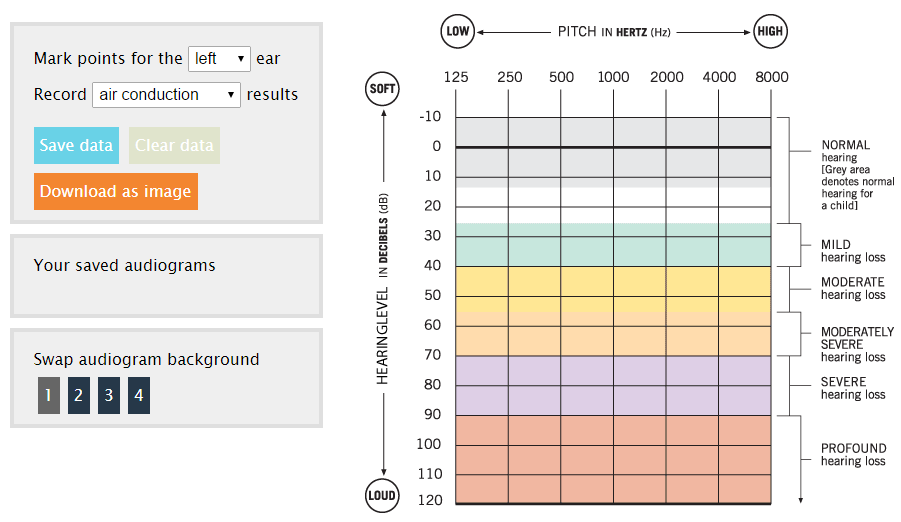
Audiogram creator updated to allow multiple diagrams

I’ve updated the Audiogram Creator so that you can now show your audiogram results on different backgrounds. the original background is still there but you can now also choose from having a background with no decoration at all, one with speech sounds shown or one with speech sounds and the speech banana on it.

The newly added background images use the UK classifications for hearing loss (normal, moderate, severe, etc) whereas the original background (the one that is shown when you first browse the Audiogram Creator) shows the USA classifications. You’ll notice that they are a bit different – for example, a mild hearing loss is 25 to 40dB on the US classification and it’s 20 to 40dB no the UK one.

A huge thank you to Vicki Kirwin from NDCS for supplying the new background images.

11 things about me, my hearing and my hearing aids

1. I take my hearing aids out when shaving because I can’t stand the scraping noise of the razor.

2. Wind noise is my biggest problem with my hearing aids.

3. I take my hearing aids out when driving to and from work for a bit of peace and quiet.

4. Hand-dryers always make my right hearing aid whistle with feedback.

5. I usually wait at least half-an-hour in the morning before putting my aids in.

6. I always have some spare batteries in the car and usually some in my pocket. Don’t think I’ve ever needed them though.

7. Motorbikes are way too loud.

8. I only listen to music on noise-reducing headphones.

9. The fast, bass-heavy dance music I liked when I was younger just gives me a headache these days.

10. I can hear remarkably well at the local swimming pool even though I’m not wearing my aids.

11. I don’t pick up accents, there’s an American guy in our office, I thought he was Australian.